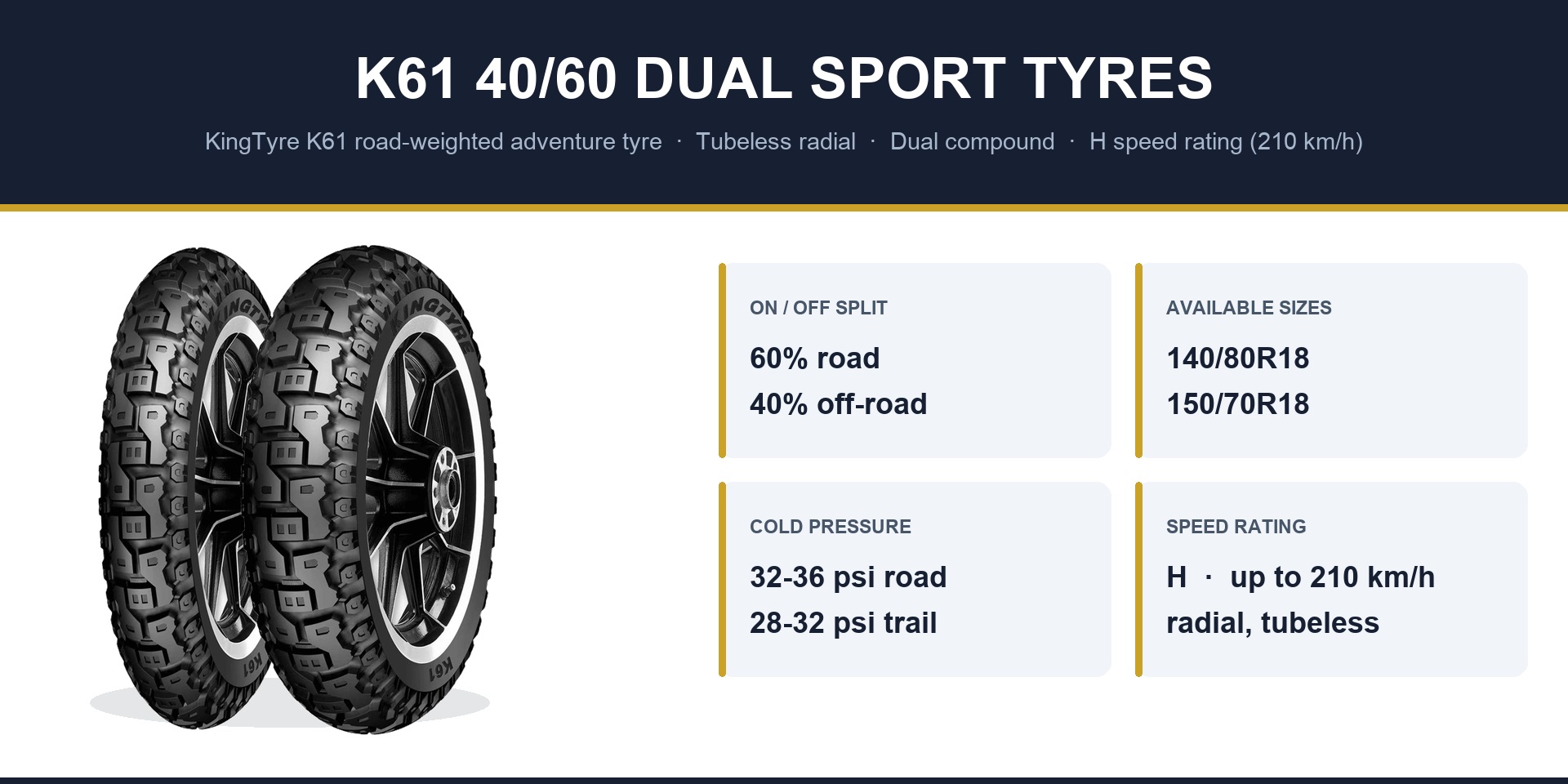
Quick answer: The KingTyre K61 is a 40/60 dual sport (ADV) tyre — 60% of the pattern is built for sealed road, 40% for gravel, hardpack and fire road. It ships in two 18-inch rear sizes (140/80R18 and 150/70R18) on a reinforced radial carcass with a dual, silica-enriched compound, 3D-stepped siping and self-cleaning shoulders. Factory cold pressure is 32–34 psi on the road for 140/80R18 og 34–36 psi for 150/70R18, dropping to 28–32 psi on trail, with an H speed rating (210 km/h).
Last updated: November 11, 2026. Written and reviewed by the KingTyre technical team. Sizes, construction, pressures and load indices are taken from the current KingTyre K61 product specification; the tread-geometry figures are KingTyre's published design specifications.
40/60 dual sport tires are built with roughly 60% of the tread working on sealed road and 40% working off it. The label describes how the pattern is allocated, not how your mileage splits. A 40/60 tyre keeps a larger, more continuous centre band than a 50/50 design, so it tracks straighter and wears more evenly at highway speed, while retaining enough shoulder block and void for gravel, hardpack and maintained fire roads.
This is the compromise that suits a specific rider very well: someone whose week is mostly paved — commuting, touring, a long highway run to the trailhead — who still wants a tyre that will hold its line on the gravel section when the weekend arrives. It is the road-weighted end of the dual sport family, sitting between the 50/50 K60 and the almost-entirely-on-road K67.
KingTyre builds the dual sport range as four distinct splits, and this is the only one of the four where the off-road share is smaller than the on-road share:
Our guide to what an ADV tyre actually is covers the category in general, and which dual sport tire sizes have the highest demand shows how the size mix splits across regions.
| Mønster | On-road / off-road split | Tread character | Published sizes | Best for |
|---|---|---|---|---|
| K61 | 40/60 | Large continuous centre band, staggered shoulder blocks, 3D siping | 140/80R18, 150/70R18 | Riders who are on tarmac most of the week |
| K60 | 50/50 | Balanced block pattern, self-cleaning channels | 90/90R21, 110/80R19, 150/70R17, 150/70R18 | Riders who mix highway and gravel equally |
| K66 | 80/20 | Deeper, wider blocks, softer compound, strong off-road bite | See the K66 product page | Trail riding, gravel, mud, sand |
| K67 | 90/10 | Shallow road pattern, longest road life, best highway comfort | See the K67 product page | Long-distance touring on sealed roads |
The K61 is the road-weighted option, and it exists because most ADV tyres are not used the way their marketing suggests. A survey of the tyres that come off adventure bikes shows that the majority of their life is spent on tarmac; the off-road portion is real, but it is not half the mileage. A tyre built for that reality gets a bigger, more stable contact patch on asphalt, a quieter ride and longer life, and it still has enough block and void structure to handle a gravel road in the rain.
Four questions usually decide it:
If your answer to question two is "regularly, and it is technical", the K60 50/50 dual sport tyre is the better buy — it keeps a larger share of off-road capability while staying road-capable.
The K61 pattern is a staggered-block design with a continuous, slightly offset centre band, and each element solves a specific problem that riders report on other dual sport tyres.

The construction features KingTyre publishes for the K61 are:

KingTyre publishes two K61 sizes, both 18-inch rear sizes, which cover the 18-inch-rear adventure platforms. The two are alternatives for the same wheel position, not a matched front-and-rear set.
| K61 size | Position | Wheel | Section width | Notes |
|---|---|---|---|---|
| 140/80R18 | Bagsiden | 18 inch | 140 mm | The narrower of the two; the choice for scrambler and dual-sport platforms with a smaller rear rim width |
| 150/70R18 | Bagsiden | 18 inch | 150 mm | The wider and more common 18-inch ADV rear; pairs with the higher 34–36 psi road pressure |
Both are rear sizes. If your motorcycle runs a 17-inch rear — which covers the majority of the adventure market — the K61 is not the tyre for that platform, and the K60, K66 or K67 families are the ones to look at instead.
Every published K61 specification is listed below, exactly as KingTyre specifies it for production. Where the factory publishes a range rather than a single value, the range is shown as published.
| Parameter | KingTyre K61 140/80R18 | KingTyre K61 150/70R18 |
|---|---|---|
| Type | 40/60 dual sport tires (radial) | 40/60 dual sport tires (radial) |
| Intended use | 60% road / 40% off-road | 60% road / 40% off-road |
| Tread compound | Dual compound (silica-enriched) | Dual compound (silica-enriched) |
| Recommended cold pressure — road | 32–34 psi | 34–36 psi |
| Recommended cold pressure — trail | 28–30 psi | 30–32 psi |
| Speed rating | H — up to 210 km/h | H — up to 210 km/h |
| Load index (typical) | 70–73 (model dependent) | 69–75 (model dependent) |
| Konstruktion | Radial, reinforced carcass | Radial, reinforced carcass |
| Key features | 3D siping, self-cleaning shoulders | 3D siping, self-cleaning shoulders |
| Shoulder void ratio | 8–10% | 8–10% |
| Sidewall construction | Tubeless radial (tubeless-ready on compatible rims) | Tubeless radial (tubeless-ready on compatible rims) |
A note on the numbers the factory does not publish. KingTyre publishes the pressure, rating, compound and construction for the K61, but it does not publish a mileage figure or a tread-width and overall-diameter figure for this pattern. Both fields are left out of the table above rather than estimated, because a road-weighted dual sport tyre's real life depends far more on the pressure you run and the mix of road and gravel you ride than on the compound name.
The K61 is the one pattern in the KingTyre dual sport range where the pressure guidance changes with the surface, because the road-weighted carcass is designed to be run lower off-road than on it.
Three things about those numbers are worth understanding before you fit a set:
On speed rating, the H marking is a homologation limit of 210 km/h, not a recommendation to ride at 210 km/h. On load index, KingTyre publishes a range per size — 70–73 for the 140/80R18 and 69–75 for the 150/70R18 — because the exact rating depends on the specific construction built for a rim width; the number moulded into your tyre is the one that counts. Our guides to DOT and ECE tyre codes explained og ECE R75 versus DOT FMVSS 119 cover how to read those markings and why importers need both.
A 40/60 tyre is deliberately asymmetric, and knowing where the asymmetry sits prevents disappointment. The table below states plainly what the K61 does well and where another pattern is the better buy.
| Surface | How the K61 behaves | Honest limitation |
|---|---|---|
| Highway asphalt | The design point — stable tracking, reduced wander at speed, quieter and longer-lived than a block-heavy 50/50 tyre | Still noisier than the 90/10 K67 on long motorway stints |
| City asphalt and wet tarmac | Silica-enriched compound plus 3D siping give predictable wet grip and resist tread squirm under braking | Block-pattern tyres never match a pure road tyre on cold, soaking wet asphalt |
| Gravel and hardpack | Open shoulder channels clear debris and provide edge bite; progressive shoulder radius makes the lean predictable | Less bite than the 50/50 K60 and far less than the 80/20 K66 |
| Light mud and clay | Self-cleaning shoulders eject stones and thin mud rather than packing the tread | Deep sticky mud is not what a 40/60 pattern is built for |
| Soft sand | Manageable on firm packed sand at reduced pressure | Deep dunes are not the 40/60's strength — this is a road-weighted tyre |
| Rocky trails and hard enduro obstacles | Reinforced block bases resist chunking on stony ground | Technical single track calls for the K82 or the K81/K83 trail range |
Pick the K61 if your riding is mostly road with a regular gravel component. Pick the K60 if the gravel component is equal to the road component, and the K66 if the trail is the point. The K67 is the next step further toward pure road.
| Question | K61 40/60 | K60 50/50 | K66 80/20 | K67 90/10 |
|---|---|---|---|---|
| Split | 40/60 | 50/50 | 80/20 | 90/10 |
| Road comfort | Very good | Good | Fair | Excellent |
| Road noise | Low | Moderate | High | Lowest |
| Road life | High | Medium — up to 20,000 km | Low | Highest |
| Gravel and hardpack | Good | Very good | Excellent | Fair |
| Mud and wet clay | Weak | Fair | Strong | Weak |
| Sand | Weak | Fair | Good | Weak |
| Wet-weather road use | Very good — silica + 3D siping | Good | Fair | Very good |
| Typical rider | Commuter and weekend touring rider who joins trail days | Weekend ADV rider, tourer who wants gravel access | Dedicated trail and enduro rider | Long-distance road adventurer |
Two more commercial points matter to distributors and dealers more than to riders:
The K61 is built to be run at two different pressures on two different surfaces, and most of the damage riders report comes from mixing those two jobs up. Six habits account for most of the difference between a K61 that lasts and a K61 that does not.
For distributors, importers and brand owners, the K61 is a compact and easy dual sport SKU to build around: two sizes, one construction, one consistent speed rating, and a certification package that clears both European and US import requirements.
Commercial and technical points to confirm before you order:
If you want to see the tyres in person, KingTyre exhibits at CIMAMotor, Hall 7, Booth 7T05, and the full range is listed on the KingTyre product list.
The KingTyre K61 is a 40/60 dual sport (ADV) motorcycle tyre. Its pattern is weighted 60% toward sealed-road use and 40% toward off-road use, and it is supplied in 140/80R18 and 150/70R18 as a reinforced radial with a dual, silica-enriched compound, 3D-stepped siping and self-cleaning shoulders.
Two sizes are published: 140/80R18 and 150/70R18. Both are 18-inch rear sizes — they are alternatives for the same wheel position, not a matched front-and-rear set.
For road use, 32–34 psi cold on the 140/80R18 and 34–36 psi cold on the 150/70R18. For sustained trail use, 28–30 psi and 30–32 psi respectively. If your motorcycle's tyre placard specifies a different pressure, follow the placard instead.
No, and it is not designed to be one. The K61 is a road-weighted dual sport tyre for riders who are on tarmac most of the week but want competent gravel performance. For technical trail riding, the 80/20 K66 or the K82 and K81/K83 trail range are the correct specifications.
The K60 is a 50/50 pattern with a larger off-road share, published in 90/90R21, 110/80R19, 150/70R17 and 150/70R18. Choose the K61 when your riding is mostly road, and the K60 when the gravel and trail time is roughly equal to the highway time.
The staggered pitch sequencing is designed to break up the harmonics that normally build up in a block pattern, so the K61 is quieter on sealed road than a block-heavy 50/50 or 80/20 tyre. It is still not as quiet as the 90/10 K67.
Yes. The silica-enriched compound and 3D-stepped siping are built to limit tread squirm and improve wet braking, which is what makes the K61 usable year-round rather than only in dry conditions.
Yes. The reinforced radial carcass and the H speed rating are rated for loaded touring, which is the use case the 40/60 split is designed around.
No. The K61 radial is tubeless on compatible rims, and an inner tube can be used in a tube-type rim. Check the rim specification before fitting.
The K61 is manufactured at KingTyre's own factory in China, which operates high-tonnage automated hydraulic curing lines, four-component tread extrusion and end-to-end barcode traceability, holds ISO 9001 and DOT certification, and ships to more than 45 countries. It is the same production group that builds the KingTyre racing programme used in endurance competition.
The KingTyre K61 40/60 dual sport tyre is available in 140/80R18 and 150/70R18, with a factory cold pressure of 32–34 psi on the road for the 140/80R18 and 34–36 psi for the 150/70R18, a load index of 70–73 and 69–75 respectively depending on construction, and an H speed rating.
For distributors and importers, the full K61 specification, the certification package and current lead times are on the KingTyre K61 product page. For OEM and private label enquiries, contact the KingTyre export team and we will quote the size mix you need.
 Danish
 English
 Spanish
 French
 German
 Korean
 Japanese
 Italian
 Russian
 Dutch
 Portuguese
 Polish
 Turkish
 Czech