
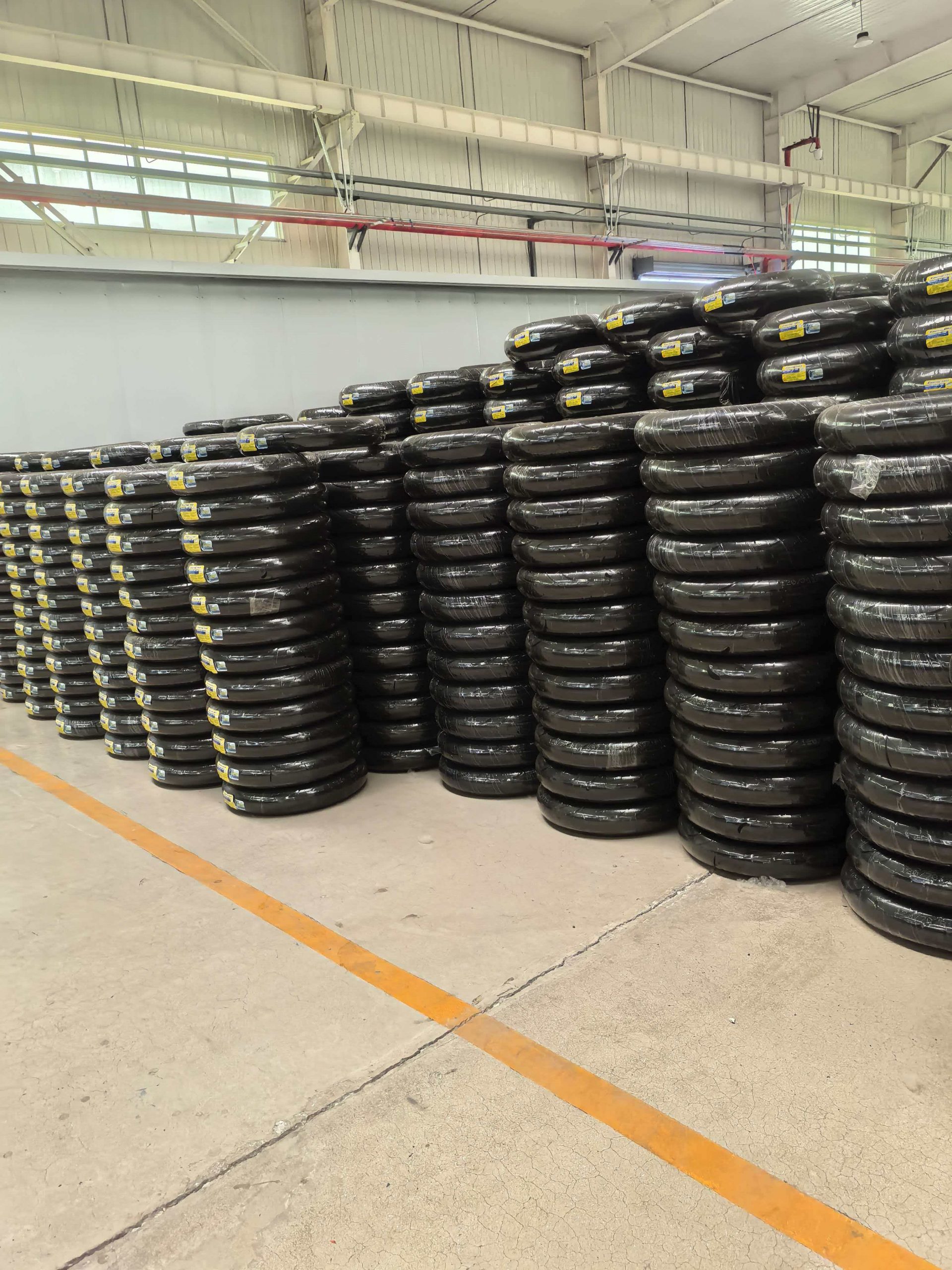
If you are planning to import motorcycle tires from China, one of the first practical questions you will ask is: how many motorcycle tires fit in a 40ft container? The answer directly affects your shipping costs, inventory planning, and overall procurement budget. For standard motorcycle tire sizes, a 40ft container holds approximately 1,700 to 1,800 tires, depending on tire dimensions, packaging, and loading configuration. This guide breaks down the calculation, the variables that affect capacity, and how to optimize your container load. For comparison, see our guide on how to import motorcycle tires from China.

A standard 40ft dry container (internal dimensions: 12.03m × 2.35m × 2.39m) can hold approximately 1,750 motorcycle tires on average. This assumes typical street and sport motorcycle tire sizes (17–18 inch rim diameter), stacked in mixed configurations. The actual number varies based on tire size and how efficiently the container is packed. For buyers who import motorcycle tires from China, understanding this capacity is the foundation of accurate shipping cost calculation and inventory planning.
A standard 40ft general-purpose container has these internal measurements: length 12.03 meters (39.5 feet), width 2.35 meters (7.7 feet), and height 2.39 meters (7.8 feet). This gives a total internal volume of approximately 67.6 cubic meters (2,390 cubic feet). Understanding these dimensions is essential when planning how many motorcycle tires fit in a 40ft container.
There are also high-cube (HC) containers available, which add approximately 30 centimeters in height (2.69m internal). While this extra height is useful for taller products, motorcycle tires are typically stacked only 4 to 5 layers high within the standard container height, so the extra height of an HC container does not significantly increase tire capacity. Buyers should specify a standard dry container (not HC) for motorcycle tire shipments unless they have specific loading requirements that need the extra headroom.
Motorcycle tires come in many sizes, and each affects container capacity differently. A typical 120/70-17 front tire (common on sport bikes) has a diameter of roughly 60cm and a width of 12cm when compressed for packing. A 180/55-17 rear tire is wider at approximately 18cm. When calculating how many motorcycle tires fit in a 40ft container, you need to account for the mix of front and rear tires in your order. A typical shipment containing 50% front and 50% rear tires will achieve the ~1,750 average.
Smaller tires — such as scooter tires (12–13 inch), commuter sizes (2.75-18, 3.00-18), and mini-GP tires — can fit significantly more, sometimes reaching 2,000+ units per container. Larger tires — such as adventure bike rears (150/70-18), cruiser tires (180/65-16), and off-road rears — reduce capacity to approximately 1,400–1,600 units. Racing slicks in 16.5–17 inch sizes typically fall in the middle range of 1,600–1,800 units. Browse Kingtyre tire sizes and specifications to plan your container mix.
The tread pattern also plays a role. Heavily lugged off-road tires interlock differently than smooth street tires, which can affect how tightly they pack together. Semi-slick and sport touring tires with minimal tread depth tend to nest more efficiently, allowing slightly higher density. When requesting a container loading plan, always specify the exact tire models and sizes you intend to order, as the loading configuration varies significantly between product lines.
To estimate how many motorcycle tires fit in a 40ft container for your specific order, start with the container floor area: 2.35 meters width by 12.03 meters length equals 28.27 square meters. A typical street motorcycle tire laid flat occupies approximately 0.016 square meters. Divide the floor area by the tire footprint and multiply by the number of vertical layers — typically 4 to 5 layers high. This gives you a baseline estimate of approximately 1,750 units.
Container plans are typically prepared by the supplier or a professional freight forwarder. These plans consider more than just basic dimensions — they account for the actual product packaging, the stacking pattern, the weight distribution across the container floor, and the center of gravity requirements for sea transport. At Kingtyre, we provide container loading plans with every wholesale order because we understand that visibility into how your tires are packed helps you plan your inventory reception and warehousing at the destination.
Weight distribution is particularly important for sea freight. An improperly loaded container can shift during transit, causing damage or even container loss overboard. Professional loading ensures that the heaviest items are distributed evenly across the container floor and that the center of gravity remains within safe limits. For motorcycle tires this is rarely an issue since tires are relatively light, but it becomes relevant when mixing tire sizes with significantly different weights, such as combining lightweight scooter tires with heavy adventure touring rears.
Understanding the port landscape helps importers make informed logistics decisions. China exports motorcycle tires through several major ports, each with distinct advantages. Tianjin Port (Xingang) is the closest major port to Beijing and serves the northern industrial region including Tianjin’s tire manufacturing cluster. It is the primary export port for Kingtyre and offers frequent sailings to Europe, North America, Africa, and Southeast Asia.
Qingdao Port in Shandong Province is China’s largest tire export hub, handling the highest volume of tire containers annually. Many of China’s tire manufacturers are located in Shandong, making Qingdao a cost-effective choice for buyers sourcing from that region. Shanghai Port offers the highest sailing frequency to global destinations but has higher port handling fees. Shenzhen and Ningbo ports serve southern manufacturers and offer competitive rates for Southeast Asian and Australian routes.
The choice of export port affects more than just shipping cost — it also impacts transit time, sailing frequency, and inland logistics. For buyers visiting the factory, Tianjin offers the convenience of being 30 minutes from downtown Tianjin and 90 minutes from Beijing by high-speed rail, making factory visits and quality inspections easier to arrange.
If you are starting with a trial order, a 20ft container (internal: 5.9m × 2.35m × 2.39m) holds approximately 800–900 motorcycle tires — roughly half the capacity of a 40ft container. However, the shipping cost for a 40ft container is typically only 40–50% more than a 20ft, making the 40ft significantly more cost-effective on a per-tire basis. Most experienced importers recommend moving to 40ft containers as soon as demand justifies the volume.
Beyond the cost per tire, the 40ft container offers additional advantages for growing importers. It requires only one set of documentation, one customs clearance process, and one inland haulage arrangement compared to two 20ft containers carrying the same total volume. The larger container also provides more flexibility in mixing tire sizes and product lines, allowing importers to test new markets with a broader product selection within a single shipment.
For new importers who are uncertain about demand, a practical approach is to start with a 20ft container of your 3 to 5 best-selling tire sizes, establish your distribution channel, and then scale to 40ft containers once you have confirmed demand patterns. This phased approach minimizes initial inventory risk while building the foundation for cost-efficient bulk importing.
The time it takes for your container to arrive depends on the destination region. From Tianjin or Qingdao to Northern Europe (Rotterdam, Hamburg) takes approximately 22 to 28 days. To the Mediterranean (Piraeus, Genoa, Barcelona) — 20 to 25 days. To the US West Coast (Los Angeles, Long Beach) — 14 to 18 days. To the US East Coast (New York, Savannah) — 22 to 28 days via the Panama Canal. To South America (Santos, Buenos Aires) — 25 to 35 days. To Southeast Asia (Singapore, Jakarta) — 6 to 10 days. To Africa (Mombasa, Lagos, Durban) — 20 to 30 days depending on the route.
These transit times are estimates and can vary depending on the shipping line, the specific service route, the season, and port congestion. During peak seasons (August to October, before holiday retail demand), space on vessels can be tight and transit times may extend by 3 to 7 days. Importers should build buffer time into their supply chain planning, particularly for their first few shipments when they are still learning the rhythm of the logistics cycle.
At 1,750 tires per 40ft container, the shipping cost per tire becomes very efficient. For example, if sea freight from Tianjin to Rotterdam is approximately $3,500 per 40ft container, the shipping cost per tire is only $2.00. Even accounting for insurance, documentation fees, and inland haulage, the total logistics cost per tire typically remains under $3.50 for full container loads to major destinations.
This is why understanding exactly how many motorcycle tires fit in a 40ft container matters — it directly impacts your landed cost per unit and your competitive pricing in the destination market. The difference between shipping 1,500 tires and 1,800 tires in the same container can mean $0.30 to $0.50 per tire in logistics cost, which at scale translates to significant margin improvement.
For comparison, shipping the same tires via LCL (less than container load) consolidation typically costs $8 to $15 per tire in freight, making FCL (full container load) shipping at $2 to $3.50 per tire dramatically more economical for volume importers. The break-even point where FCL becomes cheaper than LCL is typically around 700 to 800 tires — roughly the capacity of a 20ft container.
Based on real importing experience, here are actionable recommendations. Always request a container loading plan from your supplier before confirming the order — reputable manufacturers will provide this without hesitation. Mix tire sizes strategically to maximize density within the container. Motorcycle tires are typically shipped loose (bulk packed) to maximize container utilization — this is the standard loading method used by most manufacturers.
Work with a supplier based near a major export port — Kingtyre exports through Tianjin Port, one of northern China’s busiest shipping hubs, ensuring efficient container loading and shorter lead times. Always factor in a 5% buffer in your container count calculations to account for loading variations and settling during transport. Confirm with your supplier that the tires are properly protected during loading — some manufacturers use cardboard or foam sheet interleaving between layers to prevent abrasion during transit.
Finally, build a relationship with a reliable freight forwarder who has experience handling tire shipments. A good forwarder can advise on documentation requirements, customs clearance procedures, and port selection based on your destination. They can also help you understand the total landed cost including freight, insurance, duties, and taxes before you commit to the order.
The answer is approximately 1,750 motorcycle tires for a standard 40ft container, assuming a typical mix of street and sport tire sizes loaded in bulk configuration. This number varies with tire dimensions and loading technique. For the most accurate quote for your specific tire requirements, consult your supplier’s logistics team. Kingtyre provides detailed container loading plans and FOB/CIF shipping quotes for all wholesale tire orders.
Ready to plan your first shipment? Browse Kingtyre’s product range to select your tire sizes, or contact the sales team for a container loading plan and FOB pricing from Tianjin Port.
 Spanish
  English
  French
  German
  Korean
  Japanese
  Italian
  Russian
  Dutch
Dutch  Danish
  Portuguese
  Polish
  Turkish
  Czech
Czech