
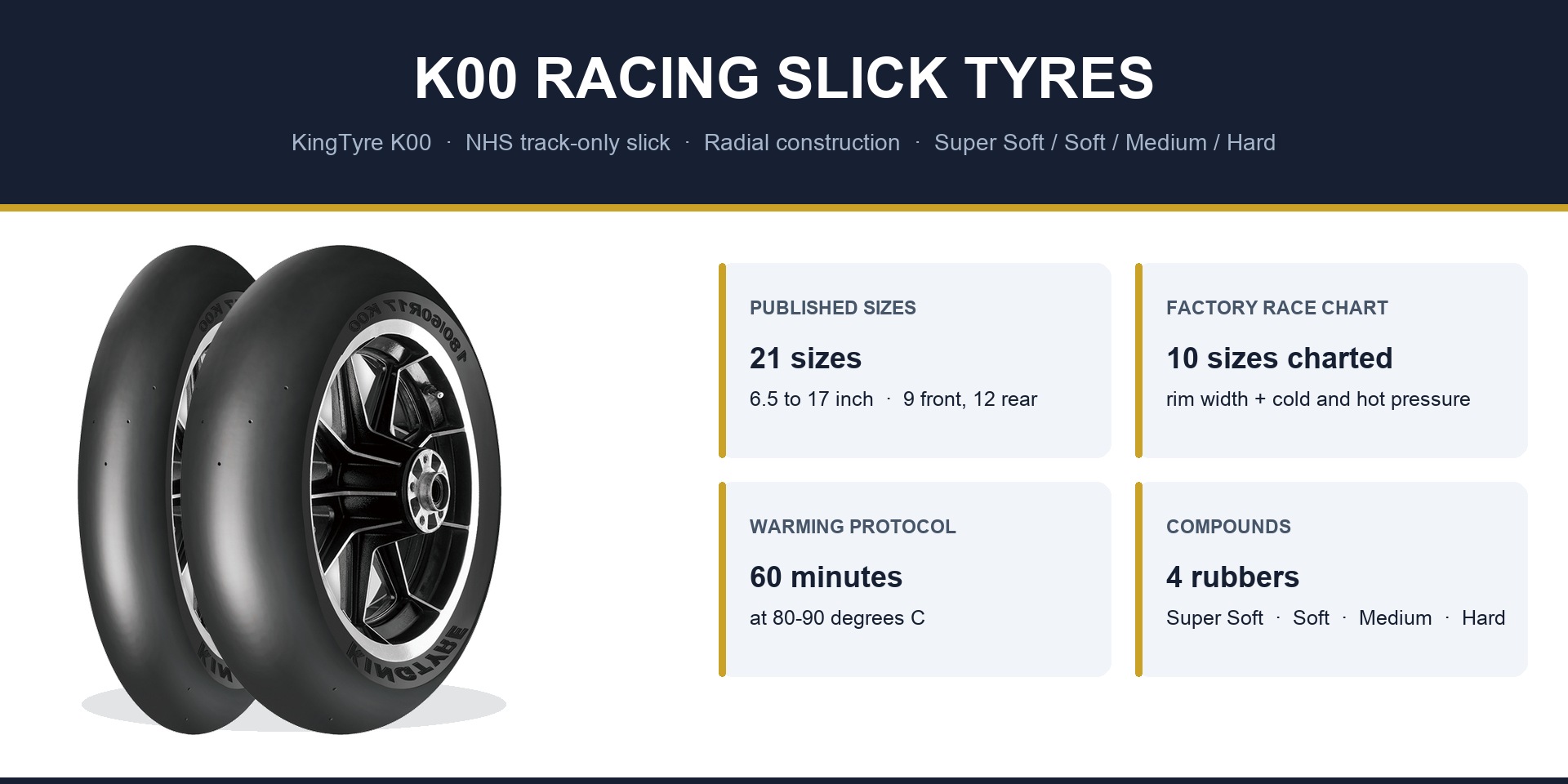
The KingTyre K00 is a racing slick, not a road tyre. It carries the NHS (Not for Highway Service) marking, it is built to a radial architecture, and it comes in four rubber compounds. What a team or a distributor actually needs next is a size list, a rim width and a pressure figure — the three numbers that decide whether a tyre can be mounted, and whether it survives a session.
KingTyre publishes all three for part of the range, and publishes the rest as sizes only. This guide separates the two, states the factory race chart exactly as KingTyre issues it, and marks every figure that is not published so nobody has to guess. It is the size and pressure reference for the K00, written for the people who have to order the tyre and set it up in the pit lane.

Everything KingTyre publishes for the K00, in one place. The short version: 21 sizes, 10 of them with a complete factory race chart, 4 with minibike chart data, and 7 published as sizes only.
| Spécifications | Published detail |
|---|---|
| Product type | Motorcycle racing slick, radial construction, NHS (Not for Highway Service) marking |
| Published sizes | 21 sizes — 9 front, 12 rear — from 6.5-inch to 17-inch rim diameters |
| Sizes with a full factory race chart | 10 sizes with tread width, overall diameter, measured rim, approved rim range, and cold and hot pressure |
| Sizes with minibike chart data | 4 sizes with measured rim and cold pressure only, and a separate warming window |
| Sizes published without chart data | 7 sizes — size only, with no geometry or pressure published |
| Compounds | Super Soft (SS), Soft (S), Medium (M), Hard (H) — one carcass, four compounds |
| Tyre warming, race slick sizes | 60 minutes at 80–90°C |
| Tyre warming, minibike sizes | 70–90°C |
| Road certification | None — the K00 is a track-only tyre with no ECE, DOT or CCC approval |
| Published race applications | Asia Road Racing Championship, FIM MiniGP Series, European Superbike Amateur Cup, China Superbike Championship, Malaysian Super Series |
| Manufacturer | Tianjin KingTyre Group, ISO 9001 plant, over 300,000 radial tyres a year, exporting to more than 45 countries |
The single most useful thing to understand about the K00 range is that "published" means three different things. Some sizes come with full factory data, some with partial data, and some are published as a size and nothing else. The table below maps all 21 sizes against what is actually available.
| Tyre size | Fitment | Data available | What the factory publishes |
|---|---|---|---|
| 90/65 R6.5 | Front | Size only | Not published — request the current chart |
| 90/90 R10 | Front | Size only | Not published — request the current chart |
| 100/85 R10 | Front | Minibike chart | Measured rim MT2.50, cold 1.3 bar (19 PSI), warming 70–90°C |
| 100/90 R12 | Front | Minibike chart | Measured rim MT2.50, cold 1.3 bar (19 PSI), warming 70–90°C |
| 125/75 R16.5 | Front | Full race chart | Tread width, overall diameter, MT3.50, rims 3.50–3.75, cold and hot pressure |
| 95/75 R17 | Front | Full race chart | Tread width, overall diameter, MT2.50, rims 2.50–3.00, cold and hot pressure |
| 110/70 R17 | Front | Size only | Not published — request the current chart |
| 120/70 R17 | Front | Full race chart | Tread width, overall diameter, MT3.50, rims 3.50–3.75, cold and hot pressure |
| 125/70 R17 | Front | Full race chart | Tread width, overall diameter, MT3.50, rims 3.50–3.75, cold and hot pressure |
| 110/55 R6.5 | Arrière | Size only | Not published — request the current chart |
| 100/90 R10 | Arrière | Size only | Not published — request the current chart |
| 120/80 R10 | Arrière | Minibike chart | Measured rim MT2.75, cold 1.1 bar (16 PSI), warming 70–90°C |
| 120/80 R12 | Arrière | Minibike chart | Measured rim MT2.75, cold 1.1 bar (16 PSI), warming 70–90°C |
| 115/75 R17 | Arrière | Full race chart | Tread width, overall diameter, MT3.00, rims 3.00–3.50, cold and hot pressure |
| 120/70 R17 | Arrière | Size only | Not published — request the current chart |
| 140/70 R17 | Arrière | Size only | Not published — request the current chart |
| 160/60 R17 | Arrière | Full race chart | Tread width, overall diameter, MT4.50, rims 4.25–5.00, cold and hot pressure |
| 180/60 R17 | Arrière | Full race chart | Tread width, overall diameter, MT5.00, rims 5.00–5.50, cold and hot pressure |
| 190/60 R17 | Arrière | Full race chart | Tread width, overall diameter, MT5.00, rims 5.00–5.50, cold and hot pressure |
| 200/60 R17 | Arrière | Full race chart | Tread width, overall diameter, MT6.00, rims 5.50–6.25, cold and hot pressure |
| 200/65 R17 | Arrière | Full race chart | Tread width, overall diameter, MT6.00, rims 5.50–6.25, cold and hot pressure |
Two entries in that table need a note. 120/70 R17 appears in both the front and the rear column. KingTyre publishes it as a front size with full race chart data, and also lists it as a rear size — the rear version has no chart entry. And 110/70 R17 and 140/70 R17 are K00 sizes in their own right, not rain tyre sizes, but neither is covered by the factory race chart.
For the seven sizes marked "size only", the correct answer is not to interpolate from a neighbouring size. Rim widths, carcass construction and target pressure all change with diameter and aspect ratio. Ask KingTyre for the current chart entry, or read it off the tyre you have in hand.
This is the geometry table, exactly as KingTyre issues it. Tread width is the width of the rubber at the contact surface, overall diameter is the total tyre diameter, the measured rim is the recommended rim width, and the approved rims column is the window the tyre may be fitted to.
| Tyre size | Fitment | Tread width (mm) | Overall diameter (mm) | Measured rim | Approved rims |
|---|---|---|---|---|---|
| 125/75 R16.5 NHS | Front | 125 | 603 | MT3.50 | 3.50 – 3.75 |
| 95/75 R17 NHS | Front | 92 | 580 | MT2.50 | 2.50 – 3.00 |
| 120/70 R17 NHS | Front | 116 | 600 | MT3.50 | 3.50 – 3.75 |
| 125/70 R17 NHS | Front | 120 | 610 | MT3.50 | 3.50 – 3.75 |
| 115/75 R17 NHS | Arrière | 111 | 604 | MT3.00 | 3.00 – 3.50 |
| 160/60 R17 NHS | Arrière | 160 | 625 | MT4.50 | 4.25 – 5.00 |
| 180/60 R17 NHS | Arrière | 179 | 649 | MT5.00 | 5.00 – 5.50 |
| 190/60 R17 NHS | Arrière | 182 | 658 | MT5.00 | 5.00 – 5.50 |
| 200/60 R17 NHS | Arrière | 203 | 672 | MT6.00 | 5.50 – 6.25 |
| 200/65 R17 NHS | Arrière | 198 | 700 | MT6.00 | 5.50 – 6.25 |
Four readings of that table matter more than the rest.
200/60 R17 and 200/65 R17 are not the same tyre with a different label. The 200/60 has the widest tread in the range at 203 mm but the smaller overall diameter at 672 mm. The 200/65 gives up 5 mm of tread width to gain 28 mm of overall diameter, which is the taller sidewall most endurance machinery wants for its swingarm geometry. Both fit the same MT6.00 rim.
95/75 R17 is the narrow front, and it is not a mistake. At 92 mm of tread and a 580 mm overall diameter it is the smallest charted tyre in the range. The 125/75 R16.5 goes the other way — a 125 mm tread on a 16.5-inch rim, 603 mm overall diameter — which is the shape used where a bike needs a narrow rim with a wide rubber band.
115/75 R17 is a rear size. It looks like a front pattern and it is not; KingTyre charts it on the rear with the lowest pressures in the range, which is consistent with a 604 mm overall diameter.
Fronts and rears share one rule of thumb on rim width. Every charted front runs on a 2.50 or 3.50 measured rim, every charted rear on 3.00, 4.50, 5.00 or 6.00. A front and a rear can be combined freely in that list, because the chart constrains each tyre to its own rim window rather than to a bike.
These are the pressures KingTyre publishes for the race slick, in bar and PSI. Cold pressure is set in the paddock before the bike goes out; hot pressure is the reading taken in the pit lane straight off the warmers.
| Tyre size | Fitment | Cold — bar (PSI) | Hot straight out of warmers — bar (PSI) |
|---|---|---|---|
| 125/75 R16.5 NHS | Front | 2.0 (29) | 2.2 (32) |
| 95/75 R17 NHS | Front | 2.0 (29) | 2.2 (32) |
| 120/70 R17 NHS | Front | 2.1 (30) | 2.3 (33) |
| 125/70 R17 NHS | Front | 2.1 (30) | 2.3 (33) |
| 115/75 R17 NHS | Arrière | 1.5 (22) | 1.8 (26) |
| 160/60 R17 NHS | Arrière | 1.4 (20) | 1.6 (23) |
| 180/60 R17 NHS | Arrière | 1.4 (20) | 1.6 (23) |
| 190/60 R17 NHS | Arrière | 1.4 (20) | 1.6 (23) |
| 200/60 R17 NHS | Arrière | 1.4 (20) | 1.6 (23) |
| 200/65 R17 NHS | Arrière | 1.4 (20) | 1.6 (23) |
The pattern in that table is the one every rider learns on day one: fronts run at roughly 50% higher pressure than rears. That is not a preference, it is geometry. A 600 mm front has far less volume to flex than a 672 mm rear, so it needs more pressure to hold the same shape. A rider who copies the rear pressure onto the front will make the front squirm; a rider who copies the front pressure onto the rear will overload the rear carcass.
On the two pressure references. KingTyre also carries a shorter summary pressure chart on the K00 product page, and that chart does not match the factory race chart reproduced above. Treat the factory race chart as governing for track work — it is per-size and tied to a measured rim, while the product-page summary is a general guide. If you are setting pressures for a race or a test session, work from the factory chart and check the hot reading in the pit lane. For the wider background on why hot pressure is the number that matters, see our guide to slick tyre pressure on track.
The factory's own caveat, which is worth reading. KingTyre's race chart states that optimal hot pressures on track vary with rider style, rider weight, track surface and temperature, and suspension set-up, and recommends checking hot pressures in the pit lane directly after a few laps and making small adjustments. The table is the starting point, not the finish line.
The four junior sizes are charted separately from the race slick, and they are not interchangeable with the 17-inch numbers. Their warming window is 70–90°C rather than 60 minutes at 80–90°C, and only a cold pressure is published.
| Tyre size | Fitment | Measured rim | Cold — bar (PSI) | Tyre warming |
|---|---|---|---|---|
| 100/85 R10 NHS | Front | MT2.50 | 1.3 (19) | 70 – 90°C |
| 100/90 R12 NHS | Front | MT2.50 | 1.3 (19) | 70 – 90°C |
| 120/80 R10 NHS | Arrière | MT2.75 | 1.1 (16) | 70 – 90°C |
| 120/80 R12 NHS | Arrière | MT2.75 | 1.1 (16) | 70 – 90°C |
A cold pressure of 1.3 bar in front and 1.1 bar at the rear looks alarming next to the 17-inch numbers, and it is correct for a much smaller, much lighter machine with a very different suspension. Note that no hot pressure and no approved rim range is published for these sizes. For the dedicated machine class, see the K96 Mini GP racing tyre product page and the K96 Mini GP racing tyre guide.
Every K00 size KingTyre charts, grouped by the rim it needs. This is the table to take to a wheel builder.
| Measured rim | Charted sizes on that rim | Approved rim range |
|---|---|---|
| MT2.50 | 95/75 R17 NHS (front) | 2.50 – 3.00 |
| MT2.50 | 100/85 R10, 100/90 R12 NHS (minibike front) | Not published |
| MT3.00 | 115/75 R17 NHS (rear) | 3.00 – 3.50 |
| MT3.50 | 125/75 R16.5, 120/70 R17, 125/70 R17 NHS (front) | 3.50 – 3.75 |
| MT2.75 | 120/80 R10, 120/80 R12 NHS (minibike rear) | Not published |
| MT4.50 | 160/60 R17 NHS (rear) | 4.25 – 5.00 |
| MT5.00 | 180/60 R17, 190/60 R17 NHS (rear) | 5.00 – 5.50 |
| MT6.00 | 200/60 R17, 200/65 R17 NHS (rear) | 5.50 – 6.25 |
The approved ranges are wider than the measured rim for every 17-inch size, which means a wheel built on the measured rim still has tolerance either side. The 160/60 rear, for example, can be mounted on a rim from 4.25 to 5.00 inches against a measured rim of 4.50 — a genuinely useful margin when you are chasing a different profile on a different bike.
KingTyre lists the following machines against the K00 on the product sheet: Yamaha R6 and R7, Kawasaki ZX-6R and ZX-10R, Honda CBR600RR and CBR1000RR, Suzuki GSX-R600 and GSX-R1000, and Ducati Panigale V2 and V4.
For each of them, the choice is made from the charted front and rear sizes rather than from a fixed pairing. A 600-class machine on a 95/75 R17 front and a 160/60 R17 rear, or a litre bike on a 120/70 R17 front with a 190/60 R17 rear, are both built from charted sizes with rim widths inside the approved windows. If your machine is not on the list, the test is whether your rim widths sit inside the approved range for the size you want to run — and then whether the bike's own geometry accepts that diameter.
For the wider picture of how 17-inch sizes divide across the market, see our 17-inch motorcycle tyre guide.
KingTyre publishes four compounds for the K00, on one carcass. The product sheet names them Super Soft (SS), Soft (S), Medium (M) and Hard (H).
| Composé | Where the product sheet places it | Published race life |
|---|---|---|
| Super doux (SS) | Qualifying, and cool ambient conditions — fastest warm-up of the four | Not published |
| Souple (S) | Qualifying and sprint racing, and the most common choice across the published range | Not published |
| Moyen (M) | Endurance racing, where the product sheet reports that Medium compounds dominated endurance events | Approximately 90–120 km under race load |
| Dur (H) | Long stints, hot ambient conditions and conservative tyre management | Not published |
Two things to be honest about here. First, only the Medium compound has a published race-life figure — approximately 90–120 km under race load — and it is a product-sheet figure rather than a laboratory test result. Second, KingTyre does not publish a peak grip temperature window per compound in the product sheet or the race chart. Some published material quotes operating windows; treat them as indicative and ask KingTyre for the current compound data sheet before writing one into a team specification.
Sidewall compound codes are also not published as a standard code system. Ask KingTyre to confirm the code convention for your order at the point of purchase — see our guide to specifying a racing slick order.

Every K00 size carries the NHS (Not for Highway Service) marking. That means the tyre is not approved for road use in any market that requires type approval, and no amount of careful riding changes that.
The regulatory position is the same across the major markets: Europe and the UK under ECE R75, the United States and Canada under FMVSS 119 and DOT, Japan under its JIS framework, Australia under ADR, and Brazil under INMETRO all require a tread pattern across the contact patch. A slick fails type approval, fails inspection, and voids insurance on public roads. The full country-by-country breakdown is in our guide to whether slick motorcycle tyres are street legal.
This is also the difference between the K00 and KingTyre's own street-legal performance tyres. If your use case involves public roads at all — a track day with a road commute either side, or a customer base that rides to the circuit — the relevant products are the K06 semi slick, which is ECE certified, or the K905 semi slick, which carries both ECE and DOT approval. The mechanics of the difference are covered in slick versus semi slick tyres.
Five products, five different jobs. Getting the right tyre to a distributor or a team is mostly a matter of knowing which of these five the customer actually needs.
| Modèle | Type | Road certification | Published sizes | Built for |
|---|---|---|---|---|
| K00 | Slick, NHS | None — track only | 21 sizes, 6.5" to 17" | Race and endurance competition in dry conditions |
| K01 | Rain slick, NHS | None — track only | 17-inch race sizes | Wet racing and mixed-condition stints |
| K06 | Semi slick, ZR | ECE | 17-inch street and track sizes | Track days and road use on the same tyre |
| K905 Semi Slick | Semi slick, ECE + DOT | ECE et DOT | 17-inch street and track sizes | Street-legal performance riding with a track bias |
| K96 | Mini GP slick | Not published | Junior machine sizes | Mini GP and junior competition |
For the wet counterpart, the K01 racing rain tyre product page and the K01 racing rain tyre guide set out the K01 sizes and their heavy-rain and wet-track pressures. For the road-legal end of the range, the K06 guide and the K905 semi slick guide cover both in full.
This table exists so that no buyer has to guess whether a missing number is missing because it is confidential or because nobody has written it down yet.
| Données | Published? | Source |
|---|---|---|
| Tyre size list (21 sizes) | Oui | K00 product sheet |
| Tread width and overall diameter | Yes — 10 sizes | Factory race chart |
| Measured rim and approved rim range | Yes — 10 sizes; measured rim only for the 4 minibike sizes | Factory race chart |
| Cold and hot pressure | Yes — 10 sizes | Factory race chart |
| Cold pressure for the minibike sizes | Yes — 4 sizes | Factory race chart, minibike table |
| Pressure and geometry for the remaining 7 sizes | No | Request the current chart from KingTyre |
| Peak grip temperature window per compound | No | Request the current compound data sheet |
| Sidewall compound code system | No — the product sheet names the four compounds | Confirm the code convention with your order |
| ECE, DOT or CCC approval | No — the K00 is NHS | Not applicable; use the K06 or K905 for road use |
| Race life | Medium compound only, approximately 90–120 km under race load | K00 product sheet |
| Test protocol, third-party test data, race results per tyre | No — the published validation is the Kingtyre Fullgas Racing Team programme at Le Mans | See the [Le Mans field report](/endurance-racing-motorcycle-tires-7-years-at-le-mans-24h-a-field-report/) |
KingTyre's published endurance programme is the strongest verifiable claim attached to the K00. The Kingtyre Fullgas Racing Team has run five consecutive campaigns at the 24 Heures Motos at Le Mans, from 2022 to 2026, running the K00 slick in dry conditions and the K01 rain tyre when the track turned.
In the 2026 race the team's #116 machine completed 742 laps over 24 hours on a Kawasaki ZX-10R. The full results, the pit-stop pattern and the compound data from that race are in the 2026 Le Mans race report and in the seven-year field report.
What that does and does not prove is worth stating plainly. It shows the K00 completing a full 24-hour endurance race in a championship environment with a team managing stints, compound changes and tyre life under pressure. It does not produce a per-size laboratory test report, and it does not replace the factory race chart for your own setup. If you are writing a specification, use the chart for pressures and the race programme for provenance.
The product sheet adds two more KingTyre-published claims that belong in the same category: that the optimised carcass design reduced lap times by up to 1.2 seconds per lap against leading competitors in internal KingTyre tests, and that Medium and Hard compounds resist thermal degradation on tracks over 3.5 km in Malaysian GP simulations. Both are manufacturer statements without a published test protocol, so we report them as such rather than presenting them as independent results.
The K00 is a specialist SKU, and it should be treated like one. For racing tyre distributors, importers supplying series organisers and club racing federations, the practical order specification is short:
On the supplier side: KingTyre operates an ISO 9001 certified plant with an annual capacity of over 300,000 radial tyres and exports to more than 45 countries, and the K00 is produced on steel belt curing presses with laser balance inspection and on-site racetrack simulation. The product sheet also states that KingTyre supplies 15 or more race teams across Asia, Europe and South America. For the import and compliance side of a racing tyre order, start with our wholesale import guide and our OEM and private label explainer, and see what ISO 9001 actually means before you ask a customer for a certification document.
The K00 is a track-only racing slick for race and endurance competition in dry conditions. It carries the NHS (Not for Highway Service) marking and has no ECE, DOT or CCC approval, so it cannot be used on public roads. KingTyre publishes the K00 against the Asia Road Racing Championship, the FIM MiniGP Series, the European Superbike Amateur Cup, the China Superbike Championship and the Malaysian Super Series.
KingTyre publishes 21 K00 sizes: 9 front and 12 rear, from 6.5-inch to 17-inch rim diameters. Ten of them carry a full factory race chart, four carry minibike chart data, and seven are published as sizes only.
Ten race sizes have a full factory chart covering tread width, overall diameter, measured rim, approved rim range, and cold and hot pressure: 125/75 R16.5, 95/75 R17, 120/70 R17 and 125/70 R17 in front, and 115/75 R17, 160/60 R17, 180/60 R17, 190/60 R17, 200/60 R17 and 200/65 R17 at the rear. The four minibike sizes have a cold pressure only.
Use the factory race chart values. Fronts run 2.0 to 2.1 bar cold (29 to 30 PSI) and 2.2 to 2.3 bar hot (32 to 33 PSI); rears run 1.4 to 1.5 bar cold (20 to 22 PSI) and 1.6 to 1.8 bar hot (23 to 26 PSI). KingTyre recommends checking hot pressures in the pit lane after a few laps and adjusting in small steps, because the optimum varies with rider weight, track surface, temperature and suspension set-up.
The measured rim and approved range are published for all ten charted race sizes: 95/75 R17 on MT2.50 (2.50 to 3.00), 115/75 R17 on MT3.00 (3.00 to 3.50), 125/75 R16.5, 120/70 R17 and 125/70 R17 on MT3.50 (3.50 to 3.75), 160/60 R17 on MT4.50 (4.25 to 5.00), 180/60 R17 and 190/60 R17 on MT5.00 (5.00 to 5.50), and 200/60 R17 and 200/65 R17 on MT6.00 (5.50 to 6.25).
No. Every K00 size is NHS and carries no road type approval. Europe, the UK, North America, Japan, Australia and Brazil all require a tread pattern across the contact patch for road use. If you need one tyre for the road and the track, the K06 semi slick is ECE certified and the K905 semi slick carries ECE and DOT.
KingTyre's race chart specifies 60 minutes at 80 to 90°C for the race slick sizes, and 70 to 90°C for the four minibike sizes. Warmers are strongly recommended, and a slick below roughly 50°C has very little grip, which is why bikes travel on trailers or change to warmers in the pit lane.
KingTyre's product sheet publishes one race-life figure, for the Medium compound: approximately 90 to 120 km under race load. No life figure is published for the Super Soft, Soft or Hard compounds, so treat any other number you see as indicative and confirm it with KingTyre.
Super Soft for qualifying in cool conditions, Soft for sprint races and qualifying, Medium for endurance stints, and Hard for long stints in hot ambient conditions or where tyre management needs to be conservative. KingTyre publishes the four compounds on a single carcass, so mixing across the axle is possible. Some published material quotes a peak grip window per compound, but KingTyre does not publish those windows in its product sheet or race chart, so confirm the current compound data with the factory.
Specify size, compound, quantities by compound, sets per race weekend, the measured rim and approved rim range, and ask for the batch sheet with the shipment. Unused slicks should be stored below 25°C. Minimum order quantities, FOB pricing, container loading and certification documentation are available from KingTyre on request — contact the team through the product list ou le contact page.
Les KingTyre K00 motorcycle slick tyre product page carries the full size list, the compound range and the series approvals. If you are specifying a tyre for a specific machine, send us the chassis, the rim widths and the class, and we will confirm what the factory currently has in production.
Two companion articles cover the reasoning behind the tyre: the K00 technical guide covers the compound system and race strategy, and the K00 engineering article covers the casing design and the endurance development programme.
 French
 English
 Spanish
 German
 Korean
 Japanese
 Italian
 Russian
 Dutch
 Danish
 Portuguese
 Polish
 Turkish
 Czech