
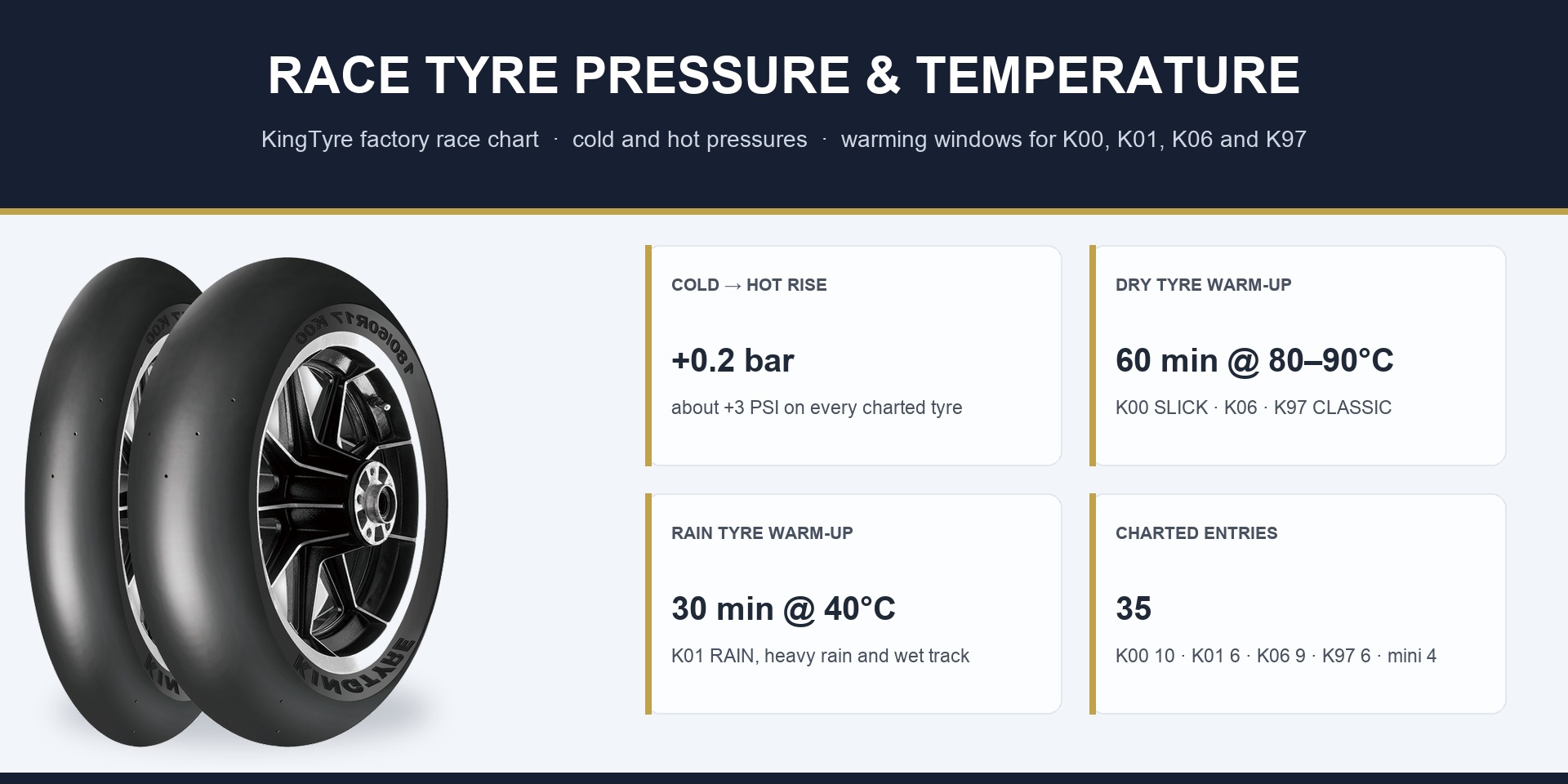
Every race team sets two numbers before the first session of the day: the cold pressure that goes on the tyre, and the hot pressure the tyre is supposed to reach once it is on track. KingTyre publishes both, together with the temperature the tyre has to be warmed to, in a single factory race chart. This guide reproduces that chart for the five KingTyre race tyre families, sets out the warming protocol for each of them, and works out what the numbers actually mean in the pit lane.
The short version: every published cold-to-hot step in the KingTyre race chart is +0.2 bar, about +3 PSI, with a single exception — the three front sizes of the K01 rain tyre, which rise +0.3 bar from 29 to 33 PSI. The dry race tyres are warmed at 80–90°C for 60 minutes. The rain tyre is warmed at 40°C for 30 minutes. The minibike chart publishes a cold pressure and nothing else.
Nothing on this page is inferred. Every figure comes from KingTyre's own race chart or from the matching KingTyre product page, and every figure KingTyre does not publish is marked as not published rather than estimated. If you are writing a setup sheet or a purchase specification, work from this page. If you want the reasoning behind the pressures rather than the numbers themselves, start with what the best tyre pressure for racing slicks actually means.
The chart covers five tyre designations: the K00 slick, the K01 rain tyre, the K06 super sport tyre, the K97 classic racing tyre and the K00 slick minibike. Between them they account for 35 chart entries. The table below gives the range of each one, so you can see at a glance which tyre your working numbers sit in.
| Tyre designation | Chart entries | Cold pressure | Hot pressure | Warming window | Warming time |
|---|---|---|---|---|---|
| K00 SLICK | 10 | 1.4 - 2.1 bar (20 - 30 PSI) | 1.6 - 2.3 bar (23 - 33 PSI) | 80 - 90°C | 60 minutes |
| K01 RAIN | 6 | 1.7 - 2.0 bar (25 - 29 PSI) | 1.9 - 2.3 bar (27 - 33 PSI) | 40°C | 30 minutes |
| K06 SUPERSPORT | 9 | 1.6 - 2.2 bar (23 - 32 PSI) | 1.8 - 2.4 bar (26 - 35 PSI) | 80 - 90°C | 60 minutes |
| K97 CLASSIC RACING | 6 | 1.5 - 2.1 bar (22 - 30 PSI) | 1.7 - 2.3 bar (25 - 33 PSI) | 80 - 90°C | 60 minutes |
| K00 SLICK MINIBIKE | 4 | 1.1 - 1.3 bar (16 - 19 PSI) | Not published | 70 - 90°C | Not published |
Two things are worth noticing straight away. The first is that the rear tyres always run a lower pressure than the front. On the K00 slick the rear sits at 1.4 bar cold where the front runs 2.0–2.1 bar, because a rear carries more load and a lower pressure keeps the contact patch working rather than folding onto the shoulder. The second is that the hot figure is always higher than the cold figure by a fixed step, and that step is what makes the chart usable: you set the cold value, and the hot value is what confirms the tyre reached its window.
A hot pressure figure is only meaningful if the tyre was in its published temperature window when it was measured. KingTyre therefore publishes the warming protocol on the same chart as the pressures, and the two are read together.
| Tyre type | Warming temperature | Warming duration |
|---|---|---|
| K00 SLICK | @ 80 - 90°C | 60 minutes |
| K00 SLICK MINIBIKE | @ 70 - 90°C | Not published |
| K01 RAIN | @ 40°C | 30 minutes |
| K06 SUPERSPORT | @ 80 - 90°C | 60 minutes |
| K97 CLASSIC RACING | @ 80 - 90°C | 60 minutes |
The dry race tyres all take the same window: 80 to 90°C for 60 minutes. The rain tyre is deliberately different at 40°C for 30 minutes, because a wet-track tyre works at a much lower temperature than a dry slick and warming it harder gives you a tyre that is too soft, too short-lived and worse in the rain, not better.
KingTyre's own chart carries this note, and it is the most important sentence on the page:
Please note that optimal hot pressures on track may vary depending on rider style, rider weight, track surface and temperature, and suspension set up. We recommend checking hot pressures in pit lane directly after a few laps and making small adjustments if necessary.
Translated: the chart gives you the starting point, not the final answer. Optimal hot pressure on track changes with the rider's style, the rider's weight, the track surface and temperature, and the suspension set up. KingTyre's instruction is to check the hot pressure directly in the pit lane after a few laps and make small adjustments if needed. The full reasoning behind reading a tyre's behaviour is covered in how many heat cycles a slick tyre can handle, and the theory of pressure and grip in the racing slick pressure guide.
The chart lets you calculate the rise for any size, because the cold and hot figures are published side by side. Worked through every charted entry, the pattern is unusually consistent.
| Tyre and position | Cold pressure | Hot pressure | Rise | Rise in PSI |
|---|---|---|---|---|
| K00 SLICK, front | 2.0 - 2.1 bar (29 - 30 PSI) | 2.2 - 2.3 bar (32 - 33 PSI) | +0.2 bar | +3 PSI |
| K00 SLICK, rear | 1.4 - 1.5 bar (20 - 22 PSI) | 1.6 - 1.8 bar (23 - 26 PSI) | +0.2 bar | +3 PSI |
| K01 RAIN, front | 2.0 bar (29 PSI) | 2.3 bar (33 PSI) | +0.3 bar | +4 PSI |
| K01 RAIN, rear, heavy rain | 1.9 bar (27-28 PSI) | 2.1 bar (30 PSI) | +0.2 bar | about +2 to +3 PSI |
| K01 RAIN, rear, wet track | 1.7 bar (25 PSI) | 1.9 bar (27-28 PSI) | +0.2 bar | about +2 to +3 PSI |
| K06 SUPERSPORT, front | 2.2 bar (32 PSI) | 2.4 bar (35 PSI) | +0.2 bar | +3 PSI |
| K06 SUPERSPORT, rear | 1.6 bar (23 PSI) | 1.8 bar (26 PSI) | +0.2 bar | +3 PSI |
| K97 CLASSIC RACING, front and front/rear | 2.1 bar (30 PSI) | 2.3 bar (33 PSI) | +0.2 bar | +3 PSI |
| K97 CLASSIC RACING, rear | 1.5 bar (22 PSI) | 1.7 bar (25 PSI) | +0.2 bar | +3 PSI |
| K00 SLICK MINIBIKE | 1.1 - 1.3 bar (16 - 19 PSI) | Not published | Not published | Not published |
Every charted tyre rises +0.2 bar, roughly +3 PSI, except the three front sizes of the K01 rain tyre, which rise +0.3 bar. The minibike chart breaks the pattern completely, because it publishes a cold pressure with no hot figure attached at all.
This is the practical value of the chart: if you know the cold figure for a size and you know the tyre is at its published warming window, you can predict the hot reading before you go out. If the hot reading comes back at something other than the charted value, the tyre was not at temperature, or the fitment is wrong, or the setup needs a small change. That is a three-way diagnosis you can make in the pit lane with a gauge.
Below is the chart as KingTyre publishes it, with nothing added, nothing removed and nothing rounded in a way that changes a number. Sizes, tread widths, overall diameters, measured rims, approved rim ranges, cold pressures and hot pressures are exactly as issued.
The K00 is the endurance racing slick and the most used tyre in the KingTyre programme. The chart gives 10 sizes, five for the front and five for the rear, each with a measured rim, an approved rim range, a cold pressure and a hot pressure straight out of the warmers.
| Tyre size | Fitment | Tread width (mm) | Overall diameter (mm) | Measured rim | Approved rims | Cold – bar (PSI) | Hot out of warmers – bar (PSI) |
|---|---|---|---|---|---|---|---|
| 125/75 R16.5 NHS | フロント | 125 | 603 | MT3.50 | 3.50 - 3.75 | 2.0 (29) | 2.2 (32) |
| 95/75 R17 NHS | フロント | 92 | 580 | MT2.50 | 2.50 - 3.00 | 2.0 (29) | 2.2 (32) |
| 120/70 R17 NHS | フロント | 116 | 600 | MT3.50 | 3.50 - 3.75 | 2.1 (30) | 2.3 (33) |
| 125/70 R17 NHS | フロント | 120 | 610 | MT3.50 | 3.50 - 3.75 | 2.1 (30) | 2.3 (33) |
| 115/75 R17 NHS | リア | 111 | 604 | MT3.00 | 3.00 - 3.50 | 1.5 (22) | 1.8 (26) |
| 160/60 R17 NHS | リア | 160 | 625 | MT4.50 | 4.25 - 5.00 | 1.4 (20) | 1.6 (23) |
| 180/60 R17 NHS | リア | 179 | 649 | MT5.00 | 5.00 - 5.50 | 1.4 (20) | 1.6 (23) |
| 190/60 R17 NHS | リア | 182 | 658 | MT5.00 | 5.00 - 5.50 | 1.4 (20) | 1.6 (23) |
| 200/60 R17 NHS | リア | 203 | 672 | MT6.00 | 5.50 - 6.25 | 1.4 (20) | 1.6 (23) |
| 200/65 R17 NHS | リア | 198 | 700 | MT6.00 | 5.50 - 6.25 | 1.4 (20) | 1.6 (23) |
If you are specifying a K00, the measured rim and the approved rim range matter as much as the pressure. A tyre fitted outside its approved rim window will not behave as the chart describes, whatever the pressure is set to. The full K00 picture, including all 21 published sizes and the ones KingTyre publishes without chart data, is in the K00 slick size and pressure guide.
One note for anyone cross-checking against the K00 product page: that page also carries a short generic pressure table with a different set of numbers. KingTyre's race chart is the size-by-size reference published with the race programme, and it is the one used throughout this guide. Work from the chart issued with your set, and ask KingTyre for the current chart if you need a size that is not charted.
The K01 rain tyre is the only charted tyre whose pressure depends on the weather. The chart treats the front and the rear differently: the three front sizes carry a single cold and hot pair, while each rear size carries two pairs, because a rear on a wet track is set up differently from a rear in heavy rain.
| Tyre size | Fitment | Tread width (mm) | Overall diameter (mm) | Measured rim | Approved rims | Cold – bar (PSI) | Hot out of warmers – bar (PSI) |
|---|---|---|---|---|---|---|---|
| 110/70 R17 NHS | フロント | 110 | 586 | MT3.00 | 3.00 - 3.50 | 2.0 (29) | 2.3 (33) |
| 125/70 R17 NHS | フロント | 122 | 600 | MT3.50 | 3.50 - 3.75 | 2.0 (29) | 2.3 (33) |
| 125/80 R17 NHS | フロント | 122 | 624 | MT3.00 | 3.00 - 3.75 | 2.0 (29) | 2.3 (33) |
| 140/70 R17 NHS | リア | 139 | 628 | MT3.75 | 3.50 - 4.00 | Heavy rain 1.9 (27-28) Wet track 1.7 (25) |
Heavy rain 2.1 (30) Wet track 1.9 (27-28) |
| 160/60 R17 NHS | リア | 161 | 624 | MT4.50 | 4.25 - 5.00 | Heavy rain 1.9 (27-28) Wet track 1.7 (25) |
Heavy rain 2.1 (30) Wet track 1.9 (27-28) |
| 190/55 R17 NHS | リア | 190 | 642 | MT6.00 | 5.50 - 6.00 | Heavy rain 1.9 (27-28) Wet track 1.7 (25) |
Heavy rain 2.1 (30) Wet track 1.9 (27-28) |
Read the rear rows as two settings rather than two values. In heavy rain the rear runs 1.9 bar (27–28 PSI) cold and 2.1 bar (30 PSI) hot. On a wet track it runs 1.7 bar (25 PSI) cold and 1.9 bar (27–28 PSI) hot. The wet track setting is lower because the water evacuation pattern on a damp surface works better with less pressure in the tyre, while a full wet race leans on the deeper cut to push water out of the contact patch, which needs a firmer tyre.
Because the setting changes with the condition, the K01 needs a re-set between a dry warm-up and a full wet stint, and a tyre that has been running in the rain will not read the same as one that has been sitting in the paddock. The wider K01 story, including the wet-weather compound and the endurance testing behind it, is in the K01 racing rain tyre guide.
The K06 super sport tyre is the road-legal member of the race chart. It is the only charted tyre with an ECE certification, which means the same tyre can be used in a race meeting and on the road. The chart publishes nine sizes with measured rims, approved rim ranges and pressures.
| Tyre size | Fitment | Measured rim | Approved rims | Cold – bar (PSI) | Hot out of warmers – bar (PSI) |
|---|---|---|---|---|---|
| 110/70 ZR17 | フロント | MT3.00 | 3.00 - 3.50 | 2.2 (32) | 2.4 (35) |
| 120/70 ZR17 | フロント | MT3.50 | 3.50 - 3.75 | 2.2 (32) | 2.4 (35) |
| 140/70 ZR17 | リア | MT3.75 | 3.50 - 4.00 | 1.6 (23) | 1.8 (26) |
| 150/60 ZR17 | リア | MT4.25 | 4.00 - 4.50 | 1.6 (23) | 1.8 (26) |
| 160/60 ZR17 | リア | MT4.50 | 4.25 - 5.00 | 1.6 (23) | 1.8 (26) |
| 180/55 ZR17 | リア | MT5.50 | 5.50 - 6.00 | 1.6 (23) | 1.8 (26) |
| 180/60 ZR17 | リア | MT5.00 | 5.00 - 5.50 | 1.6 (23) | 1.8 (26) |
| 190/55 ZR17 | リア | MT6.00 | 5.50 - 6.00 | 1.6 (23) | 1.8 (26) |
| 200/55 ZR17 | リア | MT6.25 | 6.00 - 6.25 | 1.6 (23) | 1.8 (26) |
Two figures in this table are not published by KingTyre for this tyre: tread width and overall diameter. The chart leaves both blank for the K06, and they have not been filled in here. The full K06 picture, including its four compounds and the temperatures they are stable at, is in the K06 semi slick tyre guide.
The K97 classic racing tyre is the ZR18 entry in the chart, built for classic and vintage racing machinery. It is a front-and-rear tyre, so the chart publishes one pressure pair for the two sizes that run on either axle and a lower pair for the three rear-only sizes.
| Tyre size | Fitment | Measured rim | Approved rims | Cold – bar (PSI) | Hot out of warmers – bar (PSI) |
|---|---|---|---|---|---|
| 90/90 ZR18 | Front/Rear | MT2.15 | 1.85 - 2.50 | 2.1 (30) | 2.3 (33) |
| 100/90 ZR18 | Front/Rear | MT2.50 | 2.50 - 2.75 | 2.1 (30) | 2.3 (33) |
| 110/80 ZR18 | フロント | MT2.50 | 2.50 - 3.00 | 2.1 (30) | 2.3 (33) |
| 110/80 ZR18 | リア | MT2.50 | 2.50 - 3.00 | 1.5 (22) | 1.7 (25) |
| 120/70 ZR18 | リア | MT3.50 | 3.50 - 3.75 | 1.5 (22) | 1.7 (25) |
| 130/70 ZR18 | リア | MT3.50 | 3.50 - 4.00 | 1.5 (22) | 1.7 (25) |
KingTyre does not publish a dedicated product page for the K97 classic racing chart, and it does not publish tread width, overall diameter or compound options for it. It is also worth being precise about naming here, because the K97 name is used across more than one tyre. The K97 super motard is a road-legal supermoto tyre certified to ECE, DOT and CCC, and it shares several size labels with the classic racing chart. They are different tyres with different certifications and different purposes, and the super motard's pressures are not the classic racing chart's pressures.
The minibike chart is published as a separate table with a separate column set, and it is the thinnest part of the KingTyre race chart. It covers four 10 and 12 inch sizes for minibike racing, and it gives a measured rim and a cold pressure. That is all.
| Tyre size | Fitment | Measured rim | Cold – bar (PSI) | Hot out of warmers – bar (PSI) |
|---|---|---|---|---|
| 100/85 R10 NHS | フロント | MT2.50 | 1.3 (19) | Not published |
| 100/90 R12 NHS | フロント | MT2.50 | 1.3 (19) | Not published |
| 120/80 R10 NHS | リア | MT2.75 | 1.1 (16) | Not published |
| 120/80 R12 NHS | リア | MT2.75 | 1.1 (16) | Not published |
No hot pressure, no approved rim range, no tread width, no overall diameter and no warming duration are published for these sizes. The chart gives a warming window of 70 to 90°C and stops there. Those gaps are marked rather than filled, because a guessed hot pressure on a minibike tyre is a guess on the only tyre most junior riders will ever run.
Do not confuse the minibike chart with the K96 mini GP racing tyre. The K96 is a separate, DOT-approved product that publishes its own pressures and its own warm-up guidance, and it is a different tyre with different data. The complete K00 size list, including which sizes carry chart data and which do not, is in the K00 slick size and pressure guide.
Because several KingTyre products share size labels, and because the race chart uses designations rather than product names, it is easy to pick the wrong table. The table below maps every chart designation to its product page and road status, and flags the two KingTyre race products that sit on the track but are deliberately not on this chart.
| Race chart designation | Product page | Chart entries | Road status | Note |
|---|---|---|---|---|
| K00 SLICK | KingTyre K00 motorcycle slick tires | 10 | NHS, track only | 21 sizes are published on the product page; 10 of them carry full chart data |
| K01 RAIN | KingTyre K01 racing rain tire | 6 | NHS, track only | The product page lists 5 sizes; the chart adds the 160/60 R17 rear |
| K06 SUPERSPORT | KingTyre K06 semi slick tires | 9 | ECE certified, street legal | The product page publishes 10 17-inch sizes; the chart covers 9 |
| K97 CLASSIC RACING | No dedicated product page | 6 | Not stated on the chart | ZR18 classic racing sizes. Shares size labels with K97 Super Motard, which is a different tyre |
| K00 SLICK MINIBIKE | Listed on the K00 range | 4 | NHS, track only | 10 and 12 inch minibike sizes; cold pressure only |
| Not on the race chart: K96 Mini GP | KingTyre K96 mini GP racing tire | – | DOT approved race tyre | A separate product with its own published pressures. Do not mix it with the minibike chart |
| Not on the race chart: K97 Super Motard | KingTyre K97 super motard tires | – | ECE, DOT and CCC certified, street legal | A road-legal supermoto tyre, not the classic racing chart |
This is the order of operations that KingTyre's chart and its pit-lane note describe. It is short, and every step exists because the chart assumes the one before it has been done.
KingTyre's chart note identifies four reasons why the optimal hot pressure on track can differ from the published figure. The second column below explains the mechanism behind each one, which is the physical reason the variable moves the number.
| Variable KingTyre names | Why it moves the optimal hot pressure |
|---|---|
| Rider style | How the rider loads the tyre changes how much the carcass flexes and where the heat goes, so the same tyre settles at a different pressure for a different style of rider. |
| Rider weight | More mass on the machine changes the load carried by the contact patch and the deflection of the carcass under that load. |
| Track surface and temperature | A hot, coarse surface generates more heat and more shear at the contact patch than a cold, smooth one. |
| Suspension setup | Setup changes how much of the load reaches the tyre and how much the suspension absorbs before the tyre does. |
The chart gives the temperature to warm to. Two KingTyre product pages also publish the range a tyre is expected to work in, which is a different number answering a different question.
| Tyre | Published temperature statement | Source |
|---|---|---|
| K01 rain tyre | Performs reliably in 5°C to 40°C racing conditions | K01 product page |
| K06 super sport | Soft compound remains stable from 40°C to 85°C | K06 product page |
| K06 super sport | Hard compound holds up to 120°C | K06 product page |
| K00 slick | No operating temperature range published. The chart gives a warming window of 80 - 90°C | Factory race chart |
| K97 classic racing | No operating temperature range published. The chart gives a warming window of 80 - 90°C | Factory race chart |
| K00 slick minibike | No operating temperature range published. The chart gives a warming window of 70 - 90°C | Factory race chart |
Note that a warming window is not an operating range. 80 to 90°C is the temperature a warmer's blanket should hold a dry slick at before it goes out; it is not the surface temperature the tyre will then run at on track. KingTyre does not publish measured carcass temperatures or surface temperature targets for any of the charted tyres, and this guide does not invent them.
For anyone specifying a tyre, the gaps matter as much as the numbers. Here is the full published position across the five charted designations.
| Data point | K00 SLICK | K01 RAIN | K06 SUPERSPORT | K97 CLASSIC RACING | K00 SLICK MINIBIKE |
|---|---|---|---|---|---|
| Sizes on the race chart | 10 | 6 | 9 | 6 | 4 |
| Cold pressure | Published | Published | Published | Published | Published |
| Hot pressure | Published | Published | Published | Published | Not published |
| Measured rim | Published | Published | Published | Published | Published |
| Approved rim range | Published | Published | Published | Published | Not published |
| Tread width | Published | Published | Not published | Not published | Not published |
| Overall diameter | Published | Published | Not published | Not published | Not published |
| Warming temperature | Published | Published | Published | Published | Published |
| Warming duration | Published | Published | Published | Published | Not published |
| Compound options | Published (Super Soft, Soft, Medium, Hard) | Not published | Published (4 compounds) | Not published | Not published |
| Road certification | NHS, not road legal | NHS, not road legal | ECE certified | Not stated on the chart | NHS, not road legal |
For a size that is published as a size only, with no chart data, the answer is the same in every case: request the current chart from the factory before you write the tyre into a specification. Do not interpolate between two charted sizes, and do not carry a pressure across from a neighbouring size. The relationship between size and pressure in the chart is not monotonic across the range, because a rear tyre carrying a heavier load runs a lower pressure than a lighter front tyre of a similar diameter.
A published chart only means something if somebody uses it. KingTyre's own endurance programme is the reference customer for these numbers.
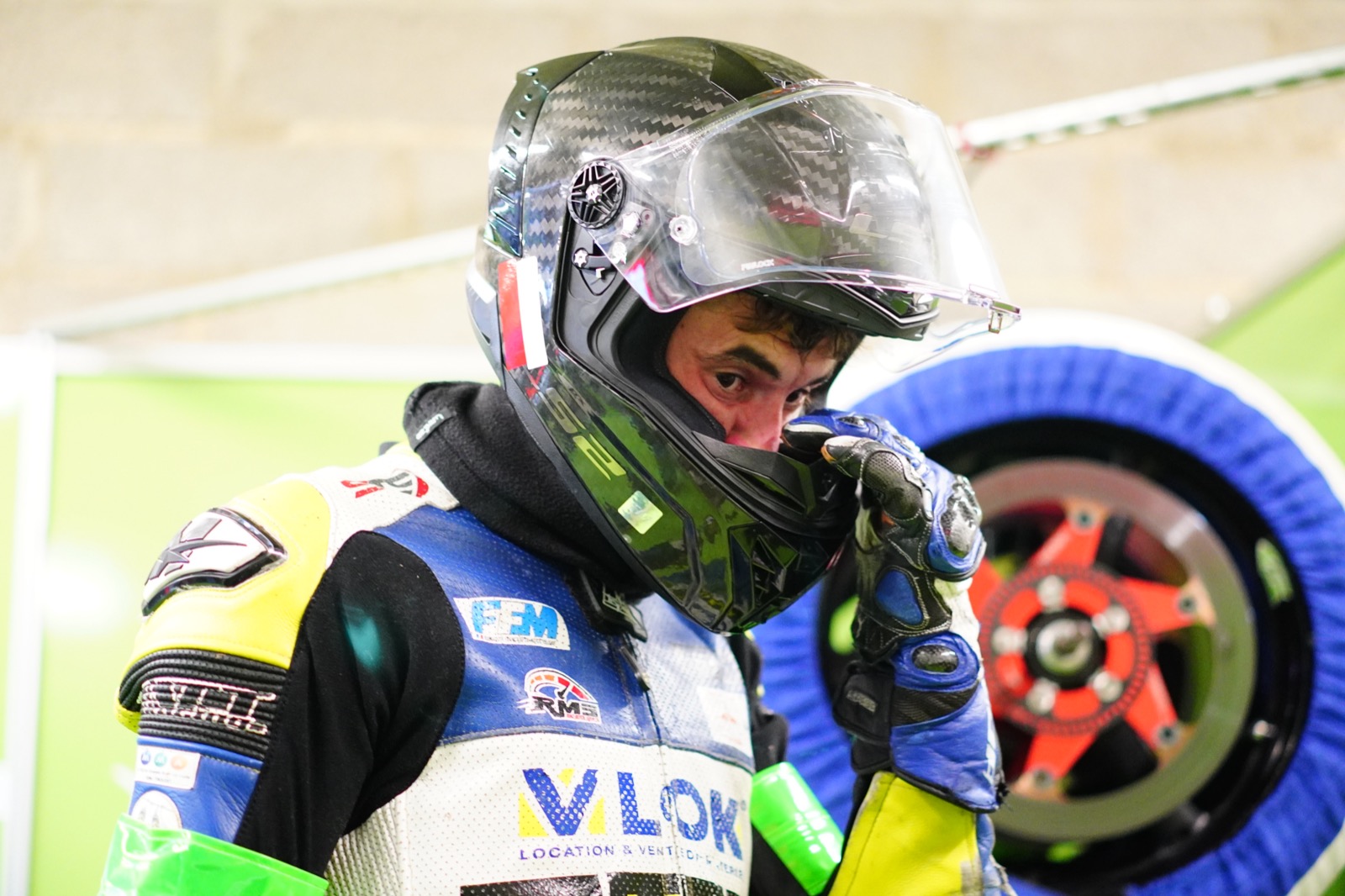
The Kingtyre Fullgas Racing Team has run five consecutive campaigns at the 24 Heures Motos at Le Mans, from 2022 to 2026, running the K00 slick in dry conditions and the K01 rain tyre when the track turned. In the 2026 race the team's #116 machine completed 742 laps over 24 hours on a Kawasaki ZX-10R. The results, the pit-stop pattern and the compound data from that race are in the 2026 Le Mans race report and in the seven-year field report. The engineering behind the K00 itself is covered in the K00 technical guide and in how the K00 slick is engineered for endurance racing.
What that record does and does not prove is worth stating plainly. It shows the K00 completing a full 24-hour endurance race in a championship environment, with a team managing stints, compound changes and tyre life under pressure. It does not produce a per-size laboratory test report, and it does not replace the factory race chart for your own setup. If you are writing a specification, use the chart for pressures and the race programme for provenance.
The race range is a specialist business and should be ordered like one. KingTyre is a manufacturer with an annual capacity of over 300,000 radial tyres and exports to more than 45 countries across Europe, South America, Asia and the Middle East, with an ISO 9001 certified production facility. For distributors, series organisers and racing teams, the practical order specification is short:
For the full import route, see the 2026 wholesale buying guide for importing motorcycle tyres from China, and for the private-label route, the private label and OEM guide.その racing slick supplier guide covers the specialist side of the trade. Request the current race chart, the compound list and the batch documentation when you first talk to us, and every quotation after that is built on the same numbers as this page.
For a KingTyre race tyre, the cold pressure is the value you set on a cold tyre and the hot pressure is the value the tyre should read straight out of the warmers. On the KingTyre race chart, every published cold-to-hot step is +0.2 bar, about +3 PSI, with one exception: the three front sizes of the K01 rain tyre rise +0.3 bar, from 2.0 bar (29 PSI) cold to 2.3 bar (33 PSI) hot. Read the hot figure as the target and work the cold figure back from it.
On KingTyre's published race chart the rise is +0.2 bar, which is roughly +3 PSI, on every charted tyre except the K01 rain tyre's three front sizes, where it is +0.3 bar (29 PSI to 33 PSI). The rise is only meaningful if the tyre is actually at its published warming window when it is measured, which is why the chart and the warming protocol have to be read together.
KingTyre's warming guide sets 80 to 90 degrees Celsius for the K00 slick, the K06 super sport tyre and the K97 classic racing tyre, 40 degrees Celsius for the K01 rain tyre, and 70 to 90 degrees Celsius for the K00 slick minibike. The rain tyre is warmed to a lower window because it runs at a much lower working temperature on a wet track than a dry slick does.
Sixty minutes for the K00 slick, the K06 super sport tyre and the K97 classic racing tyre, and 30 minutes for the K01 rain tyre. KingTyre does not publish a warming duration for the K00 slick minibike chart, only the 70 to 90 degree Celsius window, so confirm the duration with the factory for that size.
On the KingTyre race chart the rear sizes of the K01 rain tyre carry two pressure pairs. In heavy rain the tyre runs 1.9 bar (27-28 PSI) cold and 2.1 bar (30 PSI) hot. On a wet track it runs 1.7 bar (25 PSI) cold and 1.9 bar (27-28 PSI) hot. The three front sizes of the same tyre carry a single pair, 2.0 bar (29 PSI) cold and 2.3 bar (33 PSI) hot.
No, not the ones on the race chart. The K00 slick, the K01 rain tyre and the K00 slick minibike all carry the NHS, Not for Highway Service, marking, which means they are not approved for public road use. The K06 super sport tyre is the exception: it is ECE certified and can be used on the road. For the full picture, see whether slick motorcycle tyres are street legal.
They are two separate charts with different data. The K00 slick chart covers 10 sizes with a measured rim, an approved rim range, a cold pressure and a hot pressure, warmed at 80 to 90 degrees Celsius for 60 minutes. The K00 slick minibike chart covers four 10 and 12 inch sizes with a measured rim and a cold pressure only. KingTyre publishes no hot pressure and no approved rim range for the minibike sizes.
No. The minibike chart in the KingTyre race chart gives four sizes, a measured rim and a cold pressure of 1.3 bar (19 PSI) at the front or 1.1 bar (16 PSI) at the rear. It does not give a hot pressure, an approved rim range, a tread width or an overall diameter. Those figures are simply not published and should be requested from the factory rather than estimated.
Warm the tyre to the window published for that tyre type, set the cold pressure on a cold tyre, fit it on a rim inside the approved range, run a few laps, then read the hot pressure in the pit lane and compare it with the hot figure in the chart. KingTyre's own wording is to check the hot pressure directly in the pit lane after a few laps and make small adjustments if necessary.
Yes. KingTyre publishes the race chart for a defined set of sizes, and other sizes in the range are published as sizes only. For a size that is not charted, ask the factory for the current chart and the pressure data for that size before you write it into a specification or a setup sheet. The complete K00 size list, including the sizes with no chart data, is in our K00 slick size and pressure guide.
The chart is the fastest way to narrow the conversation. Send us the size, the position and the conditions, and we will confirm what KingTyre publishes for it and what is still to be requested from the factory. The full KingTyre range is on the product list, the K00 racing slick is on the K00 product page, and a request for the current race chart or a wholesale quotation goes straight to the contact team.
 Japanese
 English
 Spanish
 French
 German
 Korean
 Italian
 Russian
 Dutch
 Danish
 Portuguese
 Polish
 Turkish
 Czech