
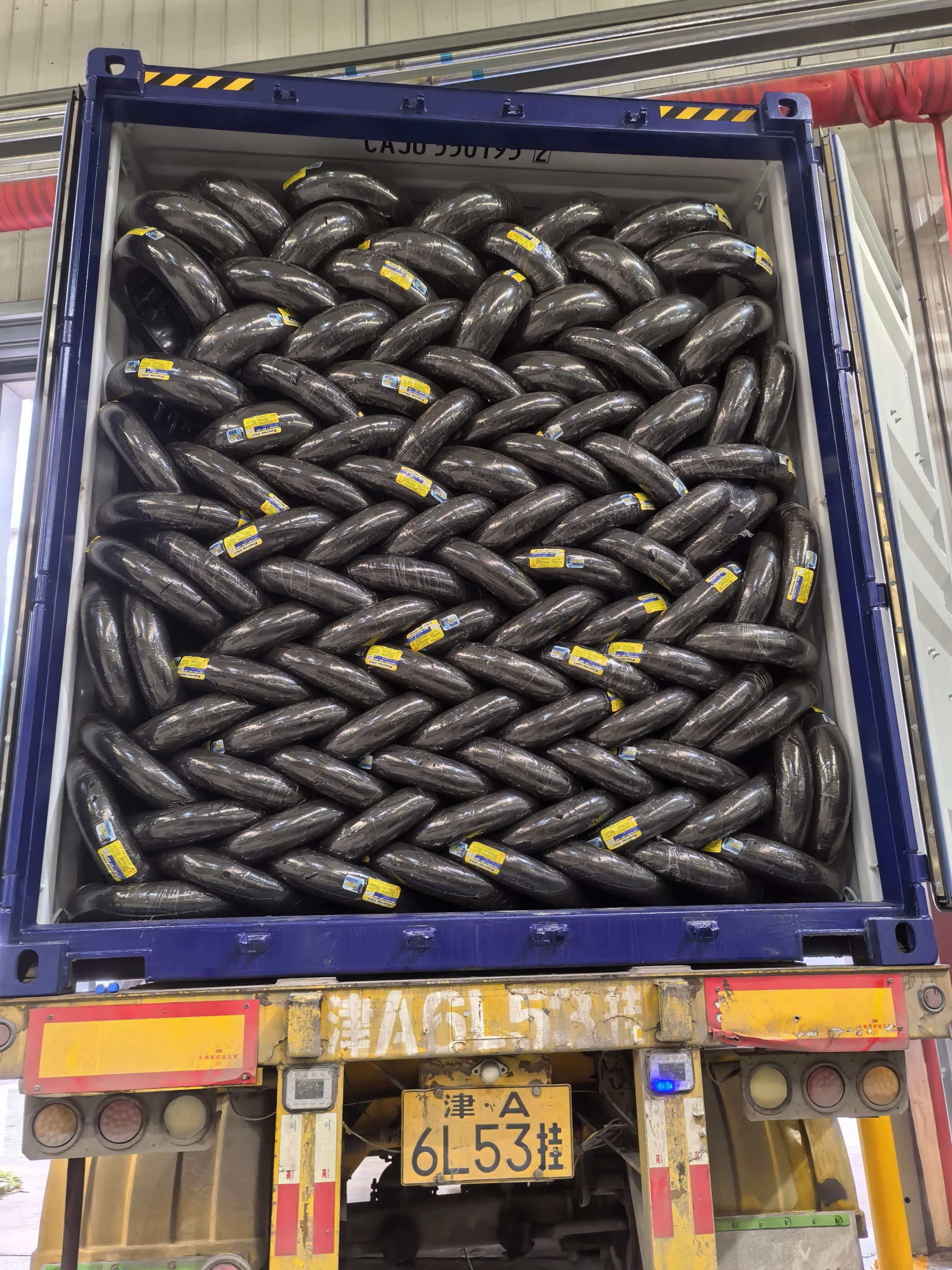
If you are looking to import motorcycle tires from China, you are not alone. Distributors, retailers, and racing teams worldwide are turning to Chinese manufacturers for quality radial tires at competitive prices. With China now producing over 40% of the world’s tires and investing heavily in radial tire technology, the question is no longer whether to source from China — it’s how to do it right. This guide walks through every step of the import motorcycle tires from China process, from supplier evaluation to customs clearance.
China has transformed from a producer of budget bias-ply tires into a manufacturing hub for advanced radial motorcycle tires. Manufacturers like Kingtyre, based in Tianjin, now produce radial tires that meet European ECE R75 and US DOT standards while competing on quality with established brands. The advantages for buyers who import motorcycle tires from China include competitive pricing, growing radial tire expertise, flexible MOQ options, and expanding certification coverage for export markets. For procurement managers evaluating tire suppliers, China offers a cost-effective entry point without compromising on compliance.
Before contacting suppliers, you need to know which certifications your target market requires. This determines which manufacturers you can work with.
All motorcycle tires sold in the European Union must carry ECE R75 type approval. This certification covers tire dimensions, high-speed durability, load performance, and tread wear indicators. The E-mark (e.g., E1 for Germany, E9 for Spain, E11 for UK) must be permanently molded into the tire sidewall. When evaluating a potential supplier to import motorcycle tires from China, request their ECE certificate and verify the approval covers the specific tire sizes you intend to import. Learn more about ECE-certified radial racing tires from Kingtyre.
The US market requires DOT (Department of Transportation) compliance, which includes a Tire Identification Number (TIN) molded on the sidewall. DOT focuses on dimensional standards, strength testing, and endurance requirements. Many Chinese manufacturers, including Kingtyre, hold both ECE and DOT certification, allowing them to serve multiple markets from a single production line.
If you plan to resell tires within China, CCC (China Compulsory Certification) is mandatory. Other regions may require additional compliance — for example, INMETRO for Brazil or SONCAP for Nigeria. Always confirm destination-market requirements before you commit to a supplier.
Not all Chinese tire manufacturers are equal. The key distinction lies in tire construction technology.
Radial tires use steel belt layers perpendicular to the tread, offering better heat dissipation, longer tread life, and superior high-speed stability. Bias-ply tires use crisscross layers and are cheaper but less suitable for high-performance applications. Most Chinese manufacturers produce bias-ply tires. Only a handful specialize in radial motorcycle tires. Kingtyre is one of the few Chinese manufacturers that has focused exclusively on radial construction since its founding in 2015, making it a relevant partner for buyers seeking radial-specific expertise. See Kingtyre’s full range of radial motorcycle tires on the product list page.
When reviewing potential sources to import motorcycle tires from China, consider: ISO 9001 quality management certification, specific ECE R75 or DOT approval for your target market, radial tire production capability (not just bias-ply), annual production capacity (300,000+ tires indicates established operations), export experience to your region, and willingness to provide samples and third-party test reports. A manufacturer that participates in international motorsport — such as Kingtyre at the 24 Heures Motos at Le Mans — demonstrates a commitment to quality that goes beyond minimum certification requirements.
Contact shortlisted suppliers with detailed specifications: tire sizes, load indexes, speed ratings, tread patterns, tubed or tubeless, and required certifications. Request a formal quotation including FOB (Free on Board) pricing. Most Chinese manufacturers export through Qingdao, Tianjin, or Shanghai ports. Kingtyre exports through Tianjin Port, one of the largest and most efficient ports in northern China.
Always order samples before committing to a bulk order. Expect to pay sample costs (typically $30–$80 per tire, refundable on bulk orders) and shipping via courier (7–10 days). Evaluate tread depth consistency, rubber compound hardness, bead seating ease, sidewall marking accuracy, and overall build quality. If possible, have the samples tested by an independent laboratory.
Minimum Order Quantities vary by manufacturer. Typical MOQ ranges when you import motorcycle tires from China are 100–300 pieces per SKU for standard wholesale, with mixed containers (combining multiple sizes) often accepted at 500+ units total. Full container loads (20GP: ~1,200 tires; 40HQ: ~2,400 tires) offer the best per-unit economics. Pricing for radial motorcycle tires typically ranges from $8–$32 per unit FOB, depending on size, construction, and compound complexity.
Standard terms for first orders are 30% deposit with the order and 70% against copy of Bill of Lading. Letters of Credit are accepted for orders over $50,000. Alibaba Trade Assurance provides additional protection for platform-sourced transactions. Once a relationship is established, more favorable terms can be negotiated.
Sea freight is the most economical method for bulk tire imports. A 40HQ container from Tianjin or Qingdao to major destinations typically takes 18–25 days to Europe, 15–20 days to the US West Coast, and 10–15 days to Southeast Asia. Key documents include Bill of Lading, Commercial Invoice, Packing List, Certificate of Origin, and ECE/DOT Certification copies.
Import duties vary by country. The EU applies a 4–8% duty on motorcycle tires imported from China, plus VAT at the destination country’s rate. The US applies a 4% duty under HTS code 4011.40. Some countries have anti-dumping duties on certain tire categories — always check with your customs broker before shipping.
Third-party inspections (SGS, Bureau Veritas, Intertek) before shipment are highly recommended for first-time orders. A pre-shipment inspection typically costs $300–$500 and can prevent costly rejects at your destination.
The most successful importers treat their Chinese suppliers as partners rather than transactional vendors. Strategies that work include visiting the factory in person (Tianjin’s manufacturing hub is well-connected by high-speed rail from Beijing), placing consistent orders to maintain production priority, providing clear feedback on quality and market performance, and collaborating on product development. Kingtyre offers OEM and private labeling services for distributors who want to build their own brand presence.
New importers often make the same mistakes. Watch for: assuming certification without checking specific approval numbers; skipping samples to save time (one of the costliest mistakes); ordering too many sizes in the first container (stick to 3–5 best-selling sizes); neglecting to verify the Certificate of Origin for duty preferences; underestimating shipping timelines and buffer stock requirements; and failing to account for destination compliance labeling. These are all avoidable if you follow a structured approach to import motorcycle tires from China.
Importing motorcycle tires from China is a proven path to competitive pricing and quality radial tires — if you follow the right process. The key steps are: verify certifications (ECE/DOT for your market), choose a manufacturer with the right expertise (radial-specific if you need performance tires), evaluate samples before committing, negotiate MOQ and payment terms aligned with your cash flow, use third-party inspection for quality assurance, and build a long-term relationship with your supplier.
All motorcycle tires sold in the European Union must carry ECE R75 type approval. It covers tire dimensions, high-speed durability, load performance and tread wear indicators, and the E-mark number (E1 for Germany, E9 for Spain, E11 for the UK) has to be molded into the sidewall and matched to the approval certificate for every size you order.
The United States requires DOT compliance under FMVSS 119, which covers dimensional standards, strength testing and endurance requirements. The proof is the Tire Identification Number molded on the sidewall, so you can verify the specific tire in front of you rather than trusting a generic supplier certificate for the whole product line.
Standard wholesale MOQ usually runs 100 to 300 pieces per SKU, and mixed containers that combine several sizes are often accepted at 500 units or more in total. If your program needs a narrow size mix rather than a full container, ask about per-size minimums early, because private-label sidewall printing can add its own minimum on top of the container quantity.
The standard structure for a first order is 30% deposit with the order and 70% against a copy of the bill of lading. Letters of credit are accepted for orders above $50,000. Once a trading relationship is established the terms normally improve, and platform trade assurance can add a further layer of protection on platform-sourced transactions.
Always order samples before committing to a bulk order. Expect to pay roughly $30 to $80 per tire, refundable once you place the bulk order, with courier shipping taking 7 to 10 days. Evaluate tread depth consistency, rubber compound hardness, bead seating ease and the sidewall markings before you approve production.
A 40HQ container out of Tianjin or Qingdao typically takes 18 to 25 days to Europe, 15 to 20 days to the US West Coast and 10 to 15 days to Southeast Asia. The core documents are the bill of lading, commercial invoice, packing list and certificate of origin, plus any destination-specific certificates your market requires.
The European Union applies a duty of roughly 4 to 8% on motorcycle tires imported from China, on top of VAT at the destination country's rate. The United States applies a 4% duty under HTS code 4011.40. Some countries add anti-dumping duties on particular tire categories, so confirm the landed position with your own broker before you commit the order.
For a first-time order it is strongly recommended. An inspector from SGS, Bureau Veritas or Intertek typically charges $300 to $500, and that fee is far cheaper than a rejected container sitting at your destination port. The inspection report should cover tire dimensions, bead fit, sidewall marking accuracy and packaging.
Three mistakes repeat constantly. First, assuming a supplier is certified without checking the specific approval numbers for the sizes you are buying. Second, skipping samples to save time, which is the most expensive shortcut on the list. Third, ordering too many sizes in the first container instead of sticking to the 3 to 5 best-selling sizes for your market.
Construction is the dividing line. Radial tires use steel belt layers perpendicular to the tread, which gives better heat dissipation, longer tread life and stronger high-speed stability; bias-ply tires use crisscrossed layers and cost less but are not suited to high-performance use. For a distributor building a long-term range, confirm radial production capacity, ISO 9001 certification and verifiable ECE R75 or DOT approvals for your market before shortlisting a supplier.
For buyers who value radial tire expertise and proven quality, Kingtyre offers ECE-certified, race-proven motorcycle tires with the flexibility to support distributors of all sizes. Browse the complete product range to see available sizes and specifications, or skontaktuj się z działem sprzedaży for wholesale pricing. For official race data, visit the FIM Endurance World Championship website.
 Polish
 English
 Spanish
 French
 German
 Korean
 Japanese
 Italian
 Russian
 Dutch
 Danish
 Portuguese
 Turkish
 Czech
how many motorcycle tires fit in a 40ft container — Shipping Guide & Loading Tips says:
[…] If you are planning to import motorcycle tires from China, one of the first practical questions you will ask is: how many motorcycle tires fit in a 40ft container? The answer directly affects your shipping costs, inventory planning, and overall procurement budget. For standard motorcycle tire sizes, a 40ft container holds approximately 1,700 to 1,800 tires, depending on tire dimensions, packaging, and loading configuration. This guide breaks down the calculation, the variables that affect capacity, and how to optimize your container load. For comparison, see our guide on how to import motorcycle tires from China. […]
Najlepiej sprzedające się rozmiary opon w Azji Południowo-Wschodniej | Kingtyre says:
[…] comparison, read our guide on how to import motorcycle tires from China for a complete overview of the shipping and documentation […]