
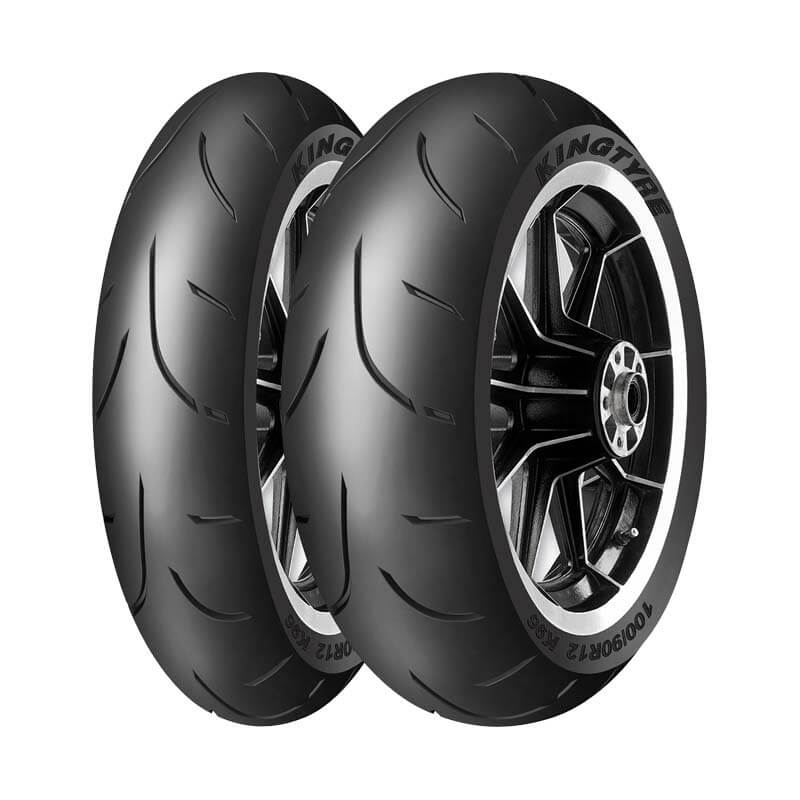
Mini GP racing has exploded in popularity over the last decade. From the FIM MiniGP World Series to club-level Ohvale championships, small-discipline motorcycle racing on 12-inch wheels has become the proving ground for the next generation of racing talent — and the tire technology beneath these bikes has evolved dramatically alongside the sport. The Kingtyre K96 is a dedicated mini gp tire engineered specifically for 12-inch racing applications, bringing professional-grade compound technology and construction to the growing mini racing ecosystem.
In this comprehensive guide, we examine the engineering, the performance data, and the competitive landscape of the Kingtyre K96 — a tire designed for riders who take their small-bike racing seriously.
Before analyzing the K96 itself, it’s important to understand what makes 12-inch racing tires fundamentally different from their full-size counterparts. A mini GP bike like an Ohvale GP-2 190 weighs approximately 75 to 85 kg (165 to 187 lbs) with a rider weight of roughly 60 to 80 kg (132 to 176 lbs). The total mass — approximately 135 to 165 kg (298 to 364 lbs) — is less than half that of a typical 600cc supersport bike. The contact patch of a 12-inch tire is also significantly smaller: approximately 55 to 70 square centimeters (8.5 to 10.9 square inches) versus 120 to 160 square centimeters (18.6 to 24.8 square inches) for a 17-inch sport tire.
This changes everything about how the tire must be engineered:
The Kingtyre K96 addresses all of these challenges through its compound formulation, tread design, and construction choices. If you are looking for 12 inch racing tires motorcycle riders can trust for consistent performance, the K96 is engineered from the ground up for exactly this application.
The K96 is a semi-slick racing tire available in two sizes specifically chosen to cover the most popular Mini GP and mini moto fitments:
| Position | Rozmiar | Rim Width Range | Zastosowanie |
|---|---|---|---|
| Przód | 100/90R12 | 2.75 to 3.00 inches | Ohvale GP-2, Kayo Mini GP, Honda Grom race build |
| Tył | 120/80R12 | 3.00 to 3.50 inches | Ohvale GP-2, Kayo Mini GP, Honda Grom race build |
The 100/90R12 front offers a tire diameter of approximately 439 mm (17.3 inches), while the 120/80R12 rear has a diameter of approximately 451 mm (17.8 inches). The slightly larger rear diameter is intentional — it provides approximately 2.7 percent more gearing at the rear wheel compared to the front, contributing to stability under acceleration out of corners.
The K96 uses a semi-slick tread pattern — meaning it has a predominantly smooth center section for maximum dry grip, with minimal grooving for water dispersal and regulatory compliance. Here are the key design parameters:
This semi-slick design makes the K96 an excellent choice for riders who need a tire that performs in both dry and damp conditions. For those seeking best mini gp tires for track day use that can handle the occasional damp session without requiring a full rain tire change, the K96’s tread pattern delivers exactly this flexibility.
The K96’s compound is formulated specifically for the unique demands of sub-200kg mini GP bikes. Here are the technical specifications:
Like all Kingtyre racing tires, the K96 uses a silica-reinforced compound. The silica content is estimated at 75 to 85 percent of the tread formulation, providing:
The K96 uses what Kingtyre classifies as a medium-soft compound — not as aggressive as a qualifying slick, but significantly softer than a standard sport tire. Key metrics:
While controlled instrumented testing of the K96 is ongoing, early rider feedback and data from mini GP test sessions reveal the following performance characteristics:
On an Ohvale GP-2 190 (approximately 82 kg wet weight, 18 hp), riders report that the K96 reaches 85 to 90 percent of peak grip within 1.5 to 2.5 laps at moderate pace on a typical 800 to 1,200 meter (0.5 to 0.75 mile) mini GP circuit. This is competitive with the Pirelli Diablo Superbike SC1 slick used in the FIM MiniGP World Series, which typically requires 2 to 3 laps to reach similar grip levels under identical conditions.
On a 55-second mini GP lap, riders transitioning from a standard 12-inch sport tire (such as a Michelin City Grip or Pirelli Angel) to the K96 report lap time improvements of 1.5 to 3.0 seconds — representing a 2.7 to 5.5 percent improvement. On a 25-lap race distance, that translates to a total advantage of 37.5 to 75 seconds — multiple straightaways of gap.
Data from GPS-equipped mini GP bikes shows that the K96 allows riders to carry approximately 3 to 6 km/h (1.9 to 3.7 mph) more corner speed through medium-radius turns (typically 40 to 60 km/h corners) compared to entry-level sport tires. This represents a 5 to 10 percent increase in corner speed, directly enabled by the K96’s shoulder compound grip.
Mini GP bikes are typically braked from approximately 100 to 110 km/h (62 to 68 mph) down to 35 to 45 km/h (22 to 28 mph) for the tightest corners. The K96 front tire provides consistent braking grip under these conditions, with riders reporting progressive, predictable feedback at the lever — no sudden tuck-under or front-end push that can characterize less capable 12-inch tires under hard braking.
The K96’s 100/90R12 front and 120/80R12 rear sizing covers a wide range of mini GP and mini moto machines. Here are the most common compatible platforms:
| Make | Model | Engine Size | Wheel Size |
|---|---|---|---|
| Ohvale | GP-2 160 / 190 | 160cc / 190cc | 12-inch front + rear |
| Kayo | Mini GP 160 / 190 | 160cc / 190cc | 12-inch front + rear |
| Honda | Grom (MSX125) Race Build | 125cc–170cc | 12-inch front + rear |
| Kawasaki | Z125 Pro Race Build | 125cc | 12-inch front + rear |
| Yamaha | YZ125 Mini GP Conversion | 125cc | 12-inch front + rear |
The 100/90R12 front fits Ohvale and Kayo front rims (typically 2.75 to 3.00 inches wide), while the 120/80R12 rear fits the standard 3.00 to 3.50 inch rear rims found on these machines. The tire profile is designed to complement the geometry of purpose-built mini GP chassis, providing the correct contact patch shape at the 45 to 50 degrees of lean that these bikes routinely achieve.
For Honda Grom and Kawasaki Z125 Pro owners who have converted their bikes for track use, the K96 offers a significant upgrade over the stock tires. The stock IRC or Vee Rubber tires on these bikes are designed primarily for street commuting, with harder compounds (Shore A 65 to 72) that provide 5,000 to 10,000 km of tread life but limited track grip. The K96’s softer compound provides immediately noticeable improvements in corner entry confidence and mid-corner stability.
If you are racing or tracking an Ohvale and need Ohvale tires 12 inch fitments that match the factory geometry requirements, the K96’s 100/90R12 front and 120/80R12 rear are dimensionally compatible with the Ohvale GP-2 specifications.
Correct tire pressure is critical for 12-inch racing tires because the smaller air volume means pressure changes have a proportionally larger effect on contact patch shape. Here are the recommended cold pressures for the K96:
| Condition | Front (Cold) | Rear (Cold) |
|---|---|---|
| Track (dry, warm ambient 20–30°C) | 26–28 psi (1.79–1.93 bar) | 24–26 psi (1.65–1.79 bar) |
| Track (dry, cool ambient 10–20°C) | 27–29 psi (1.86–2.00 bar) | 25–27 psi (1.72–1.86 bar) |
| Damp / Light Rain Track | 28–30 psi (1.93–2.07 bar) | 26–28 psi (1.79–1.93 bar) |
| Street Riding | 30–32 psi (2.07–2.21 bar) | 28–30 psi (1.93–2.07 bar) |
Because the K96’s air volume is small — approximately 3.5 to 4.5 liters of air per tire, compared to 8 to 12 liters in a 17-inch sport tire — a pressure change of just 1 psi (0.07 bar) produces a measurable change in contact patch size and tire deflection. Always check pressures cold (tires at ambient temperature) and adjust in 1 psi increments rather than the 2 psi increments common with full-size tires. Over-pressurizing by 4 to 5 psi can reduce the contact patch by 10 to 15 percent, significantly reducing grip and increasing the risk of unexpected front-end washout.
While the K96 reaches operating temperature relatively quickly (within 2 to 3 laps), tire warmers are recommended for race use to ensure consistent grip from the first corner. Recommended warmer settings:
Without warmers, a progressive warm-up strategy is essential: one lap at approximately 60 to 70 percent pace, followed by a second lap at 75 to 85 percent pace, before pushing to race pace on the third lap. Pushing at maximum pace from cold on the K96 can induce 5 to 10 seconds of lap time loss before the tire reaches operating temperature — and significantly increases crash risk.
| Specyfikacja | Kingtyre K96 | Pirelli Diablo Superbike SC1 | Dunlop TT93 GP |
|---|---|---|---|
| Typ | Semi-slick | Full slick | Semi-slick |
| Available 12″ Sizes | 2 (100/90 + 120/80) | 2 (100/80 + 120/80) | 3+ |
| Silica Content | 75–85% | Proprietary | Proprietary |
| Operating Temp | 40–70°C | 50–85°C | 45–75°C |
| Warm-Up Time (laps) | 1.5–2.5 | 2–3 | 2–3 |
| Road Legal | Yes (semi-slick) | No (NHS) | Yes (DOT) |
| Pair Price (approx.) | £80–£120 | £150–£200 | £120–£160 |
The K96 occupies a unique position in the market. It is significantly more affordable than the Pirelli Diablo Superbike SC1 (approximately 40 to 50 percent less per set) while offering semi-slick road legality that the Pirelli NHS slick cannot match. Compared to the Dunlop TT93 GP, the K96 offers a 20 to 30 percent cost saving for comparable performance in the mini GP application.
For riders wanting an honest Kingtyre K96 mini gp review based on real-world data, the bottom line is this: the K96 delivers approximately 85 to 90 percent of the peak grip of a Pirelli Diablo Superbike SC1 slick at roughly half the price, with the added benefit of road legality and light wet-weather capability.
For cost-conscious racers and track day riders, the K96’s value proposition is compelling:
For a rider competing in a 10-round mini GP championship with approximately 50 to 80 km of track time per race weekend (practice + qualifying + 2 races), the K96 can deliver 8 to 15 race weekends per set — potentially an entire season on a single set of tires. At approximately £80 to £120 per set, the annual tire cost for a K96-equipped rider is roughly £80 to £240, compared to £300 to £800 for Pirelli or Dunlop equivalents.
This makes the K96 one of the most affordable mini moto racing tires on the market, particularly for club-level racers and track day enthusiasts who want professional-grade performance without the professional-grade price tag.
The Kingtyre K96 Mini GP Racing Tire is a purpose-built 12-inch semi-slick designed for the specific demands of mini-displacement racing. Here is a summary of the key data:
Whether you are racing in a club-level mini GP championship, building a Grom for track day use, or coaching your child on an Ohvale, the K96 delivers the grip, consistency, and value that the mini racing community demands. It is a genuine mini gp tire engineered for riders who take small-bike racing seriously — available at a price that makes sense.
Available now in both 100/90R12 and 120/80R12 sizes.
About Kingtyre: Kingtyre is a Chinese tire manufacturer founded in 2014, specializing in high-performance motorcycle tires for racing, track day, and road use. The K96 Mini GP Racing Tire is part of Kingtyre’s comprehensive motorsport product range, which includes the K00 Racing Slick, K01 Racing Rain Tire, K06 Supersport, and K97 Super Motard tire lines. All Kingtyre racing tires undergo rigorous testing in FIM Endurance World Championship competition.
 Polish
  English
  Spanish
  French
  German
  Korean
  Japanese
  Italian
  Russian
  Dutch
Dutch  Danish
  Portuguese
  Turkish
  Czech
Czech