
Short answer: A racing slick is a treadless motorcycle tire built exclusively for closed-circuit use, where the absence of grooves maximizes the rubber contact patch and therefore dry grip. The KingTyre K00 is a radial-construction racing slick engineered specifically for endurance racing — designed to deliver competitive lap times across a 24-hour stint while holding casing integrity, compound temperature, and predictable wear behavior. Five consecutive Le Mans 24H campaigns (2022–2026) and over 1TB of telemetry data back every spec on the data sheet.
Quick orientation for B2B buyers: Skip to the compound table, o endurance field data section, or the B2B sizing matrix below.
A motorcycle racing slick is a tire with no tread pattern across the contact patch — a continuous band of vulcanized rubber, usually silica- and carbon-black-rich compound, bonded to a radial or bias-ply casing. The absence of grooves means the entire footprint is in contact with the track at any given moment. On a warm, dry circuit, that is pure mechanical advantage: more rubber, more grip, more cornering force.
There is a strict regulatory boundary around this advantage. Slicks are not street legal in any major motorcycle market. ECE R75 (Europe, UK, most of Asia and Latin America), FMVSS 119 / DOT (United States and Canada), Japan’s JIS framework, Australia’s ADR, and Brazil’s INMETRO regime all require a tread pattern across the contact patch. A tire with zero grooves fails type approval, fails safety inspection, and voids insurance on public roads. For the full country-by-country breakdown, see Article 1: Are Slick Motorcycle Tires Street Legal?.
The same lack of grooves that makes slicks illegal on the road is exactly what makes them valuable on track:
For B2B buyers — racing tire distributors, importers supplying series organizers, club racing federations — the slick is a specialized SKU, not a general-purpose tire. It belongs in a catalog next to ECE R75 street tires, semi-slicks (K06), and rain tires (K01), but it should never be sold or marketed as a road product.
The K00 is KingTyre’s radial-construction racing slick, first released for track use in 2019 and continuously refined through the Kingtyre Fullgas Racing Team’s endurance program. Where most Chinese motorcycle tire manufacturers focus on commuter and mid-tier sport products, the K00 is a deliberate bet on the highest-margin, highest-prestige segment of the racing tire market: endurance racing, where tires must survive 16+ pit stops over 24 hours without a single casing failure.
The design brief was specific:
This brief is unusual. Most racing slicks on the market are designed for sprint races — 8 to 20 minutes per stint, one or two compounds per series, single-event performance optimization. The endurance brief forces the K00 to balance compound longevity against outright grip, casing integrity against sidewall compliance, and rider feel against telemetry repeatability. That balance is what the Kingtyre Fullgas Racing Team has been testing in public at Le Mans for five consecutive years.
The motorcycle tire industry still ships most race tires in bias-ply construction. Bias-ply casings — layers of cord laid diagonally across the bead — are well understood, easy to manufacture, and forgiving on cold starts.
Radial construction, in which the carcass cords run perpendicular to the direction of travel with a separate belt package wrapping the crown, behaves differently:
For endurance racing, the radial trade-off favors KingTyre’s positioning. The lower rolling resistance and stable contact patch give the tire more usable life per stint. The heat-distribution benefit delays the catastrophic grip loss that bias-ply endurance tires tend to suffer in the final two hours of a 24-hour race.
The catch is that radial racing tires are more demanding on the rider. They need to be in their working temperature window (80–120°C on the tread surface for the K00) before the rider commits to race pace, and they need to be kept there. That’s why the K00 ships with a specific warming protocol and is sold alongside consistent, batch-traceable warmers in team kits.
The K00 uses a four-compound tread system, with each compound tuned to a defined operating temperature window. The compound is identified by a code prefix on the tire sidewall and product code:
| Prefix | Composto | Working temperature window | Typical use case |
|---|---|---|---|
| GH | Super Soft | 60–95°C | Cool ambient, short sprint qualifying, low-grip surfaces |
| G | Suave | 75–110°C | Standard sprint race, mild ambient, abrasive tracks |
| GR | Médio | 85–115°C | Endurance stint, mid-ambient, smooth tracks |
| GC | Difícil | 100–125°C | Hot ambient, abrasive tracks, long stints |
The compounds share the same casing profile and the same sidewall markings — only the tread rubber changes. That consistency is the key engineering choice. A racing team can run Super Soft in qualifying and Medium in the race on the same wheel set, without changing chassis setup, and the rider’s reference points (lean angle, throttle pickup, brake pressure threshold) stay within a predictable envelope.
For B2B buyers, the four-compound system has a commercial consequence: it lets a distributor stock one carcass and four SKU variants, instead of four full product lines. That simplifies inventory, reduces MOQ pressure, and lets racing teams order the right compound for a given weekend without committing to a second tire program.
In sprint racing, a tire’s compound thermal history is short and predictable: warm-up, race, cool-down. In endurance racing, the same tire may see multiple heat cycles, ambient swings from 8°C at dawn to 32°C at midday, damp patches in sector two, and a dry line in sector three. The K00’s compound system is engineered to absorb that cycling without losing the lap-time-versus-stint-age curve that teams plan around.
Telemetry from the 2024 Le Mans 24H, captured across more than 850 laps on K00 and K01 tires, shows three measurable behaviors:
The same data is fed back into KingTyre’s street, sport-touring, and adventure product lines. The K06 semi-slick, the K905 sport-touring tire, and the K66 / K67 adventure tires all use compound and casing know-how developed on the K00 race program.
The K00’s casing is a radial-ply architecture with a steel-belt package across the crown. Three construction choices define how the tire performs:
The carcass cords run perpendicular to the direction of travel, anchored at the bead. Under cornering load, the carcass deflects sideways rather than buckling, which keeps the contact patch flat and stable across the lean-angle range. KingTyre’s testing has validated the K00 to lean angles above 50° without casing distortion — a threshold that matches or exceeds most bias-ply endurance race tires.
Across the crown, a separate belt package — typically two layers of steel cord laid at opposing angles — locks the tread to the carcass. The steel belt does three jobs at once:
The bead area is reinforced to handle repeated mount/dismount cycles in the pit lane and to maintain bead-seat pressure under hard braking. The lower sidewall is tuned for compliance (so the tire settles into corners), while the upper sidewall is stiffer (so feedback to the rider stays sharp). This split personality is one of the harder things to get right in a radial racing tire — most radials lean either too soft or too stiff across the full sidewall.
The K00 is sold with a defined warming and pressure protocol, validated across five Le Mans campaigns. The protocol exists because the tire’s compound and casing are tuned to a specific thermal window — outside that window, neither grip nor wear behavior is predictable.
Recommended pressures vary by size and fitment. The table below covers the most common 17-inch K00 sizes used in endurance racing:
| Tamanho | Fitment | Cold pressure | Hot pressure |
|---|---|---|---|
| 120/70 R17 | Frente | 2.1 bar (30 PSI) | 2.3 bar (33 PSI) |
| 125/70 R17 | Frente | 2.1 bar (30 PSI) | 2.3 bar (33 PSI) |
| 125/80 R17 | Frente | 2.0 bar (29 PSI) | 2.3 bar (33 PSI) |
| 115/75 R17 | Traseira | 1.5 bar (22 PSI) | 1.8 bar (26 PSI) |
| 160/60 R17 | Traseira | 1.4 bar (20 PSI) | 1.6 bar (23 PSI) |
| 180/60 R17 | Traseira | 1.4 bar (20 PSI) | 1.6 bar (23 PSI) |
| 190/60 R17 | Traseira | 1.4 bar (20 PSI) | 1.6 bar (23 PSI) |
| 200/60 R17 | Traseira | 1.4 bar (20 PSI) | 1.6 bar (23 PSI) |
Cold pressure is the pressure at ambient track temperature, before warmers. Hot pressure is the pressure measured in pit lane after 2–3 laps at race pace. The tire warming guide recommends 80–90°C for 60 minutes before the bike leaves pit lane.
Important: Optimal hot pressures on track may vary depending on rider style, rider weight, track surface and temperature, and suspension setup. We recommend checking hot pressures in pit lane directly after a few laps and making small adjustments if necessary.
A new K00 typically needs 3 to 8 heat cycles before it reaches peak grip. A heat cycle is one full warm-up to working temperature and cool-down to ambient. Teams running endurance programs often dedicate the first stint of a race weekend to cycling fresh tires through this break-in process before pushing for qualifying lap times.
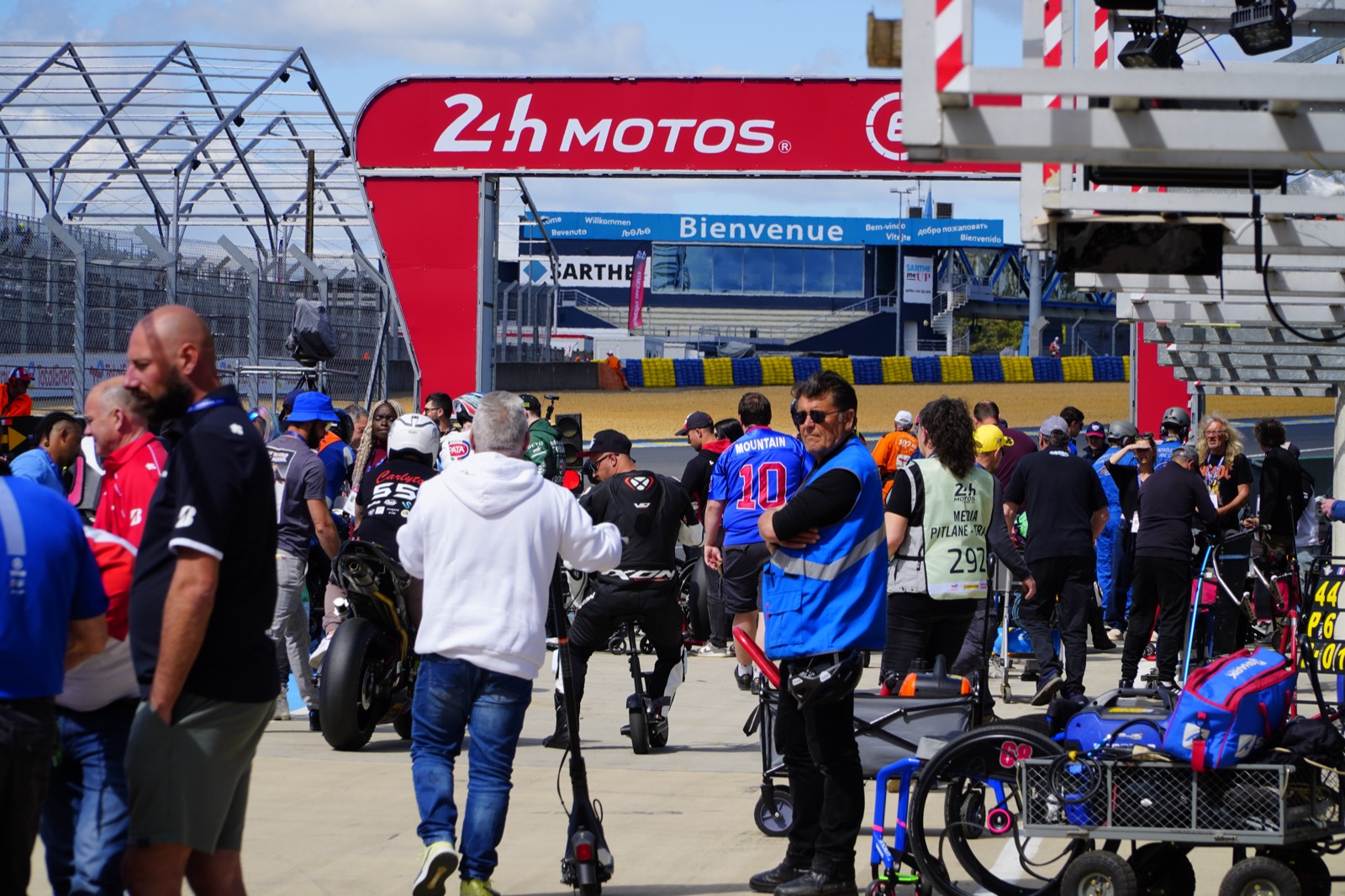
The K00’s data sheet is one thing. The K00’s performance at the 24 Heures Motos — the opening round of the FIM Endurance World Championship, held at Le Mans — is another. Below is a summary of the field data the Kingtyre Fullgas Racing Team has captured across five consecutive campaigns (2022–2026).
| Year | Result | Laps completed | Tires used | Notable data |
|---|---|---|---|---|
| 2022 | First Chinese tire manufacturer at Le Mans | — | K00 + K01 debut | Compound window validated |
| 2023 | Second-year refinement | — | Updated GR/GC compound | Casing endurance validated |
| 2024 | Fourth-year milestone | 850+ laps | K00 + K01 in mixed conditions | 1TB cumulative telemetry across four years |
| 2025 | Continued iteration | — | Sidewall and shoulder updates | Puncture-repair count reduced |
| 2026 | Fifth consecutive year | 742 laps on #116 bike | K00 + K01 across wet and dry stints | 16 pit stops total |
The headline number for B2B buyers is consistency, not peak lap time. Across the five-year program, the K00 has been run in:
In every condition, the casing has held. No race-ending failures. No surprise delamination. No shoulder separations. That is the standard the Kingtyre Fullgas Racing Team holds itself to, and it is the standard any serious endurance racing team should expect from a supplier.
Across the 2024 Le Mans stint data, three telemetry findings are worth highlighting:
This data is the same dataset that informs the K06 semi-slick and the K905 sport-touring tire compound selection. Endurance racing is the fastest iteration loop KingTyre has, and the technology transfer to consumer products is one of the reasons a Chinese tire manufacturer can credibly serve the racing tire market at all.
The K00 is a purpose-built endurance racing slick. It is the right tool for:
The K00 is not the right tool for:
The K00 is available in a wide range of 17-inch sizes for Superstock, Supersport, Superbike, and endurance classes. Below is the current production matrix:
| Tamanho | Code (GH / G / GR / GC) | Weight (kg) | Recommended rim |
|---|---|---|---|
| 95/75 R17 | G1759 / GR759 / GC759 | 3.53 | MT2.50–MT3.00 |
| 110/70 R17 | G1744 / GR744 / GC744 | 4.25 | MT3.00–MT3.50 |
| 115/75 R17 | G1755 / GR755 / GC755 | 4.25 | MT3.00–MT3.50 |
| 120/70 R17 (front) | GH743 / G1743 / GR743 / GC743 | 4.98 | MT3.50 |
| 120/70 R17 (rear) | G1760 / GR760 / GC760 | 4.80 | MT3.50 |
| 125/70 R17 | G1713 / GR713 / GC713 | 5.01 | MT3.50 |
| 140/70 R17 | GH745 / G1745 / GR745 / GC745 | 5.55 | MT3.75 |
| 160/60 R17 | GH732 / G1732 / GR732 / GC732 | 6.16 | MT4.50 |
| 180/60 R17 | GH714 / G1714 / GR714 / GC714 | 6.81 | MT5.00 |
| 190/60 R17 | GH761 / G1761 / GR761 / GC761 | 7.06 | MT5.00 |
| 200/60 R17 | GH726 / G1726 / GR726 / GC726 | 8.00 | MT6.00 |
| 200/65 R17 | GH769 / G1769 / GR769 / GC769 | 8.12 | MT6.00 |
For B2B buyers: minimum order quantities, FOB pricing, container loading, and certification documentation (ECE R75, DOT, CCC, ISO 9001) are available on request. KingTyre’s 15,000 m² Tianjin plant produces 300,000+ motorcycle tires annually, with 150+ sizes across the full product line, and ships to 45+ countries.
For racing teams, distributors, and series organizers, the standard K00 order should include:
For volume orders (full container or recurring series supply), KingTyre offers batch reservation programs — a compound and size can be reserved against a season’s planned consumption, with staged deliveries aligned to the team’s race calendar. This is the same supply discipline the Kingtyre Fullgas Racing Team uses internally.
Is the K00 street legal?
No. The K00 is NHS-rated (Not for Highway Service) and has no tread pattern. It is intended for closed-circuit use only. For a street-legal alternative, see the KingTyre K06 semi-slick, which carries an ECE R75 approval and is designed for road-legal track-day riding.
What is the difference between K00 and K06?
The K00 is a full racing slick with no tread pattern, designed exclusively for closed-circuit use. The K06 is a semi-slick — it has minimal edge grooves that allow it to meet ECE R75 type approval, making it street legal in Europe, the UK, and most other markets that follow UNECE rules. On a warm dry track, the K06 delivers 90–95% of the K00’s grip, with the practical advantage of being able to ride the bike to and from the circuit.
Can I use the K00 in the wet?
The K00 is a dry-compound slick and should not be used in standing water or on a wet track. In wet conditions, the K01 rain tire is the correct choice. The K01 is engineered for high-speed water drainage, carries an ECE R75 approval, and has been validated across hundreds of laps in wet stints at the 24 Heures Motos.
How long does a K00 last in endurance racing?
A typical K00 set can complete 400–700 laps of endurance racing depending on compound, track, ambient conditions, and rider style. The 2024 Le Mans 24H saw over 850 laps completed across multiple tire sets, with most individual stints falling in the 30 to 90 lap range per set.
What is the difference between the four K00 compounds?
The compounds differ in working temperature window and wear rate. Super Soft (GH) works at 60–95°C and is fastest on cool tracks. Soft (G) works at 75–110°C and is the standard sprint compound. Medium (GR) works at 85–115°C and is the endurance workhorse. Hard (GC) works at 100–125°C and is built for hot ambient or abrasive tracks.
How does KingTyre validate the K00?
Through the Kingtyre Fullgas Racing Team’s endurance program at the 24 Heures Motos (Le Mans). Across five consecutive campaigns (2022–2026), the team has accumulated over 1TB of telemetry data covering temperature, wear, pressure, and lap-time behavior. This data feeds directly back into the K00’s compound and casing specifications, and informs KingTyre’s street, sport, and adventure tire development.
Can the K00 be supplied with a private label?
KingTyre supports OEM and private-label programs for racing tire distributors and series organizers. Minimum order quantities, branding options, and packaging specifications are available on request. Note: the K00 itself is a KingTyre-branded product for retail and track use; private-label programs apply to selected product lines under separate commercial terms.
Where is the K00 manufactured?
The K00 is manufactured at KingTyre’s 15,000 m² production facility in Tianjin, China. The facility is ISO 9001 certified, uses advanced hydraulic curing presses and a four-compound tread blending system, and supports barcode-driven inventory tracking for batch traceability. Every K00 shipment includes manufacturing batch records and applicable type-approval certificates.
The K00 is one of five KingTyre tire families covered in our September hub-and-spoke content series. To get the full picture:
For product specifications and ordering:
About KingTyre: KingTyre (Tianjin Kingtyre Group Co., Ltd.) is a professional motorcycle radial tire manufacturer headquartered in Tianjin, China. Founded in 2015, the company operates a 15,000 m² ISO 9001 certified production facility with 300,000+ tires of annual capacity, 150+ tire sizes, and exports to 45+ countries. Certifications include ISO 9001, DOT, ECE R75, and CCC. The Kingtyre Fullgas Racing Team has competed at the 24 Heures Motos at Le Mans since 2022, with a best lap time of 1:47.22, 16 pit stops in the 2026 race, and over 1TB of cumulative endurance telemetry. https://www.chinakingtyre.com/
 Portuguese
  English
  Spanish
  French
  German
  Korean
  Japanese
  Italian
  Russian
  Dutch
Dutch  Danish
  Polish
  Turkish
  Czech
Czech