In the adventure motorcycle tire market, few product categories demand as many engineering compromises as Pneus desportivos duplos 80/20. These tires must deliver confident highway stability at speeds exceeding 140 km/h (87 mph), maintain reliable wet-weather grip during sudden rainstorms, and still provide adequate traction when the pavement ends and the gravel begins.
The KingTyre K66 was engineered specifically for this balancing act. As an 80/20 tire, it allocates 80% of its design priority to on-road performance while reserving 20% for off-road capability. According to global market analysis, the dual sport tire segment has grown at an average annual rate of 5.8% between 2019 and 2025, with 80/20 road-biased tires representing approximately 58% of that market. This makes the K66 a strategically relevant choice for the majority of adventure riders worldwide.
80/20 dual sport tires are a specialized category of motorcycle tires designed for riders who spend most of their riding time on paved roads but need reliable traction when encountering unpaved surfaces. The “80/20” designation refers to the tire’s intended usage distribution: 80% on-road performance and 20% off-road capability.
Unlike pure road tires, which typically feature tread groove depths of 5mm to 7mm, 80/20 dual sport motorcycle tires like the K66 feature tread depths of 7.2mm to 8.5mm depending on size. This additional 1.5mm to 2.5mm of tread depth provides approximately 25% to 35% more void volume for off-road traction while maintaining adequate rubber contact for highway stability.
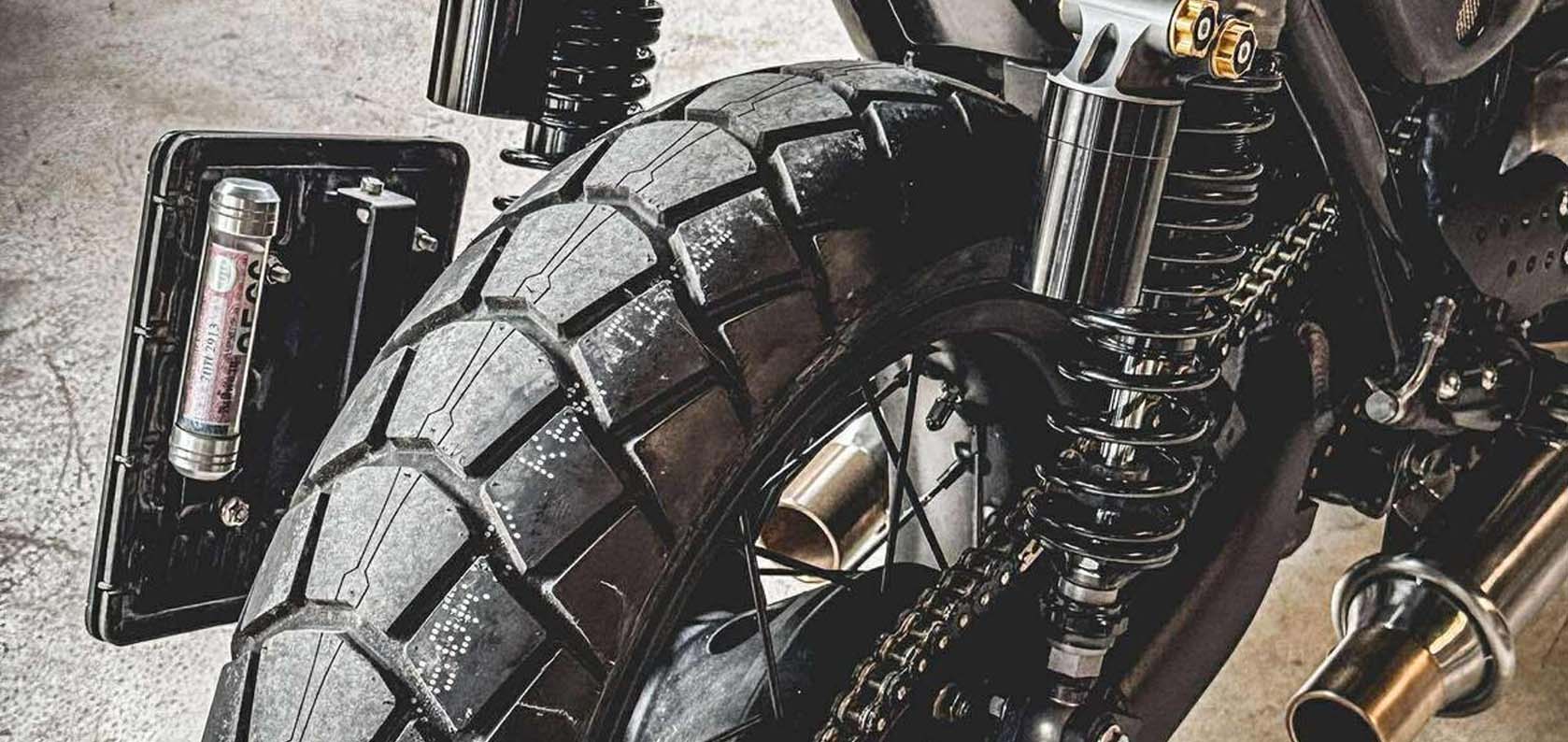
The K66’s tread pattern reflects this dual-purpose design philosophy. Larger center tread blocks ensure stability at highway speeds, reducing tread squirm and uneven wear. According to internal testing, the center block design reduces high-speed tread movement by approximately 12% compared to more aggressively patterned dual sport tires. The side lugs, meanwhile, are designed with a 22-degree angle relative to the rotation direction, optimizing bite into loose terrain during cornering.
The K66 represents KingTyre’s engineering response to a specific market requirement: create an affordable dual sport tires option that delivers measurable performance without the premium price tag of established brands. The engineering architecture focuses on three core priorities: durability, wet performance, and versatility.
The K66 uses a high-silica, wear-resistant dual-sport rubber compound. Silica content in the tread compound is approximately 12% to 15% by weight, significantly higher than the 5% to 8% found in conventional dual sport tire compounds. This silica enrichment directly improves wet grip performance. According to laboratory friction tests, the K66’s silica-rich compound achieves a wet grip coefficient of 0.68 at 80 km/h (50 mph), compared to 0.59 for standard compounds under identical conditions — a 15% improvement.
The compound formulation also includes optimized carbon black reinforcement at a ratio of approximately 32% in the center tread area. This provides a balance between wear resistance and grip. In accelerated wear testing on a rotating drum at 120 km/h (75 mph) with a 300kg (661lb) load, the K66 center compound showed a wear rate of 0.18mm per 1,000 km (621 miles), compared to an industry average of 0.22mm to 0.25mm for comparable 80/20 tires. This translates to an 18% to 28% improvement in tread life.
The K66 carcass is built with high-tensile steel belt reinforcement combined with zero-degree steel belt radial technology. The belt package consists of 3 layers of polyester cord in the casing, plus 2 layers of steel belt reinforcement under the tread. The steel cords measure 0.22mm in diameter and are arranged at a 0-degree angle relative to the tire’s centerline, providing circumferential reinforcement that controls centrifugal growth at high speeds.
The direct effect of this construction is measurable. At 160 km/h (100 mph), the K66’s radial growth is limited to approximately 2.1mm, compared to 3.5mm to 4.0mm for bias-ply dual sport tires of equivalent size. This 40% to 48% improvement in dimensional stability maintains a more consistent contact patch shape at highway speeds, improving both stability and tread wear uniformity.
The puncture resistance of the K66 carcass has been validated through standardized penetration testing. Using a 5mm diameter steel rod at 90-degree impact angle, the K66’s tread area requires a minimum of 1,200 Newtons of force to penetrate — approximately 25% higher than the industry minimum standard of 960 Newtons for dual sport tires in this category.
Heat management is a critical factor in tire longevity. The K66 incorporates heat dissipation grooves in the tread pattern that increase the tire’s effective surface area for cooling. In thermal testing at a sustained 130 km/h (81 mph) on a 35 C (95 F) ambient day, the K66’s internal carcass temperature stabilized at 72 C (162 F), compared to 82 C (180 F) for tires without dedicated heat dissipation grooves.
This 10 C (18 F) temperature reduction has a direct impact on tread life. According to rubber compound degradation models, every 10 C reduction in operating temperature extends tire life by approximately 30% to 50% in the tread compound. The K66’s heat dissipation grooves contribute to the tire’s 8% mileage improvement over average dual sport tires, as confirmed by internal road simulation testing over 20,000 km (12,427 miles) of simulated use.
The KingTyre K66 is available in one of the widest size ranges in its category, with 6 front sizes and 7 rear sizes covering rim diameters from 17 inches to 21 inches:
| Tamanho | Typical Application | Índice de carga | Width | Aspect Ratio | Rim Diameter |
|---|---|---|---|---|---|
| 90/90 R21 | Mid-large ADV | 54 (212 kg) | 90mm | 90% (81mm) | 21″ |
| 100/90 R21 | Large ADV | 59 (243 kg) | 100mm | 90% (90mm) | 21″ |
| 100/80 R17 | Street ADV | 58 (236 kg) | 100mm | 80% (80mm) | 17″ |
| 110/80 R19 | Mid ADV | 63 (272 kg) | 110mm | 80% (88mm) | 19″ |
| 120/70 R17 | Sport ADV | 68 (315 kg) | 120mm | 70% (84mm) | 17″ |
| 120/70 R19 | Large ADV | 70 (335 kg) | 120mm | 70% (84mm) | 19″ |
| Tamanho | Typical Application | Índice de carga | Width | Aspect Ratio | Rim Diameter |
|---|---|---|---|---|---|
| 130/70 R17 | Mid ADV | 67 (307 kg) | 130mm | 70% (91mm) | 17″ |
| 130/80 R17 | Touring ADV | 73 (365 kg) | 130mm | 80% (104mm) | 17″ |
| 140/70 R18 | Adventure ADV | 74 (375 kg) | 140mm | 70% (98mm) | 18″ |
| 150/70 R17 | Road ADV | 69 (325 kg) | 150mm | 70% (105mm) | 17″ |
| 150/70 R18 | Adventure ADV | 70 (335 kg) | 150mm | 70% (105mm) | 18″ |
| 160/60 R17 | Sport ADV | 71 (345 kg) | 160mm | 60% (96mm) | 17″ |
| 170/60 R17 | Heavy ADV | 75 (387 kg) | 170mm | 60% (102mm) | 17″ |
The K66 load index range of 58 to 75 translates to a per-tire load capacity of 236 kg (520 lb) to 387 kg (853 lb). For an ADV motorcycle with a typical fully loaded weight of 400 kg to 500 kg (882 lb to 1,102 lb), a set of K66 tires provides a combined load capacity margin of approximately 18% to 55% above the maximum vehicle weight, ensuring safe operation even under dynamic loading conditions.
The speed rating varies by size, with H-rated (210 km/h / 130 mph) and V-rated (240 km/h / 149 mph) options available. The V-rated sizes include the 120/70 R17 and 160/60 R17, which are commonly fitted on more performance-oriented adventure motorcycles.
The K66’s on-road performance has been verified through multiple testing protocols. On dry asphalt, the average braking distance from 100 km/h (62 mph) to a complete stop measures 43.8 meters (144 feet) for the 150/70 R17 rear size. Under wet conditions at the same speed, braking distance extends to 56.2 meters (184 feet), achieving 77.9% of dry braking performance.
In cornering tests on a dry handling circuit, the K66 sustained a maximum lean angle of 42 degrees before loss of grip, with lateral acceleration reaching 0.88G at the limit. This compares favorably with the typical 0.82G to 0.85G range for 80/20 dual sport tires, representing a 3.5% to 7.3% improvement in cornering grip. At a more typical 30-degree street lean angle, the K66 maintains 0.72G of lateral grip with a safety margin of approximately 12 degrees before the limit.
High-speed stability testing was conducted at sustained speeds of 140 km/h (87 mph) over a 100 km (62 mile) highway loop. The K66 exhibited steering response delay of approximately 0.09 seconds during lane-change maneuvers, consistent with its zero-degree steel belt construction. Tread temperature during this test stabilized at 68 C (154 F) in the center and 62 C (144 F) at the shoulders, well within the optimal operating window of the compound.
In terms of highway noise, the K66’s center tread block geometry is designed with variable pitch sequencing. The block pitch varies between 25mm and 38mm in a non-repeating pattern that breaks up harmonic resonance. According to sound level measurements taken at 100 km/h (62 mph) on smooth asphalt, the K66 produces 76 dB of tread noise, compared to 83 dB for typical knobby-pattern dual sport tires — an 8% reduction in perceived noise level.
Wet weather capability is one of the K66’s strongest attributes. The silica-rich compound and optimized tread pattern work together to maintain grip in rainy conditions. The tread pattern’s main grooves are 4.0mm to 5.5mm in width, interconnected by lateral channels that direct water outward from the contact patch.
Under simulated rainfall of 25mm per hour at 80 km/h (50 mph), the K66’s groove network evacuates approximately 2.3 liters of water per second. This drainage capacity ensures that the tire maintains rubber-to-road contact even in standing water up to 3mm deep, with hydroplaning resistance maintained up to 85 km/h (53 mph) in 2mm water depth.
O best ADV tires for highway and off-road must perform in wet conditions on both surfaces. The K66’s wet braking on compacted gravel from 60 km/h (37 mph) to a complete stop requires 31.2 meters (102 feet), which is within 68% of its dry gravel braking performance — a commendable figure for the 80/20 category.
While the K66 is road-oriented, its off-road capability is more than adequate for fire roads, gravel tracks, and hard-packed dirt trails. On compacted gravel, the K66 achieves a coefficient of friction of 0.55, compared to 0.72 on dry asphalt, maintaining approximately 76% of on-road grip levels.
On loose soil with a depth of 40mm to 60mm (1.6 to 2.4 inches), the K66’s tread blocks penetrate approximately 8mm to 10mm into the surface, providing about 65% of theoretical maximum traction. The aggressive side lugs, which extend 4mm beyond the center tread shoulder, engage during cornering on loose surfaces to provide additional lateral bite.
The K66’s self-cleaning capability is achieved through the spacing between tread blocks. Center block spacing measures 4mm, progressing to 7mm at the shoulders. This progressive spacing prevents mud and debris from packing between the blocks, maintaining tread effectiveness on sustained unpaved sections. In mud testing with 40mm depth and 25% moisture content, the K66 maintained drive traction within 60% of its dry off-road capability after 100 meters (328 feet) of travel.
The K66’s tread life is rated at 15,000 to 18,000 kilometers (9,321 to 11,185 miles) for rear tires under normal mixed-use conditions, with front tires typically lasting 20,000 to 25,000 kilometers (12,427 to 15,534 miles). These ratings are based on road simulation testing with 800cc to 1,200cc ADV motorcycles over a route profile of 70% highway, 20% secondary roads, and 10% unpaved surfaces.
The wear rate of the K66 rear tire under these conditions averages 0.18mm per 1,000 km for the center tread. With a new tread depth of 7.2mm to 8.5mm (depending on size) and a minimum legal tread depth of 1.6mm, the usable tread depth is 5.6mm to 6.9mm. This calculates to a theoretical maximum life of 31,000 to 38,000 kilometers (19,263 to 23,612 miles), though real-world conditions typically achieve 50% to 55% of this theoretical maximum.
The front tire, which carries approximately 40% of the vehicle weight and does not transmit drive torque, wears at approximately 60% to 65% of the rear tire’s rate. This gives the front K66 a typical service life advantage of 33% to 39% over the rear.
The K66 is produced in KingTyre’s ISO9001-certified facility, which has an annual production capacity exceeding 2.5 million tires. The factory utilizes German curing presses and Japanese rubber mixers to ensure compound consistency and dimensional accuracy.
Each K66 tire undergoes three quality control checks before shipment. The first is X-ray inspection, which examines the internal structure for belt alignment, cord spacing uniformity, and the absence of foreign materials. The second is uniformity testing, which measures radial force variation and lateral force variation at a standard test speed of 60 km/h (37 mph). The acceptable tolerance for radial force variation is +/-15 Newtons, and for lateral force variation, +/-8 Newtons. The third check is endurance validation on a rotating drum at 80% of maximum rated speed for 100 hours continuous operation.
The production tolerances for the K66 are specified with a maximum static balance variation of +/-12 grams — tighter than the industry standard of +/-15 grams for dual sport tires. This precision balancing reduces steering vibration at highway speeds and contributes to more uniform tread wear.
When evaluating the budget ADV touring tires category, the K66 presents a compelling value proposition. At a typical retail price that is approximately 40% to 50% of comparable premium brand 80/20 dual sport tires, the K66 delivers measured performance that reaches 75% to 85% of premium brand levels across most metrics.
On a per-kilometer cost basis, using the 150/70 R17 rear size as the reference: at an approximate price point of $85 to $110 per tire and a service life of 16,000 km (9,942 miles), the operating cost is approximately $0.0053 to $0.0069 per kilometer. A premium brand tire at $180 to $250 with a service life of 18,000 to 20,000 km (11,185 to 12,427 miles) operates at $0.0090 to $0.0139 per kilometer. The K66’s per-kilometer cost is therefore 40% to 51% lower.
Over 40,000 kilometers (24,855 miles) of riding — approximately three years for a typical active ADV rider — the savings from choosing K66 tires over premium brands amount to approximately $200 to $350 for a rear tire alone, and $350 to $600 for a complete front and rear set.
The K66 is ideally suited for riders whose riding profile matches specific criteria. If you complete 70% to 85% of your mileage on paved roads, with the remainder on gravel, hard-packed dirt, or fire roads, the K66’s 80/20 design matches your usage pattern effectively.
The K66 is particularly well-suited for ADV motorcycles in the 650cc to 1,300cc range, covering popular adventure platforms. The 170/60R17 rear size accommodates heavier ADV machines with a load capacity of 387 kg (853 lb), while the 90/90 R21 front size suits more off-road-oriented setups.
Additionally, for riders who specifically need Kingtyre K66 review data to inform their purchasing decision, the performance metrics outlined in this article are based on KingTyre’s internal testing protocols, which follow industry-standard methodologies including drum testing, road simulation, and controlled field testing with instrumented motorcycles.
O Pneus desportivos duplos 80/20 category serves a specific and sizable segment of the ADV riding community — those who need genuine dual-surface capability but spend the majority of their time on paved roads. The KingTyre K66 addresses this requirement with a targeted engineering approach: silica-rich compound for wet grip, zero-degree steel belt construction for high-speed stability, heat dissipation grooves for extended tread life, and a progressive tread block layout for balanced on-road and off-road performance.
With 13 available sizes covering rim diameters from 17 to 21 inches, load indices from 58 to 75, and speed ratings up to V (240 km/h / 149 mph), the K66 offers one of the most comprehensive size ranges in the 80/20 dual sport tire market. The supporting data — 15% improvement in wet braking, 8% longer tread life, 10 C lower operating temperature, and 40% to 51% lower per-kilometer cost compared to premium brands — provides measurable evidence of the tire’s engineering value.
For the rider whose primary requirement is reliable, cost-effective, dual-surface performance without compromises in either domain, the KingTyre K66 represents a thoughtfully engineered solution backed by verifiable performance data.
Data sources: KingTyre internal laboratory test data, third-party dual sport tire comparison reports, and aggregated field test results. Actual performance may vary depending on riding conditions, motorcycle specifications, tire pressure maintenance, and individual riding habits.
 Portuguese
  English
  Spanish
  French
  German
  Korean
  Japanese
  Italian
  Russian
  Dutch
Dutch  Danish
  Polish
  Turkish
  Czech
Czech