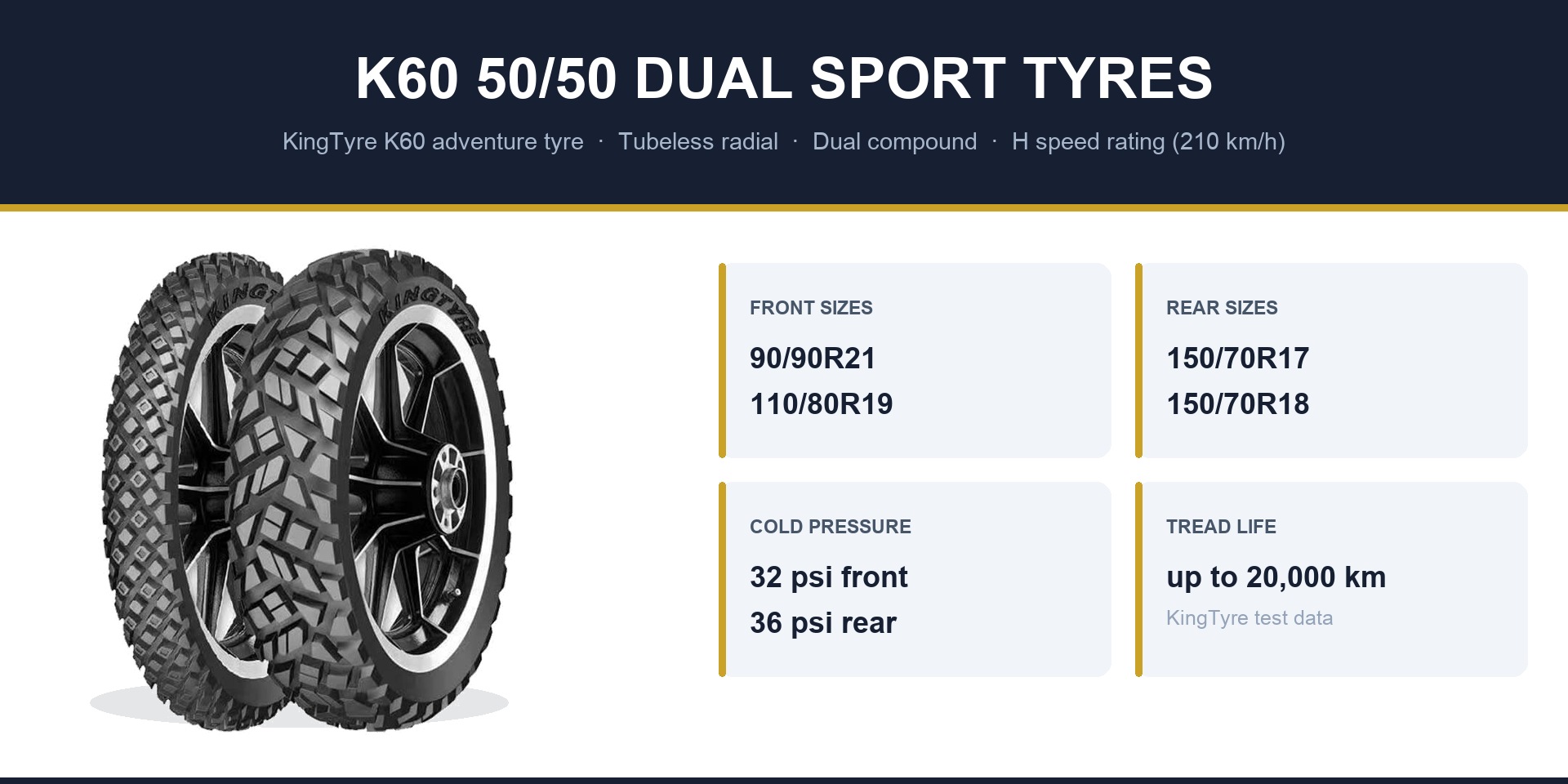
Quick answer: The KingTyre K60 is a 50/50 dual sport (ADV) tyre — a pattern that splits its tread between sealed road and unmade surface. It ships in four sizes (90/90R21 and 110/80R19 front, 150/70R17 and 150/70R18 rear), uses tubeless radial construction with a dual-compound carcass, carries an H speed rating (210 km/h) and a load index of 54–70 depending on size, and runs at a factory cold pressure of 32 psi front and 36 psi rear.
Last updated: November 11, 2026. Written and reviewed by the KingTyre technical team. Sizes, construction and pressures are taken from the current KingTyre K60 product specification; the mileage, road-noise and compound figures are KingTyre's own published test results.
50/50 dual sport tires are designed to spend equal time on sealed road and unmade surface. The 50/50 label describes how the tread pattern is split between the two jobs, not how your mileage splits. A 50/50 tyre carries a block pattern that stays stable and quiet at highway speed on asphalt, and still bites into gravel, hardpack, sand and shallow mud once the road turns to dirt.
That balance is why the 50/50 format became the default for adventure bikes: a rider can leave a paved highway at 100 km/h, turn onto a fire road, and keep the same front and rear tyre on the rim. Riders who live in cities and never leave tarmac get more from a road-biased tyre, and riders who spend the season in the trails get more from an off-road-biased one.
KingTyre builds the dual sport range as four distinct splits, and the difference between them is the single most important decision a buyer makes:
Our guide to what an ADV tyre actually is covers the category in general, and which dual sport tire sizes have the highest demand shows how the size mix splits across regions.
| Muster | On-road / off-road split | Tread character | KingTyre sizes published | Best for |
|---|---|---|---|---|
| K60 | 50/50 | Balanced block pattern, self-cleaning channels | 90/90R21, 110/80R19, 150/70R17, 150/70R18 | Riders who mix highway and gravel equally |
| K61 | 40/60 | Road-weighted, higher mileage, stronger sealed-surface grip | See the K61 product page for the current list | Riders who commute and weekend |
| K66 | 80/20 | Deeper, wider blocks, softer compound, strong off-road bite | See the K66 product page for the current list | Trail riding, gravel, mud, sand |
| K67 | 90/10 | Shallow road pattern, longest road life, best highway comfort | See the K67 product page for the current list | Long-distance touring on sealed roads |
The K60 is the middle of the range, and that is exactly why it is the highest-volume dual sport tyre KingTyre sells. It is not the best tyre for any single surface, and that is the point — it is the tyre that does not have to be replaced when the rider's plan changes.
Three questions usually decide it:
Die K61 40/60 dual sport tyre sits one step further toward the road and is the natural alternative for riders who say "I ride to the trailhead, and I want the tyre to last."
The K60 is a block-pattern tyre with a continuous centre strip and staggered shoulder blocks, and every part of that layout has a job. The centre strip carries the load and the straight-line stability at highway speed; the shoulder blocks provide the lateral bite when the bike leans into a gravel corner or a wet painted line.

The construction features KingTyre publishes for the K60 are:

KingTyre currently publishes four K60 sizes — two front and two rear — which together cover the majority of modern adventure platforms. The pairings are listed below with the platforms they are commonly specified on. Always confirm against the tyre placard on your own motorcycle and the rim width before you order.
| K60 size | Position | Wheel | Commonly specified on |
|---|---|---|---|
| 90/90R21 | Vorderseite | 21 inch | Current-generation adventure and dual sport models using a 21-inch front wheel |
| 110/80R19 | Vorderseite | 19 inch | Mid-weight adventure platforms using a 19-inch front wheel |
| 150/70R17 | Rückseite | 17 Zoll | The most widely used adventure rear size — also covered in our 17-inch tyre guide |
| 150/70R18 | Rückseite | 18 inch | Adventure platforms that specify an 18-inch rear, such as the Africa Twin pattern |
The four sizes cover the three most common adventure wheel layouts in the market: 21/17, 21/18 and 19/17. If your motorcycle runs 19/19, 17/17 or a 120/70R19 front, the K60 is not the tyre for that platform and the K66 or K67 family is the one to look at instead.
Every published K60 specification is listed below, exactly as KingTyre specifies it for production. Where the factory does not publish a figure, it is marked as such rather than estimated.
| Parameter | KingTyre K60 specification |
|---|---|
| Tire type | 50/50 Dual Sport (ADV) tire |
| Muster | K60 |
| Bauwesen | Radial, tubeless, dual compound |
| Available front sizes | 90/90R21, 110/80R19 |
| Available rear sizes | 150/70R17, 150/70R18 |
| Load index | 54 – 70 depending on size (printed on the sidewall) |
| Speed rating | H — up to 210 km/h |
| Recommended pressure | Front 32 psi cold, rear 36 psi cold |
| Pressure in bar | Front approx. 2.2 bar, rear approx. 2.5 bar cold |
| Tread life | Up to 20,000 km (KingTyre endurance test result) |
| Road noise | 15% lower than a standard dual sport tyre in KingTyre's own comparison test |
| Verbindung | Silica-enriched blend with carbon black, dual compound construction |
The K60 runs at 32 psi front and 36 psi rear when cold — a deliberate step up from a pure road tyre, because the same tyre has to carry a taller wheel and a loaded bike over loose surfaces.
Three things about those numbers are worth understanding before you fit a set:
On speed rating, the H marking is a homologation limit of 210 km/h, not a recommendation to ride at 210 km/h on a dual sport tyre. On load index, KingTyre publishes a range of 54 to 70 across the four sizes because the rating changes with size; the exact load index and speed rating for your tyre are moulded into the sidewall. Our guides to DOT and ECE tyre codes explained und ECE R75 versus DOT FMVSS 119 cover how to read those markings and why importers need both.
A 50/50 tyre is a compromise by design, and knowing where the compromise sits prevents disappointment. The table below states plainly what the K60 does well and where another pattern is the better buy.
| Surface | How the K60 behaves | Honest limitation |
|---|---|---|
| Highway asphalt | Stable, quiet for a block pattern, comfortable over long distances at touring speeds | Not as quiet or as long-lived as the K67 90/10 |
| City asphalt and wet tarmac | Silica-enriched compound gives predictable wet grip; blocks resist squirm under braking | Wet grip on cold wet tarmac is never equivalent to a pure road tyre |
| Gravel and hardpack | This is the design point — blocks key into the surface and the self-cleaning channels keep it clear | Sharp rock and embedded objects can cut a block-pattern tyre |
| Light mud and clay | Self-cleaning grooves shed mud rather than packing the tread | Deep, sticky mud is not a 50/50 tyre's job — move up to the K66 for that |
| Soft sand | Usable on firm, packed sand at reduced pressure | Deep dunes and sand require a lower-pressure, lower-speed approach than most riders expect |
| Hard enduro obstacles | Not the intended environment | Choose the K82 or the K81/K83 trail range for technical single track |
Pick the K60 if your riding is genuinely split between road and trail. Pick the K66 if the trail is the point, and the K67 if the road is the point. The K61 is the sensible middle-road option for riders who want a longer life than a 50/50 tyre but do not need trail capability.
| Question | K60 50/50 | K61 40/60 | K66 80/20 | K67 90/10 |
|---|---|---|---|---|
| Split | 50/50 | 40/60 | 80/20 | 90/10 |
| Road comfort | Good | Very good | Fair | Excellent |
| Road noise | Mäßig | Low | Hoch | Lowest |
| Road life | Medium — up to 20,000 km | Hoch | Low | Höchste |
| Gravel and hardpack | Very good | Good | Excellent | Fair |
| Mud and wet clay | Fair | Weak | Strong | Weak |
| Sand | Fair | Weak | Good | Weak |
| Typical rider | Weekend ADV rider, tourer who wants gravel access | Commuter who joins trail days occasionally | Dedicated trail and enduro rider | Long-distance road adventurer |
Two more commercial points matter to distributors and dealers more than to riders:
The 20,000 km figure is a test result, not a promise. Six habits account for most of the difference between a K60 that lasts and a K60 that does not.
For distributors, importers and brand owners, the K60 is one of the most straightforward SKUs to build a dual sport programme around: four sizes, a single construction, a consistent speed rating and a certification package that clears both European and US import requirements.
Commercial and technical points to confirm before you order:
If you want to see the tyres in person, KingTyre exhibits at CIMAMotor, Hall 7, Booth 7T05, and the full range is listed on the KingTyre product list.
The KingTyre K60 is a 50/50 dual sport (ADV) motorcycle tyre. Its tread pattern is split evenly between sealed-road and off-road use, and it is supplied in 90/90R21, 110/80R19, 150/70R17 and 150/70R18 as a tubeless radial with dual-compound construction and an H speed rating.
Four sizes are published: 90/90R21 and 110/80R19 for the front, and 150/70R17 and 150/70R18 for the rear. Together they cover the 21/17, 21/18 and 19/17 adventure wheel layouts that make up most of the current market.
KingTyre's factory recommendation is 32 psi cold at the front and 36 psi cold at the rear, which is approximately 2.2 bar and 2.5 bar. If your motorcycle's tyre placard specifies a different pressure, follow the placard instead.
The K60 carries an H speed rating, which is a homologated limit of 210 km/h. That is a certification ceiling, not a riding recommendation — a 50/50 dual sport tyre is normally ridden well below it.
The K60's self-cleaning grooves shed mud effectively on gravel, dirt and light mud, and it handles packed hardpack well. For deep, sticky mud and clay, the 80/20 K66 is the better-specified tyre.
KingTyre's published endurance test result for the K60 is up to 20,000 km. Real life depends heavily on pressure maintenance, rotation and how much of the riding is off-road, so treat 20,000 km as a well-maintained test-cycle figure rather than a guarantee.
KingTyre's published comparison test shows 15% lower road noise than a standard dual sport tyre, achieved through the block pattern and the silica-enriched compound. A 90/10 road tyre such as the K67 remains the quietest option in the range.
Yes. The K60 is supplied as a tubeless radial in all four published sizes, and it can be fitted with an inner tube where a full tubeless system is not available or not preferred.
The K60 is the balanced 50/50 pattern. The K66 is 80/20 off-road weighted for trail riding, and the K67 is 90/10 road weighted for highway touring. If you ride equal distances on road and trail, the K60 is the correct choice.
The K60 is manufactured at KingTyre's own factory in China, which operates automated curing and moulding lines, holds ISO 9001 and DOT certification, and ships to more than 45 countries. It is the same production group that builds the KingTyre racing programme used in endurance competition.
The KingTyre K60 50/50 dual sport tyre is available in 90/90R21, 110/80R19, 150/70R17 and 150/70R18, with a factory cold pressure of 32 psi front and 36 psi rear, a load index of 54–70 depending on size and an H speed rating.
For distributors and importers, the full K60 specification, the certification package and current lead times are on the KingTyre K60 product page. For OEM and private label enquiries, contact the KingTyre export team and we will quote the size mix you need.
 German
 English
 Spanish
 French
 Korean
 Japanese
 Italian
 Russian
 Dutch
 Danish
 Portuguese
 Polish
 Turkish
 Czech