Short answer: No. Slick motorcycle tires — tires with no tread pattern, designed exclusively for dry track use — are not street legal in any major motorcycle market. The EU, UK, US, Canada, Australia, Japan, and Brazil all require some form of tread pattern, type approval, or both. Slicks are restricted to closed circuits, sanctioned race events, and trailer-transported bikes.
Quick rule of thumb: If a tire has zero grooves across the contact patch, it is illegal on public roads in every country covered below. Skip to the country table or jump to what track-day riders actually use.
Two regulatory frameworks cover roughly 90% of the world’s motorcycle markets: ECE R75 (Europe, UK, most of Asia and Latin America) and FMVSS 119 / DOT (United States and Canada). If your tire doesn’t meet one of these, it doesn’t meet either.
ECE Regulation 75 is the type-approval standard for every motorcycle tire sold in the European Union, the United Kingdom (post-Brexit), and most countries that follow UNECE rules. To carry a valid E-mark, a tire must:
Slicks have no tread pattern, so by definition they cannot be ECE R75 approved. There is no “track day exemption” — the E-mark requirement is binary: grooves, or no approval.
DOT stands for the U.S. Department of Transportation. Tires sold for on-road motorcycle use in the US must comply with FMVSS 119, which requires:
DOT does not have a specific “wet grip” requirement the way ECE R75 does, but the tread requirement alone rules out slicks. The DOT does not homologate tires at the federal level for motorcycles the way it does for passenger cars — but state safety inspections will fail any motorcycle running on a tire without grooves.
A slick tire delivers more grip than a treaded tire on dry pavement because it has a larger contact patch and no grooves interrupting the rubber. On a race track, that’s pure advantage. On a public road, the same lack of grooves means:
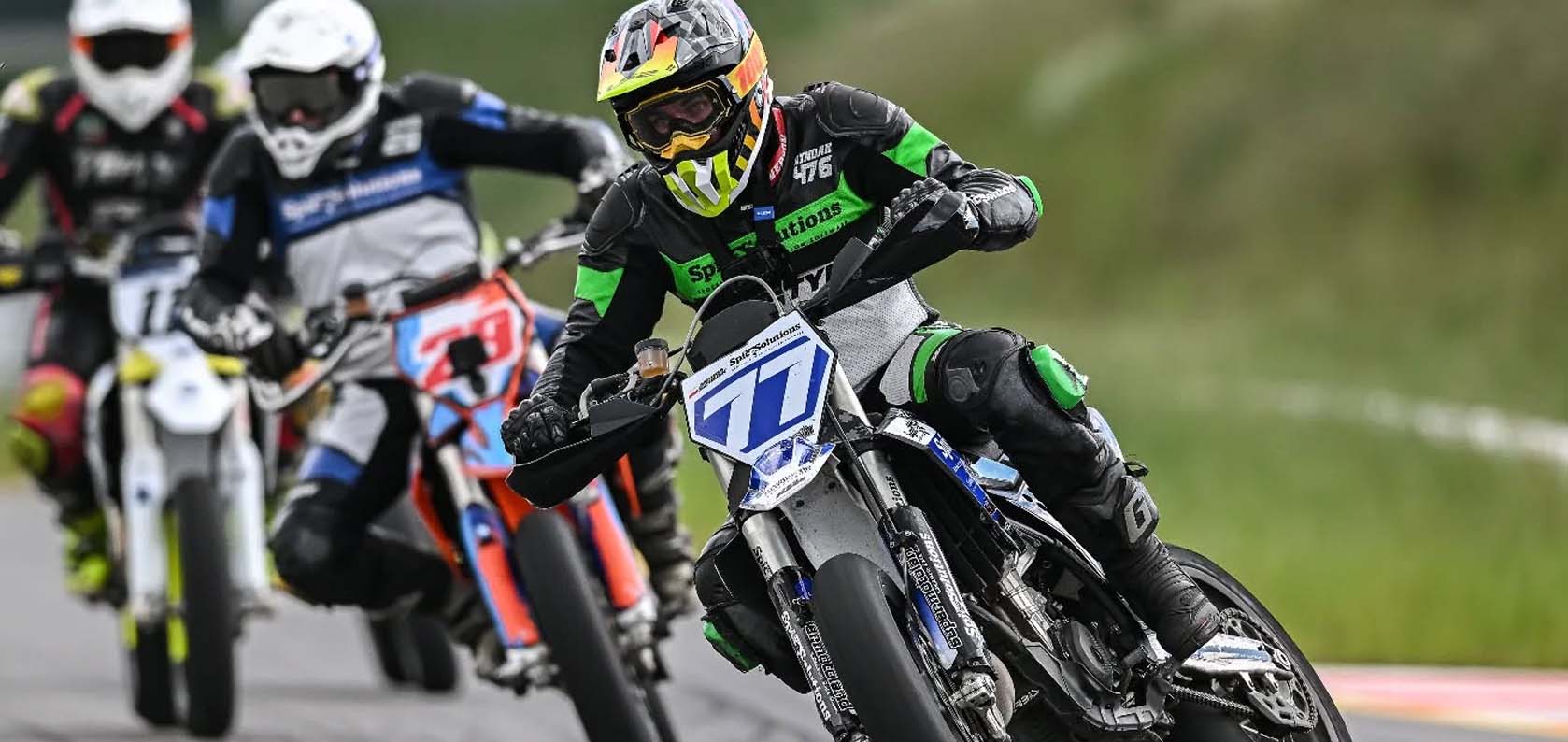
This is why every serious track-day rider runs two sets of wheels — one with street tires, one with slicks or semi-slicks — and swaps at the circuit. The bike that arrives at your local trackday on a trailer, with slicks mounted, is the legal norm; the bike that arrives on slicks ridden there is a citation waiting to happen.
| Region / Country | Legal on public road? | Standard | Notes |
|---|---|---|---|
| Europäische Union | ❌ No | ECE R75 | Tread pattern + E-mark required; no exemptions |
| United Kingdom | ❌ No | ECE R75 (post-Brexit) | UK-issued “E11” marks accepted; same rules as EU |
| Vereinigte Staaten | ❌ No | FMVSS 119 (DOT) | Tread + DOT marking; state inspection will fail |
| Canada | ❌ No | CMVSS 119 | Mirrors US FMVSS 119 |
| Australia | ❌ No | ADR (based on ECE R75) | State inspections (e.g., pink slip NSW) will fail |
| Japan | ❌ No | ECE R75 / JIS | Tread pattern mandatory; most circuits require approved compounds |
| Brazil | ❌ No | INMETRO / ECE R75 | Strong track-day culture; slicks shipped for closed-circuit use only |
Every tire sold in the EU for public road use must carry an E-mark under ECE R75. Tread depth across the contact patch is mandatory — there is no minimum depth exemption, no “track day only” exception, and no grace period. Insurance companies will deny a claim if a vehicle is involved in an accident on slicks, and several EU countries (notably Germany, France, and Italy) can impound a vehicle on the spot for an equipment violation this serious.
Post-Brexit, the UK continues to recognize ECE R75 type approvals. A tire with a valid E-mark (including “E11” for UK-issued approvals) is legal. Slicks remain illegal on public roads in both Great Britain and Northern Ireland. The UK does not have a separate motorcycle tire homologation regime.
FMVSS 119 requires a tread pattern. The DOT doesn’t homologate tires, but a tire without tread pattern will fail state safety inspections. Several states (notably California, New York, Texas, and Florida) have specific motorcycle safety inspection regimes that would catch a slick-tired bike. The typical fine is $100-$500 depending on the state, plus potential impound.
Canada’s CMVSS 119 mirrors the US FMVSS 119. Slicks are not legal for street use. Provincial inspection regimes (e.g., Ontario, Quebec) follow the same standard.
Australia’s ADR framework references ECE R75. Tread pattern is mandatory. State-level inspections — pink slip in New South Wales, roadworthy certificate in Victoria — will fail a slick-tired motorcycle. The country has a strong track-day culture (Phillip Island, The Bend, Wakefield), so demand for racing slicks exists — but for closed-circuit use only.
Japan recognizes both ECE R75 and JIS (Japanese Industrial Standards). Slicks are not approved for public road use. Even on track days, many Japanese circuits (e.g., Suzuka, Tsukuba, Autopolis) have specific compound and approval requirements for sanctioned race events.
Brazil follows INMETRO regulations, which largely align with ECE R75. Slicks are not legal on public roads. The country has a strong track-day culture especially in São Paulo and Curitiba, with multiple racing series (e.g., SuperBike Brasil) requiring full slicks. The market for racing slicks exists, but only for closed-circuit use.
There are a handful of situations where a slick-tired motorcycle might appear on a public road without immediate consequence — but they are narrow:
None of these exceptions change the underlying rule: on a public road, in normal weather, operated under a standard motorcycle license, slicks are not legal.
If you want the grip of a slick with the practicality of a street-legal tire, here are your real options — ordered from most to least track-focused.
Semi-slick tires — sometimes called “track day tires” or “road-legal race tires” — keep a smooth center strip for dry grip but add minimal tread grooves on the edges for wet performance and type approval. They typically carry an E-mark.
Die KingTyre K06 semi-slick tire is one example. It’s ECE R75 approved, available in sizes from 120/70ZR17 to 200/60ZR17, and has been validated across four consecutive years of endurance racing at Le Mans 24H. On a track-day bike ridden to and from the circuit, the K06 is the most common solution we ship to track-day operators across Europe and Asia.
On a warm dry track, a well-engineered semi-slick like the K06 will deliver 90-95% of the grip of a full slick — with the huge practical advantage that you can ride the bike home (or to the gas station) legally and safely in any conditions.
If you’re racing in changeable conditions, a full wet tire like the KingTyre K01 gives you tread patterns designed for standing water. The K01 is ECE R75 approved and is one of the few rain tires with a Le Mans endurance racing pedigree (over 850 laps completed in wet conditions during the 2024 race).
Rain tires are not ideal for track days — they heat up slowly, wear fast in dry conditions, and have lower outright grip on dry pavement. But they are street legal and they will get you home in the rain.
If you’re racing in a sanctioned series, full slicks like the KingTyre K00 are the fastest option. The K00 is available in four compounds (Super Soft / Soft / Medium / Hard) and ships to racing teams and series organizers in 45+ countries. Use them only on closed circuits, with tire warmers, and only transport the bike on a trailer.
Slicks deliver the most grip but require:
For more on compound selection, see our slick tire pressure guide and our heat cycles article — both coming later in August.
Counterfeit E-marks and DOT markings are a real problem in the motorcycle tire market, especially for low-cost imports. Here’s how to check:
If you’re sourcing tires as a distributor or importer, request the type-approval certificate from the manufacturer. KingTyre provides this documentation with every wholesale shipment — see our import guide for distributors for the full process.
Can I get pulled over for riding on slicks?
Yes. In every country covered above, a motorcycle on public roads with slick tires can be cited for an equipment violation. The fine varies by jurisdiction but is typically $100-$500 USD, and some countries (notably Germany and France) can impound the vehicle on the spot.
Do slicks void my insurance?
Almost always, yes. If you’re in an accident on slicks, your insurance company will investigate the tire and may deny the claim based on “use of non-approved equipment” — even if the accident wasn’t your fault. In some EU countries, riding on slicks on public roads can be considered a criminal offense if it results in injury.
What’s the closest legal alternative to a slick?
A semi-slick tire like the KingTyre K06. On a warm dry track, you’ll get within 5-10% of the grip of a full slick, with the bonus of being able to ride the bike to the gas station, the supermarket, or anywhere else on a public road.
Are slicks legal on private property?
Yes — on closed private circuits and private test facilities, slicks are completely legal. The rules above apply only to public roads.
Can I convert a slick to street-legal by adding grooves?
No. Grooving a slick after manufacture does not give it type approval. The approval is granted to the tire as manufactured, with specific mold designs, compound formulations, and testing. Modifying a slick voids its (already nonexistent) type approval and is considered a serious safety issue by most sanctioning bodies.
What about race-replica tires with very minimal tread?
Some “race-replica” street tires have very minimal tread (e.g., 1-2mm grooves at the edges). These are legal if they carry a valid E-mark or DOT approval. The KingTyre K06 is one such tire — it has a smooth center strip for dry grip and minimal edge grooves for wet performance and type approval.
If you’re a track-day rider who needs a street-legal tire that performs, the KingTyre K06 semi-slick is the most popular choice. If you’re a distributor or importer sourcing racing tires, see our Manufacturer Hub for KingTyre’s full range and our import guide for the wholesale process.
For more on racing tire technology, our slick tire pressure guide und heat cycles article are coming in late August.
Browse KingTyre racing tires:
Or:
 German
  English
  Spanish
  French
  Korean
  Japanese
  Italian
  Russian
  Dutch
Dutch  Danish
  Portuguese
  Polish
  Turkish
  Czech
Czech