
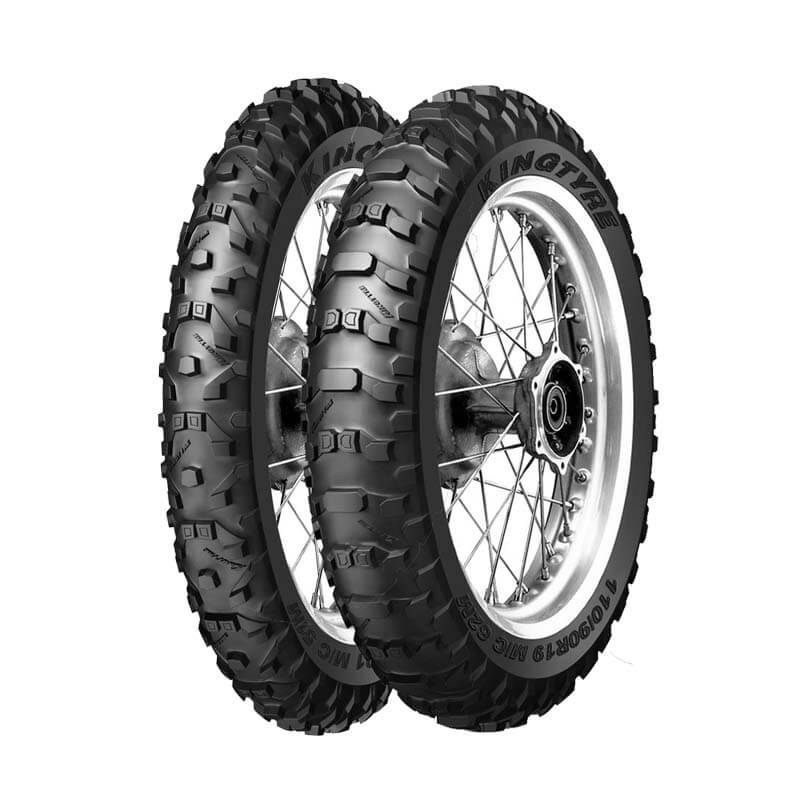
If you have ever bought a set of neumáticos para motocicleta todoterreno that looked aggressive in the shop but packed with mud on the second corner, you have already learned the first lesson the off-road tire market does not advertise: most trail tires are designed for marketing photos, not for the conditions riders actually encounter.
The gap between a tire that clears mud effectively and one that becomes a rolling slick after thirty minutes in the woods is invisible on the showroom wall. The gap between a sidewall that survives a rock strike and one that fails at the trailhead is invisible until it happens to you. And the gap between a compound that lasts a full season and one that needs replacement after ten hard rides is invisible until the bill arrives.
This article breaks down what actually goes into serious neumáticos para motocicleta todoterreno, drawing on the engineering behind the Kingtyre K81 and K83 — tires designed for mud, gravel, loose dirt, rocky trails, and forest terrain. We will look at the engineering décisions that determine whether a tire clears mud or packs with it, the role of compound technology in heat resistance and durability, and what trail riders should look for when choosing the best off road motorcycle tires for their riding style.
Off-road tires operate in conditions that no other tire category approaches. A trail ride might encounter mud, loose gravel, wet roots, embedded rocks, and sand within a single hour. The tire must clear mud continuously while providing enough bite for traction on wet wood. A weak sidewall fails on a single rock strike. A compound that softens in summer heat tears within hours of rocky use.
Three engineering problems dominate the design of serious off road tires for dirt bikes: compound durability under variable conditions, carcass impact resistance, and self-cleaning geometry.
Compound durability in off-road riding is measured in hours of mixed-condition use, not just kilometers of smooth trail. A typical weekend trail rider might put 30 to 50 hours on a set before the knobs show significant wear. An enduro racer or hardcore trail rider might exceed 80 hours.
The compound must resist knob tearing under acceleration and cornering while staying flexible enough to grip irregular surfaces. It must also handle temperature swings — cold morning starts, hot afternoon sections, water crossings that drop surface temperature 20°C in seconds. The K81 and K83 use heat-resistant polymer blends that maintain their physical properties across the operating range.
For technical reference on off-road motorcycle tire standards, the FIM Enduro Regulations provide detailed specifications for off-road competition categories.
Carcass impact resistance determines whether a tire survives the rock strikes and root impacts that trail riding delivers. Multi-ply carcass construction — the standard for serious off-road tires — uses multiple layers of cord material angled against each other to provide structural integrity. The K81 and K83 use multi-ply reinforced construction with reinforced sidewalls that resist cuts and punctures.
Single-ply construction is lighter and cheaper but cannot absorb the repeated impact loads that trail riding produces. The sidewall is the most vulnerable part of any off-road tire because it flexes during cornering and absorbs the majority of impact energy. A weak sidewall cuts easily, bulges under low pressure, and eventually fails — sometimes far from the trailhead.
Self-cleaning geometry is the third critical dimension. The tread pattern prevents the tire from becoming a rolling cylinder of compacted mud. Void ratio, knob angle, knob spacing, and channel depth all determine whether mud ejects as the tire rotates or packs into the tread. When a tire packs with mud, it effectively becomes a slick — no tread pattern, no grip. The K81 and K83 are designed with self-cleaning tread geometry specifically to address this failure mode.
The K81 is designed as a versatile off road motorcycle tires for trail riding option, balancing the demands of varied trail conditions. The deep knobby tread pattern with optimized channel geometry provides traction on loose dirt, gravel, and forest floor while clearing mud effectively.
In typical trail riding, the tire encounters a mix of conditions: muddy sections, rocky climbs, loose gravel, wet roots, and hard-packed sections where the trail has been worn smooth. The K81 tread geometry addresses this balance through deep lugs that bite into soft surfaces and channels wide enough to eject mud as the tire rotates.
The K81 compound is formulated to maintain flexibility at lower temperatures — important for early-morning rides where trail surfaces may still be cool. It also provides the heat resistance needed for sustained use during summer trail days when surface temperatures can exceed 50°C.
The K81 is a strong choice for enduro and trail riding where the conditions are genuinely mixed. Riders who encounter mud, rocks, and hard-pack on a single ride will find the K81 delivers consistent performance across the range.
The K83 is the more aggressive option in the Kingtyre off-road range. The deep knobby tread with wider lug spacing is optimized for the most demanding off-road conditions — deep mud, loose soil, and technical rocky terrain.
The K83 tread geometry provides more aggressive self-cleaning than the K81. The wider spacing between knobs allows mud to be ejected more aggressively, making the K83 a better choice for riders who frequently encounter deep mud or loose soil conditions.
The reinforced side lugs on the K83 provide the cornering stability that aggressive trail riding demands. When a dirt bike is leaned into a turn at speed, the side blocks are the contact patch. The K83 side lugs are reinforced to resist the tearing that causes the most common off-road tire failure — knobs folding over under sustained cornering loads.
The K83 is a strong choice for riders who ride primarily in muddy or loose-soil conditions, or for enduro racers who need maximum traction in technical sections.
Both the K81 and K83 use multi-ply reinforced carcass construction. Multiple layers of cord material are angled against each other to provide structural integrity under the impact loads that off-road riding delivers.
The reinforced sidewalls on both tires provide cut and puncture resistance while maintaining enough compliance to absorb impacts. The balance is critical. Over-reinforce and the tire becomes harsh, transmitting every rock strike to the rider. Under-reinforce and the tire fails in the field.
The K81 and K83 sidewall compounds are formulated to resist the cuts and abrasions that occur when a tire slides along a rock or root at low pressure. This is particularly important for riders who run lower tire pressures for better traction in technical terrain.
For riders interested in the engineering principles behind off-road tire construction, the Tire Industry Association provides technical resources on tire design and manufacturing standards.
The K81 and K83 are available in the three sizes that fit the vast majority of off-road motorcycles:
This focused size range is deliberate. A manufacturer offering 15 off-road sizes has spread its engineering resources across configurations that rarely sell. The K81 and K83 are concentrated on the three sizes that fit approximately 90 percent of off-road motorcycles, with compound and tread design calibrated specifically for each size.
For specific fitment guidance, always refer to your motorcycle manufacturer's specifications. The AMA Off-Road Riding Guide provides resources on off-road tire selection and fitment standards.
Heat is a significant factor in off-road tire durability. A tire that performs well in a cool morning ride may degrade during a hot afternoon session. Compound temperatures under sustained riding can exceed 60°C even on trail bikes.
The K81 and K83 use heat-resistant rubber formulations that maintain their physical properties across the operating range. This is not a minor engineering detail. The same compound development capability that supports the K81 and K83 also supports the K00 racing slick used in Kingtyre's four consecutive finishes at the Le Mans 24 Heures Motos endurance race.
Endurance racing generates the most demanding compound stress available: 24 hours of continuous operation with temperature cycles from overnight lows to 45°C track-surface highs. The engineering team that develops compounds for Le Mans uses the same infrastructure for off-road compounds.
A tire can have an excellent design and still fail in the field if manufacturing quality is inconsistent. Off-road tires are particularly demanding because the same impact that would cause a road tire to flex slightly can cause a defective off-road tire to fail completely.
At the Kingtyre factory in Tianjin, every tire passes through a documented quality control process. Computerized curing systems ensure heat and pressure profiles match engineered specifications. Precision molds maintain dimensional tolerances of the tread pattern — even a 1mm variation in knob height affects traction and self-cleaning performance.
The 100 percent X-ray inspection applied to every Kingtyre tire identifies internal defects — ply alignment variations, trapped air pockets, inconsistent belt tension — invisible from the outside but capable of causing impact failures. The documented defect rate at Kingtyre's facility stays below 0.2 percent.
The K81 and K83 are purpose-built off-road tires designed exclusively for trail and enduro use. They are not road-legal tires and do not carry ECE R75 or DOT certification — a deliberate design choice consistent with the off-road category worldwide.
This is normal for serious off-road tires. The compounds, tread patterns, and construction are optimized for off-road performance, not for sustained highway use. Riders who use their off-road motorcycles on public roads to reach trailheads should be aware of local road-legal tire requirements and use appropriate DOT-approved tires for any road sections.
For trail riding, enduro events, and off-road recreation, the K81 and K83 deliver the performance that the category demands — without the compromises that road certification would impose.
The combination of focused size range, terrain-specific patterns, multi-ply construction, and race-proven compound development places the K81 and K83 among the best off road motorcycle tires available for serious trail and enduro riders.
For riders who want off road motorcycle tires for trail riding on mixed conditions, the K81 is the right choice. The deep knobby tread with optimized self-cleaning geometry provides consistent traction across the conditions most trail riders encounter.
For riders who ride primarily in aggressive terrain — deep mud, loose soil, or technical rocky sections — the K83 is the better option. The more aggressive tread geometry provides maximum traction in the conditions where standard trail tires fail.
For riders who want a single tire for off road tires for dirt bikes across the full range of off-road conditions, the K82 dirt bike tire offers a versatile alternative with a different tread design.
The K81 and K83 are the right tires for off-road riders who want terrain-specific performance from a manufacturer that produces racing tires for the highest level of competition. They are not the right tires for riders who need road-legal certification, or for casual riders who want a single versatile tire for a mix of on-road and off-road use.
The K81 is designed for trail riders who encounter varied conditions. The K83 is designed for riders who ride primarily in aggressive terrain. Both tires deliver the performance that the category demands — deep knobby tread for traction, multi-ply construction for impact resistance, heat-resistant compound for sustained use, and 100 percent X-ray inspection for consistent quality.
For everyone who rides off-road seriously, the K81 and K83 are engineered to be the answer. The compound survives the heat. The carcass absorbs the impacts. The tread clears the mud. The sidewalls resist the cuts. The quality control ensures consistency from tire to tire.
That is what the K81 and K83 were designed to be. That is what they are.
Kingtyre manufactures the K81 and K83 off-road motorcycle tires in an ISO 9001 certified facility in Tianjin, China. The company specializes exclusively in radial motorcycle tires and has competed in the FIM Endurance World Championship at the 24 Heures Motos for four consecutive years, providing direct race-to-road technology transfer across the full product range. The K81 and K83 are off-road tires without road certification.
 Spanish
  English
  French
  German
  Korean
  Japanese
  Italian
  Russian
  Dutch
Dutch  Danish
  Portuguese
  Polish
  Turkish
  Czech
Czech