
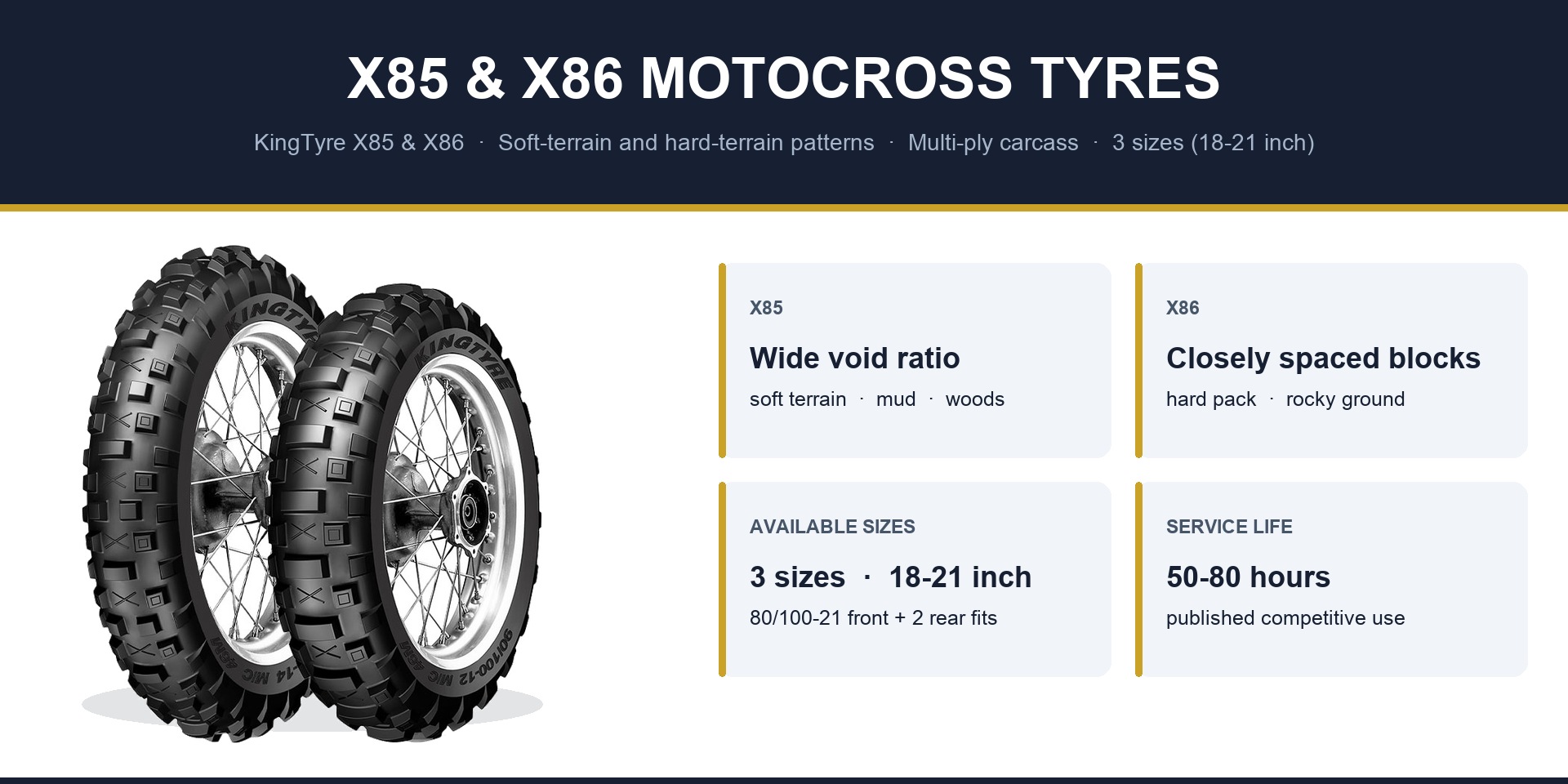
Quick answer: The KingTyre X85 and X86 are 100% off-road motocross tires built on a multi-ply reinforced carcass with reinforced sidewalls and heat-resistant rubber compounds. They are published in three sizes — one front and two rear, on 18- and 19-inch rears with a 21-inch front — and they carry no road certification: no ECE or DOT approval, no speed rating and no load index are published for them. The X85 is the soft-terrain pattern, with an aggressive knobby tread and a wide void ratio for mud clearance; the X86 is the hard-terrain pattern, with closely spaced reinforced tread blocks for rock and hard-pack.
Last updated: November 14, 2026. Written and reviewed by the KingTyre technical team. Tread, construction, size and application figures come from the current KingTyre X85 & X86 product page; company figures come from the KingTyre about page. Where KingTyre has not published a figure — including certification, speed rating, load index, tire pressure and rim width — this guide says so rather than estimating it.
The KingTyre X85 and X86 are a complementary pair of 100% off-road motocross tires, engineered as the soft-terrain and hard-terrain halves of the same race programme. They share the same carcass platform — multi-ply reinforced construction, reinforced sidewalls and heat-resistant rubber compounds — and they differ only in tread geometry, which is what decides which one belongs on your bike.
Il X85 is the soft-terrain tire. Its aggressive knobby tread is laid out with a wide void ratio, meaning more space between the blocks relative to their size. That spacing is what lets mud fall out instead of packing into the tread, and it is why the X85 is the pattern for woods riding, muddy tracks and loose soil. The compound is formulated to stay flexible at lower temperatures, which matters on an early-morning race start when the track is still cold.
Il X86 is the hard-terrain tire. Where the X85 opens up space between the knobs, the X86 packs them closer together, putting more rubber in contact with the ground at any moment. More contact area means more traction on hard-packed soil, and more bite points across irregular rock. The X86's knob bases are reinforced, which directly targets the failure mode that ends most hard-pack races: knobs folding over under sustained cornering load, cracking at the base and eventually separating from the carcass.


For the deeper engineering behind both patterns — how knob geometry and compound interact under race load — our guide to the engineering inside the tires that decide who finishes the race is the companion read, and the engineering decisions that separate a serious off-road tire from a cheap one covers what the off-road category demands of a carcass in the first place.
Everything KingTyre publishes for the X85 and X86 is in the table below. It is deliberately short, because these are two focused race-oriented off-road patterns sold as one range with a shared size list.
| Specifiche | KingTyre X85 | KingTyre X86 |
|---|---|---|
| Tread pattern | Aggressive knobby with a wide void ratio for self-cleaning and mud evacuation | Closely spaced, reinforced tread blocks for maximum contact area |
| Costruzione | Multi-ply carcass with reinforced sidewalls | Reinforced construction with reinforced sidewalls |
| Composto | Premium rubber, formulated to stay flexible at lower temperatures | Heat-resistant compound for hard-pack and sustained race load |
| Primary terrain | Woods riding, muddy tracks, loose soil and soft ground | Rocky terrain, hard-packed soil and compact tracks |
| Published front size | 80/100-21 | 80/100-21 |
| Published rear sizes | 110/90-18, 110/90-19 | 110/90-18, 110/90-19 |
| Published service life | Riders typically achieve 50–80 hours of competitive use, depending on terrain | |
| Published application range | Motocross and enduro competition | |
| Certification, speed rating, load index | Not published — the X85 and X86 carry no ECE or DOT approval | |
| Product category | Pneumatici fuoristrada | |
Both patterns are built with the same manufacturing discipline across the range: computerized curing systems, precision moulds and automated testing, with the same compound development capability that supports KingTyre's race tyre line. Our guide to what ISO 9001 really means for a tyre manufacturer explains what the quality system covers and what it does not.
Both are multi-ply, reinforced-sidewall, heat-resistant off-road tires; the difference is how much contact patch you want and how quickly you need the tread to clear itself. This is the single question that decides between them.
| What you ride | Pick | Perché |
|---|---|---|
| Deep mud, bogs and wet forest trails | X85 | The wide void ratio lets mud fall out rather than pack into the tread, which is the difference between a tire that clears a muddy gully and one that skates across it |
| Woods riding with roots, wet leaves and soft soil | X85 | Wide knobs bite into soft surfaces while the spacing still keeps enough contact area for traction on firmer sections |
| Early-morning races on a cold track | X85 | The compound is formulated to stay flexible at lower temperatures rather than going stiff and skipping |
| Hard-packed race tracks | X86 | Closer-spaced blocks put more rubber on the ground, which on hard-pack converts directly into traction |
| Rocky, rutted terrain | X86 | The extra contact patches give more bite points across irregular rock surfaces |
| Sustained cornering loads on hard ground | X86 | Reinforced knob bases resist the tearing that causes the most common hard-pack failure — knobs folding over, cracking at the base and separating |
| Mixed-course racing | Both | Most mixed-terrain riders run the X85 through the mud and woods sections and switch to the X86 for the hard-pack and rock sections |
One honest note on competition claims. The product page states that these sizes have been tested extensively in motocross and enduro competitions, and it lists both models for competition use — but it publishes no test protocol, no race results and no independent validation data for the X85 and X86. KingTyre's documented competition record sits on its race tyre line instead: the K00 slick and K01 rain tyre have run the FIM Endurance World Championship at the 24 Hours of Le Mans, and our field report from seven years at Le Mans 24H covers what that record involved. The X85 and X86 are the pair to quote for off-road and motocross programmes; the K00 and K01 are the pair with a documented race result.
Three published fitments: one front and two rear, covering the standard motocross and enduro geometry. KingTyre publishes the X85 and the X86 as one range with a shared size list, so a pair is assembled from the front plus one of the rear options.
| Dimensione | Position | Typical machine |
|---|---|---|
| 80/100-21 | Anteriore | The standard front fitment on motocross and enduro bikes from 125cc to 450cc. The designation publishes two section-width options — 80 and 100 — on a 21-inch rim, so confirm which moulding is in stock |
| 110/90-18 | Posteriore | The 18-inch rear, fitted to older enduro platforms and to bikes with a shorter or lower-mounted rear |
| 110/90-19 | Posteriore | The 19-inch rear and the most common rear fitment on current motocross and enduro machines |
Two practical points that matter when you quote a fitment.
First, the front is narrower than the trail tyre front. The X85 and X86 front is published as 80/100-21, while the K81 and K83 off-road tires use a 90/90R21 front and the K82 dirt bike tire adds a 120/70R19 front. The narrower motocross front is correct for MX and enduro machines, but it means a 90/90R21 front rim will not take these tyres — and the X85/X86 range publishes no 19-inch front at all.
Second, the rear sizes are shared with the trail tyre line. Both 110/90-18 and 110/90-19 are the same rears used by the K81 and K83. That makes cross-fitting possible where the chassis allows it: an X85 or X86 rear on a 90/90R21-front machine, or a K81/K83 rear on an 80/100-21-front machine. It also means a distributor can cover the 18-inch and 19-inch rear demand from either line.
Always confirm fitment against the motorcycle manufacturer’s specification before quoting. The off-road trail riding guide explains why a manufacturer concentrates engineering on a small set of sizes rather than spreading it across configurations that rarely sell.
For an off-road race tyre, the difference between a published figure and an assumed one is the difference between a tyre you can quote and a tyre you cannot. This is the complete list.
| Data point | KingTyre status | What to do |
|---|---|---|
| Tread pattern, construction and compound | Published | Use as-is: aggressive knobby wide-void X85, closely spaced reinforced X86, multi-ply carcass, reinforced sidewalls |
| Published sizes | Published — 3 fitments | Use as-is: 80/100-21 front, 110/90-18 and 110/90-19 rear |
| Service life | Published — 50–80 hours of competitive use, terrain dependent | Quote it as hours, not kilometres, and attribute it to the product page rather than to a test report |
| ECE R75 / DOT FMVSS 119 certification | Not published | Do not present as road legal; check the sidewall marking from the factory |
| Speed rating | Not published | Request the figure per size in writing before publishing it |
| Load index | Not published | Request the per-size table; do not carry over another model’s index |
| Cold and hot tire pressure | Not published | Give the method in your copy and request the official table from the factory |
| Rim width, tread width, overall diameter | Not published | Request the technical data sheet; never estimate from the size designation |
| Test protocol and race results | Not published for this line | Attribute competition credentials to the K00 and K01 race tyres instead |
| Quality certification | ISO 9001 per the company about page; the product page additionally cites ISO/TS 16949 automotive quality standards | Confirm the current certificate scope and validity dates with the factory before tendering |
The off-road, dual sport and race lines solve different problems, and shipping the wrong one is the most expensive mistake in this category. Here is the whole range side by side, with the certification status included because it decides what you can legally ship where.
| Model | Tread | Published sizes | Designed for |
|---|---|---|---|
| X85 / X86 | X85 aggressive knobby with a wide void ratio; X86 closely spaced reinforced blocks | Front 80/100-21 / Rear 110/90-18, 110/90-19 | Motocross and enduro competition, soft terrain with the X85 and hard terrain with the X86. Published life of 50–80 hours. No certification published |
| K81 & K83 | Deep knobby; K81 balanced trail, K83 wider lug spacing | Front 90/90R21 / Rear 100/90R18, 110/90-19 | Trail, enduro and extreme adventure riding. No certification published |
| K82 | Deep block with reinforced side lugs and self-cleaning channels | Front 90/90R21, 120/70R19 / Rear 140/80R18, 150/70R17, 150/70R18, 170/60R17 | All-terrain off-road across woods, trail, enduro and desert. Published life of 3,500–5,000 km. No certification published |
| K67 90/10 | Dual sport, road-biased | Front 90/90R21 / Rear 150/70R18 | Adventure touring with 10% off-road capability. Load index 54–70, speed rating H (210 km/h), published pressures |
| K60 50/50 | Dual sport, equal road and trail bias | Front 90/90R21, 110/80R19 / Rear 150/70R17, 150/70R18 | Mixed road and trail use. DOT certified, load index 54–70, speed rating H, published life up to 20,000 km |
| K66 80/20 | Adventure dual sport, road-dominant | 17″, 18″, 19″ and 21″ rims | Adventure touring and paved travel. Load index 58–75, speed rating H and V (up to 240 km/h) |
| K00 / K01 / K06 / K97 | Slick, rain, semi slick and classic racing patterns | Published in the race tyre specification sheet | Track and endurance racing, NHS-marked where competition-only. This is the line with a documented race record |
Read it as a funnel. If the tyre must be road legal, it is a K60, K66 or K67 — never an X85, X86, K81, K83 or K82. If the tyre is purely off-road, the choice is between the X85/X86 competition pair, the K81/K83 trail pair and the wider-ranging K82. And if the programme is a race programme with a documented result, that is the race tyre line. The product pages for each of them carry the full published detail: the K81 and K83 off-road tires, il Pneumatici per moto da cross K82, il K67 90/10 dual sport tires, il K60 50/50 dual sport tires and the K66 80/20 ADV tires.
Two construction decisions do most of the work in a race off-road tyre, and both models use them. Multi-ply carcass construction is the baseline for a serious off-road tire: layers of cord material are angled against each other so the carcass can absorb repeated impact loads without deforming. Single-ply construction is lighter and cheaper, but it cannot take the hits that a motocross track delivers — and the weight saving is worth far less than a finished ride.
Reinforced sidewalls matter because the sidewall is the most vulnerable part of any off-road tyre. It flexes through every corner and absorbs most of the impact energy, and a cut that reaches the casing is a retirement rather than a repair. The balance is delicate: over-reinforce and the tyre becomes harsh and transmits every rock strike straight into the rider, under-reinforce and it fails in the field.
Heat is the silent killer of motocross tires. Compound temperatures under sustained racing can exceed 80°C, and a compound that softens excessively loses knob integrity, accelerates wear and eventually fails through knob separation. A tire that performs in a 20-minute moto can degrade across a 90-minute enduro test on the same compound, which is why both the X85 and the X86 use heat-resistant rubber formulations that hold their physical properties across the operating range.
For the reasoning behind carcass geometry and compound behaviour in detail, the engineering inside the tires that decide who finishes the race covers how blocks, carcass and compound interact under race load.
This section matters most to importers and distributors, because it decides whether you can sell the tyre at all in a given market. The X85 and X86 are published for motocross and enduro competition. No ECE R75 approval and no DOT FMVSS 119 approval is published for either model, and no speed rating or load index table is published for them.
What that means in practice:
KingTyre does not publish a pressure table for the X85 or the X86. Anyone who gives you one figure for a motocross tyre is guessing, because track temperature, surface hardness and rider weight all move the answer. This is the method instead:
For the reasoning behind off-road pressure, including how terrain and rider weight change the target, read qual è la migliore pressione degli pneumatici per una moto da cross?.
On a race tyre, the wear pattern tells you what failed before the tread depth does. Four signals matter, and they are not the same for the two patterns.
Because the published figure for this pair is in hours rather than kilometres, condition is the honest replacement trigger. For a broader view of the current off-road shortlist, see quali sono i migliori pneumatici per bici da cross.
For distributors, the X85 and X86 are the simplest product to quote in the whole off-road range: two patterns, one size list, three fitments and an unambiguous certification position. They also cover a demand most import ranges leave unfilled — a pair of genuine competition-oriented off-road tyres rather than a road dual sport with a knobby tread pattern.
The manufacturing background is verifiable. KingTyre (Tianjin Kingtyre Group Co., Ltd.) was founded in 2015 in Tianjin and is one of the few Chinese manufacturers producing motorcycle tyres at scale. The Tianjin plant runs an annual capacity of more than 300,000 radial tyres across 150-plus sizes and five product categories — racing, adventure, off-road, cruiser and commuter — and KingTyre currently exports to more than 45 countries across Europe, South America, Asia and the Middle East. The company is certified to ISO 9001 for quality management, and the range is certified to DOT for the United States, ECE R75 for Europe and CCC for China.
KingTyre also runs OEM and ODM programmes for teams and resellers, including private-label moulding and branding — our private label and OEM motorcycle tyre manufacturer guide explains how that works in practice, and the wholesale importing guide covers the logistics and documentation side.
Two points for importers specifically. First, the X85 and X86 are not in KingTyre’s race tyre specification sheet, which covers the K00 slick, K01 rain tyre, K06 semi slick and K97 classic racing tyres only. Any specification you need for the X85 or X86 — tread width, overall diameter, rim width, cold and hot pressures, load index, the 80/100-21 section width — has to come from the factory, not from the race tyre data. Ask for it in writing before you publish it in your own catalogue.
Second, treat any capacity figure you see quoted for this product with care. The X85/X86 product page carries a production-volume claim that does not reconcile with the company’s own published plant capacity, so the number to quote in a supply agreement is the one you get in writing from the factory against a dated figure.
For a supplier assessment rather than a single SKU, read how to choose a motorcycle tyre manufacturer in China, and browse the complete KingTyre product range to see how the X85 and X86 sit alongside the trail, dual sport and race lines.
Both are 100% off-road motocross and enduro tires. The X85 is the soft-terrain pattern, with an aggressive knobby tread and a wide void ratio for mud evacuation in woods and loose soil. The X86 is the hard-terrain pattern, with closely spaced reinforced tread blocks that put more rubber on the ground for rock and hard-pack traction.
Both share a multi-ply reinforced carcass, reinforced sidewalls and heat-resistant rubber compounds. The X85 uses widely spaced knobs for self-cleaning and stays flexible at low temperatures, which suits mud and cold starts. The X86 packs its tread blocks closer together for maximum contact area and reinforces the knob bases against the tearing that hard-pack cornering loads cause.
Three published fitments: 80/100-21 for the front, and 110/90-18 or 110/90-19 for the rear. The front designation publishes two section-width options on a 21-inch rim, so confirm which moulding is available. KingTyre publishes the X85 and X86 as one range with a shared size list rather than a per-model split.
KingTyre’s product page states that riders typically achieve 50–80 hours of competitive use, depending on terrain. That is a rider-typical figure rather than a laboratory test result, and it is expressed in riding hours rather than kilometres, so a rough conversion depends entirely on the terrain and the pace of the riding.
No. Neither model carries published ECE R75 or DOT FMVSS 119 approval, and no speed rating is published for them. They are 100% off-road competition products. Check the sidewall marking and your local rules, and quote a dual sport such as the K60, K66 or K67 if the customer needs road legality.
KingTyre publishes no pressure table for these models. Start from the sidewall limit and the bike owner’s manual, set cold, lower for mud and ruts, raise for hard track and speed, then adjust by how the tyre behaves and re-check after every session. Off-road pressures run far below road pressures.
It is a dual-width designation on a 21-inch rim, publishing two section-width options — 80 and 100 — rather than a single width. It is the standard motocross and enduro front fitment on bikes from 125cc to 450cc. Because the two widths are different tyres, confirm which moulding the factory is shipping before you quote a set.
Both patterns are built and published for motocross and enduro competition, and they suit trail riding as well — the X85 on soft, wet terrain and the X86 on hard-pack and rock. For a dedicated trail and woods product line, the K81 and K83 off-road tires are positioned there, and the Pneumatici per moto da cross K82 cover the widest size range with a published service life.
They are the dedicated motocross and enduro models in KingTyre’s off-road range, and the product page states that their sizes have been tested extensively in competition. No test protocol, race result or independent validation data is published for either model. KingTyre’s documented race programme runs on the K00 slick and K01 rain tyre in the FIM Endurance World Championship at Le Mans.
The tyres are fitted on adventure bikes for their off-road sections, and the X85 in particular is a natural choice for loose dirt and mud on those machines. They are not road legal, so a customer who rides paved roads between trails needs a certified dual sport tyre such as the K67 90/10, K60 50/50 or K66 80/20 instead.
The X85 and the X86 are one programme split across two terrain problems: soft ground and hard ground. The X85 is the tyre that stays clean in the mud and woods; the X86 is the tyre that keeps its contact patch on hard-pack and rock. Both are built to the same multi-ply standard, both are certified to nothing on the road, and both share a three-size list that covers the standard motocross and enduro fitments.
For a distributor, the decision is simple: quote the pair for motocross and enduro customers, keep the K81/K83 for trail and adventure work, keep the K82 for the widest size coverage, and route every road-legal enquiry to the K60, K66 or K67. For the full published specification, the current size list and the pressure and fitment method, start with the X85 and X86 motocross tires product page — or talk to the KingTyre team and ask for the technical data sheet and a dated capacity statement for the model you are quoting.
 Italian
 English
 Spanish
 French
 German
 Korean
 Japanese
 Russian
 Dutch
 Danish
 Portuguese
 Polish
 Turkish
 Czech