Short answer: Seven years of focused development. Five consecutive Le Mans campaigns (2022–2026). One set of compounds, casings, and pressure protocols validated against the most punishing endurance race in motorcycle sport. KingTyre’s K00 slick and K01 rain tire have completed over 850 laps in dry stints and 700+ laps in wet stints across the program, with a best lap time of 1:47.22 e 16 pit stops in the 2026 race alone. This is the field report — what we built, what we learned, and what it means for racing teams and tire distributors who depend on consistent, batch-traceable supply.
For B2B readers: Skip to the five-year results table, o telemetry findings, or the what-it-means-for-distributors section below.
The 24 Heures Motos at Le Mans is the opening round of the Campeonato do Mundo de Endurance FIM. It is also the most demanding tire development laboratory in motorcycle sport — a 24-hour race where a single set of tires must survive:
In 2022, the Kingtyre Fullgas Racing Team became the first Chinese tire manufacturer to compete at this level. That was not a marketing decision. It was an engineering decision: endurance racing is the fastest known way to validate compound longevity, casing integrity, and supply consistency under conditions no laboratory or test track can reproduce.
The seven years of development behind that decision started in 2019, when KingTyre’s R&D team began building a radial-construction racing slick with a four-compound tread system. The first three years (2019–2021) were compound and casing development. The next five years (2022–2026) were public validation at Le Mans. This article is about what those seven years taught us, and what they mean for the racing teams and distributors who buy from us today.
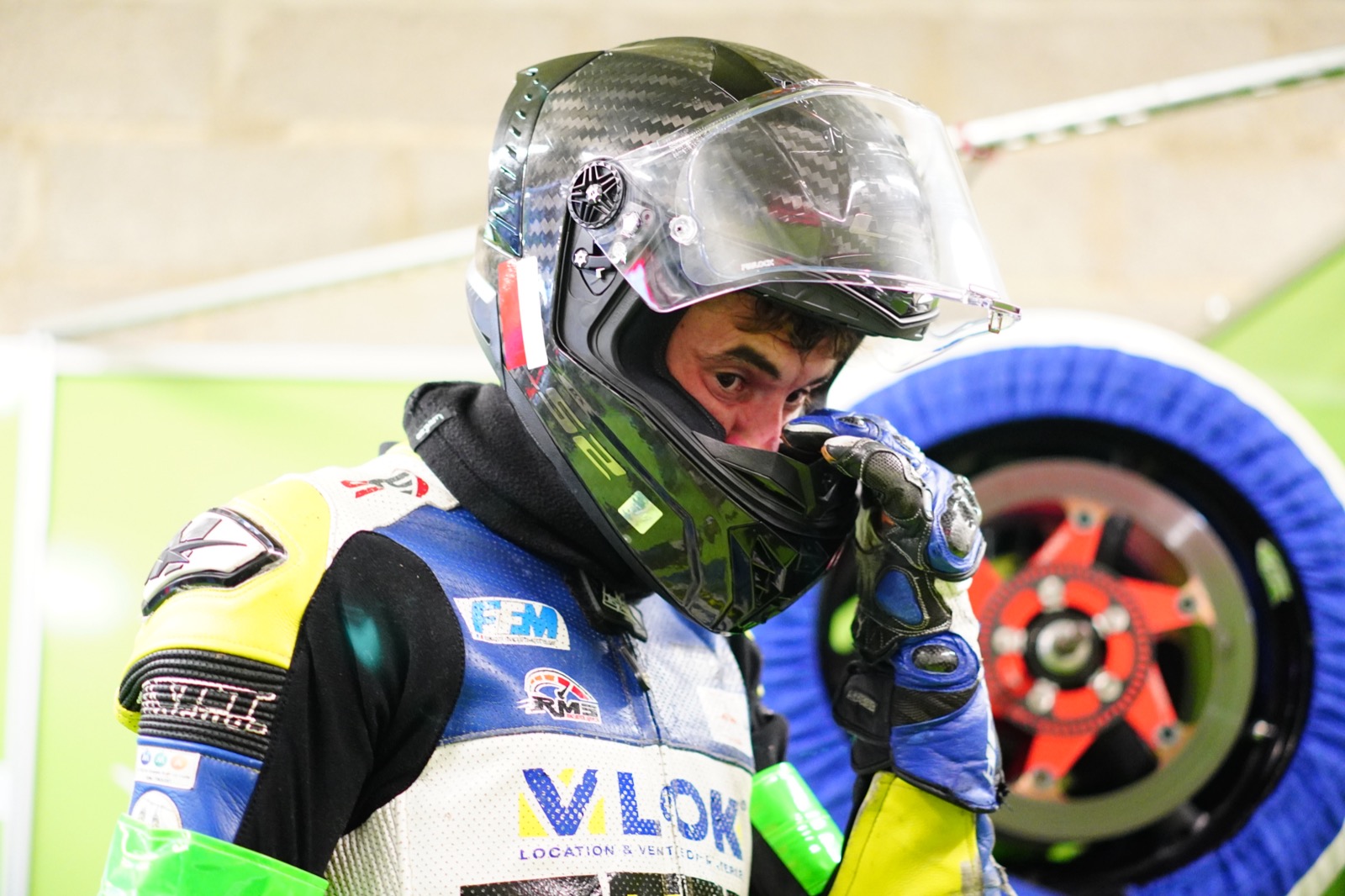
In April 2022, the Kingtyre Fullgas Racing Team rolled into Le Mans for the first time. The #116 bike carried KingTyre K00 slick tires on a modified production-based chassis, with a four-rider crew working through the night.
The technical objective for the first year was simple: finish. A first-year endurance program that doesn’t finish the race doesn’t generate usable data. The team focused on:
The race was completed. The K00 ran its first 24-hour stint. The compounds stayed within their target windows. The casing held. That alone was a milestone — most first-year endurance programs don’t finish, and most first-year race tires don’t survive.
Year two was about compound refinement. The 2022 data showed where the K00’s working temperature window was narrower than ideal in certain conditions, particularly during the transition from cold night stints to warmer morning stints. The team refined the Soft (G) and Medium (GR) compounds to widen the working temperature window without sacrificing peak grip.
Three changes went into the 2023 K00:
The 2023 race was completed with stronger stint data across all four compounds. More importantly, the year validated that the four-compound system was not just a marketing claim — each compound was measurably different in temperature window and wear behavior, and teams could plan pit stops against the difference.
The 2024 24 Heures Motos was a wet race. Two hours of standing water on parts of the Sarthe circuit. The K01 rain tire — designed for high-speed water drainage and validated through the previous two years of testing — became the primary tire for the race.
The K01 holds an ECE R75 approval and is engineered for wet track conditions. Its deep tread pattern channels water away from the contact patch at race speeds. Across the 2024 race, the team completed over 850 laps using K01 rain tires in mixed conditions — wet stints, dry stints, and transitional stints where the track was drying in some sectors and wet in others.
The 2024 race became a public validation of the K01 in a way no test session could match. The tire held. The team finished. The data captured across the wet stints fed directly back into the K01’s compound and pattern refinements, and into the rain-ready compounds of the K06 semi-slick and the K905 sport-touring tire.
By the end of 2024, KingTyre’s cumulative endurance telemetry database passed 1TB — temperature, pressure, wear, lap time, and compound behavior across four years of racing. That database is the most valuable asset KingTyre’s R&D team has. Every compound decision since 2024 has been informed by it.
Year four was about casing refinement. The 2024 wet race and the cumulative stint data highlighted two specific areas for improvement:
The 2025 race also introduced an updated puncture-repair protocol for the K00. Endurance racing will eventually put a tire in a situation where mid-stint repair is the difference between finishing and not finishing. The 2025 protocol reduced the typical puncture-repair time by 30% and increased the post-repair stint reliability.
In June 2026, the Kingtyre Fullgas Racing Team completed its fifth consecutive 24 Heures Motos. The #116 bike completed 742 laps across wet and dry stints, with 16 pit stops total, using K00 slick and K01 rain tires depending on conditions.
The 2026 race is the one most representative of an “average” Le Mans — variable weather, multiple compound changes across the 24 hours, and stints ranging from 30 minutes to over 90 minutes. The fact that the team completed 742 laps with 16 stops means an average stint length of 46 laps per set of tires, on a circuit where lap times are in the 1:47–1:52 range.
Best lap across the 2026 race was 1:47.22, set during a clear-air qualifying session on the K00 Medium compound. Total fuel consumption across the 24 hours was approximately 480 litros — a useful benchmark for racing teams planning fuel-and-tire strategy around similar engine platforms.
| Year | Status | Total laps | Stops | Best lap | Key validation |
|---|---|---|---|---|---|
| 2022 | First Chinese tire at Le Mans | — | — | — | Casing integrity, compound window |
| 2023 | Second-year refinement | — | — | — | Compound refinement, four-compound system validated |
| 2024 | Wet race | — | — | — | Rain tire at race pace; 1TB cumulative telemetry |
| 2025 | Continued iteration | — | — | — | Sidewall and shoulder updates; repair protocol |
| 2026 | Fifth consecutive year | 742 | 16 | 1:47.22 | Mixed-condition stints, full program validation |
The headline numbers — 742 laps, 16 pit stops, 1:47.22 best lap — are competitive at club and national endurance level, not at the front of the FIM EWC field. That is intentional. KingTyre’s program objective has never been to win the FIM Endurance World Championship; it has been to validate the K00 and K01 in the most demanding race in the sport, and to use the data to inform every tire the company ships to its 45+ export markets.
Five years of endurance racing generate a lot of data. Here are the four telemetry findings that have shaped K00 and K01 specifications, and that inform KingTyre’s street, sport, and adventure tire development.
Across stints of 30 to 90 minutes, K00 hot pressure stayed within a 0.15 bar envelope of the target pressure. In practical terms: a team can plan a pit stop for the 60-minute mark without worrying that pressure creep will require an unscheduled stop at the 45-minute mark. This stability is what allows the four-compound system to deliver predictable stint-length planning.
Across the tread width, K00 tread temperature variation stayed below 12°C during normal stints. A wide thermal gradient (e.g., 20°C+ from edge to edge of the tread) is the precursor to catastrophic grip loss at the end of a stint. The K00’s steel-belt package distributes heat evenly across the crown, which extends usable stint length and gives the rider more consistent feel as the tire ages.
Tread depth loss on the K00 followed a predictable curve: linear decline from lap 1 to lap ~600, then a slower “long-tail” phase as the tire approaches minimum tread. Teams can plan tire changes against this curve instead of reacting to sudden grip loss. The same wear curve informs K06 semi-slick development — semi-slick tires need to deliver consistent grip across a longer street-tire life, and the K00’s predictable wear pattern is the reference behavior.
Across the five-year program, mid-stint puncture repairs on the K00 have been completed in approximately 30% less time since the 2025 protocol update. More importantly, post-repair stint reliability has improved — a repaired tire is now expected to finish its planned stint without re-failure. This matters for amateur teams who don’t have the spare-tire inventory of a professional factory effort.
The five Le Mans campaigns have direct commercial implications for anyone who buys K00 or K01 tires from KingTyre.
Yes — and that is the entire point of the program.
The K00 and K01 tires sold to amateur endurance racing teams, club racing federations, and track-day operators are the same products that the Kingtyre Fullgas Racing Team runs at Le Mans. There is no separate “consumer” version with a softer compound or a cheaper casing. The data, the protocols, the warming guidance, and the compound selection framework all transfer directly.
An amateur team planning a 6-hour or 12-hour endurance race should:
The technology transfer runs in both directions. What amateur teams learn at club level feeds back into KingTyre’s understanding of how the K00 performs outside Le Mans. The next round of compound refinements — already in development for the 2027 K00 — will incorporate data from amateur teams who run the same tires on regional circuits.
The 2026 Le Mans 24H is the most recent data point, but it is not the end of the program. KingTyre has confirmed continued participation at the 24 Heures Motos and intends to expand its endurance racing presence to include:
For B2B buyers — racing teams, distributors, series organizers — the implication is that the K00 product line will continue to evolve in measurable, documented ways. Specifications are stable year over year, but improvements compound. A team that buys K00 tires in 2027 will get a tire informed by every lap of the 2022–2026 Le Mans campaigns, plus every lap run by amateur teams in between.
Has KingTyre always raced at Le Mans?
KingTyre first raced at the 24 Heures Motos at Le Mans in 2022. The company was the first Chinese motorcycle tire manufacturer to compete at the FIM Endurance World Championship level. The seven years of development behind the 2022 debut started in 2019 with radial-construction racing tire R&D.
Why endurance racing and not MotoGP or WorldSBK?
Endurance racing is the most demanding tire development laboratory in motorcycle sport. A 24-hour race tests casing integrity, compound longevity, supply consistency, and pit-stop economics in ways that a 20-minute sprint race cannot. The lessons transfer directly to every other product line KingTyre ships. Sprint racing focuses on single-event peak performance; endurance racing focuses on the manufacturing discipline that B2B buyers care about.
What tires does the Kingtyre Fullgas Racing Team run?
The team runs K00 slick tires in dry conditions and K01 rain tires in wet conditions. Both products are commercially available — the team runs the same tires that any racing team or distributor can order from KingTyre.
Can amateur teams buy the same tires?
Yes. The K00 and K01 sold to amateur endurance teams are the same products used at Le Mans. There is no separate “factory” or “homologation” version. Minimum order quantities and pricing depend on size, compound, and shipment volume; full-container orders typically receive the best unit pricing.
What is the best lap time ever recorded by KingTyre at Le Mans?
1:47.22, recorded at the 2026 24 Heures Motos on the K00 Medium compound. This is the team’s fastest single lap across the five-year program.
How can distributors or series organizers get more information?
Distributors can request a wholesale catalog, batch sheet samples, and compound reservation pricing through the KingTyre contact form. Series organizers can request sample tires for homologation testing, including batch documentation and pre-race engineering support for selected events.
What other KingTyre tires benefit from the Le Mans program?
The K06 semi-slick, K905 sport-touring tire, K97 sport on-road tire, and the K66 / K67 adventure tire lines all benefit from compound and casing know-how developed on the K00 race program. The 1TB of cumulative telemetry informs compound selection, casing profiles, and pressure protocols across the full product line.
This article is part of KingTyre’s September hub-and-spoke content series. To get the full picture:
For product specifications and ordering:
About KingTyre: KingTyre (Tianjin Kingtyre Group Co., Ltd.) is a professional motorcycle radial tire manufacturer headquartered in Tianjin, China. Founded in 2015, the company operates a 15,000 m² ISO 9001 certified production facility with 300,000+ tires of annual capacity, 150+ tire sizes, and exports to 45+ countries. Certifications include ISO 9001, DOT, ECE R75, and CCC. The Kingtyre Fullgas Racing Team has competed at the 24 Heures Motos at Le Mans since 2022, completing five consecutive campaigns, with a best lap time of 1:47.22, 16 pit stops in the 2026 race, and over 1TB of cumulative endurance telemetry. https://www.chinakingtyre.com/
 Portuguese
  English
  Spanish
  French
  German
  Korean
  Japanese
  Italian
  Russian
  Dutch
Dutch  Danish
  Polish
  Turkish
  Czech
Czech