
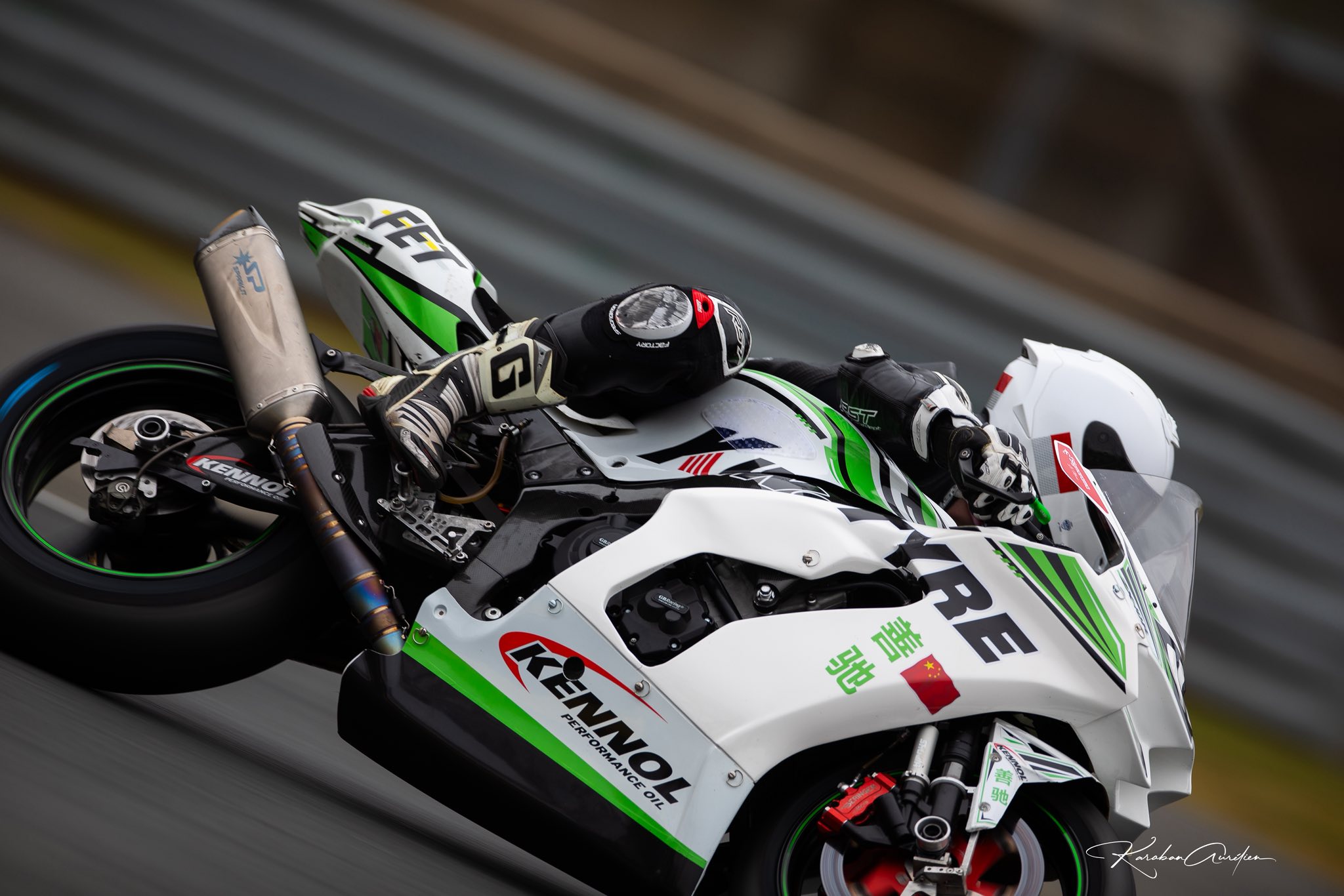
Riders who push hard on track eventually encounter motorcycle slick tire problems that can ruin a session or cost a race win. The key is knowing what causes these issues and how to address them. This guide breaks down nine of the most common motorcycle slick tire problems and explains how Kingtyre’s precision-engineered range — including the K00, K06, и K905 — solves each one.
The problem: Every slick tire has an optimal temperature range, typically no wider than 15–20°C. Drop below it and the rubber feels like plastic; exceed it and the compound turns greasy. Many slicks force riders to compromise — running a compound that is perfect for the first five laps but falls apart in the last five, or vice versa.
The Kingtyre solution: Сайт K00 full slick is available in four distinct compounds — Super Soft, Soft, Medium, and Hard — each engineered for a specific temperature band. This lets riders match the exact compound to track conditions rather than accepting a one-size-fits-all compromise.
| Состав | Optimal Ambient Track Temperature | Best Use Case |
|---|---|---|
| Super Soft | 15–25°C (59–77°F) | Cold tracks, sprint races, qualifying |
| Мягкий | 20–35°C (68–95°F) | Fast track days, club racing |
| Средний | 30–45°C (86–113°F) | Hot tracks, endurance racing |
| Hard | 40°C+ (104°F+) | Extreme heat, high-wear circuits |
Сайт K06 и K905 offer the same compound choice flexibility, with semi-slick variants providing an even broader operating window for riders who split time between road and track.
Important distinction: The table above shows ambient track temperature for compound selection. Once on track, the tire itself generates heat through carcass flexing and friction, reaching a tire surface working temperature of 80–120°C (176–248°F). This is the actual temperature at which the rubber delivers maximum grip. A cold tire below 60°C (140°F) surface temp will lack traction regardless of compound choice.
The problem: Cold slick tires are dangerously slippery. A slick tire’s treadless design means it relies entirely on its compound reaching operating temperature to generate grip. When cold — such as at the start of a session or after a pit stop — the rubber cannot deform into the pavement surface, resulting in dramatically reduced traction that has caught out countless riders on the first flying lap.
The Kingtyre solution: Kingtyre’s compound formulation incorporates advanced polymer technology that activates at lower temperatures than conventional racing slicks. The K00 Super Soft and Soft compounds reach functional grip levels within one lap of moderate pacing, significantly reducing the window of vulnerability. The semi-slick K06 and K905 variants use a computer-aided compound distribution system that maintains pliability even when the tire is not yet at full operating temperature, providing a safety margin that pure race slicks often lack. This directly addresses one of the most critical motorcycle slick tire problems faced by riders on cool mornings.
Riders in the Asia Track Series have reported predictable, confidence-inspiring cold behavior from the Kingtyre K00, with the progressive grip build-up allowing smoother early-lap pacing.
The problem: Every lap spent warming tires is a lap not spent setting a personal best. Some slick tires require three, four, or even five laps of aggressive cornering before they reach peak grip. In a sprint race format — where every lap counts — a slow warm-up can be the difference between pole position and mid-pack.
The Kingtyre solution: The treadless surface of the K00 and K905 full slick variants allows rapid, even heat generation across the entire contact patch. Rider feedback consistently shows the K00 Soft compound reaching full operating temperature (80–120°C surface temperature) within 1.5 to 2 laps, with the Super Soft compound ready to push in as little as one lap.
The semi-slick versions of the K06 and K905 require 2 to 3 laps — competitive with any semi-slick on the market. The Medium compound in both semi-slick models offers a particularly progressive warm-up characteristic that builds confidence for riders transitioning from street tires to track rubber.
For sprint racers and qualifying specialists, the K00 Super Soft delivers the fastest warm-up in the Kingtyre range, making it the tire of choice when every tenth of a second matters.
The problem: Tread tearing — the physical ripping of rubber from the tire surface — is one of the most visible signs of a slick tire under distress. It occurs when localized forces exceed the tensile strength of the compound, often caused by excessive wheel spin, aggressive throttle application, or a compound that is too soft for the track surface and ambient temperature. Once tearing begins, grip degrades rapidly, and the tire is effectively done.
The Kingtyre solution: Kingtyre addresses tearing at the compound engineering level. The K00 full slick uses a multi-compound carcass design where the tread compound is supported by a structurally optimized casing that distributes forces more evenly across the contact patch. This reduces localized stress concentrations that trigger tearing.
For riders who frequently encounter tearing issues — typically those running on abrasive track surfaces or in high-torque applications — stepping up to the K00 Medium or Hard compound provides greater tear resistance while still delivering competitive grip levels. The K06 and K905 semi-slick variants benefit from their computer-aided compound distribution system, which ensures even rubber density and reduces the stress points that lead to tearing.
The problem: A compound that is too soft for the track temperature will overheat, wear out in a single session, and may begin tearing. But a compound that is too hard will never reach operating temperature, leaving the rider with inadequate grip throughout the session. Finding the right compound for a given day’s conditions is a constant challenge — and one of the most frequent motorcycle slick tire problems reported by club racers.
The Kingtyre solution: Having four compound options across the K00, K06, and K905 range means there is a Kingtyre tire for virtually any track condition. The compound selection guide is straightforward:
The Medium compound in the K00 full slick offers the best cost-per-lap ratio of any Kingtyre slick, delivering over 1,000 km of track use while maintaining consistent grip throughout its life. This makes it the recommended starting point for riders unsure of which compound suits their conditions — it is forgiving enough to work across a range of temperatures while still delivering competitive performance.
The problem: Many slicks are engineered for a narrow set of ideal conditions — smooth pavement, warm temperatures, and a clean track surface. When conditions deviate — cooler morning sessions, a recently resurfaced track with different abrasion characteristics, or a dusty/dirty surface — these tires can become unpredictable or perform far below expectations.
The Kingtyre solution: Kingtyre’s testing program spans a wide range of track conditions, from the smooth tarmac of dedicated racing circuits to the abrasive surfaces found at mixed-use tracks. The carcass construction across the K00, K06, and K905 range is designed to maintain consistent feedback and grip even when surface conditions are less than ideal.
The semi-slick variants of the K06 and K905, with their broader operating windows, are particularly well-suited to variable conditions. Riders who do track days at circuits that host both racing and street riding will find these tires more adaptable than pure race slicks that demand perfect conditions.
The problem: Slick tires are notoriously sensitive to tire pressure. A difference of just 1–2 PSI can mean the difference between a tire that grips predictably and one that slides unpredictably or wears unevenly. Getting the pressure wrong by even a small margin can ruin a session and create a safety risk. Alongside temperature management, pressure is one of the most overlooked motorcycle slick tire problems among newer track riders.
The Kingtyre solution: Kingtyre’s carcass construction is engineered to provide a wider effective pressure window than many competitors’ slicks. This means the tire maintains consistent contact patch shape and performance across a broader range of pressures, giving riders more margin for error.
General starting pressure recommendations for Kingtyre full slicks:
| Tire | Cold Pressure (Track Use) | Hot Pressure Target |
|---|---|---|
| K00 Front | 30–32 PSI (2.1–2.2 bar) | 33–35 PSI (2.3–2.4 bar) |
| K00 Rear | 28–30 PSI (1.9–2.1 bar) | 31–33 PSI (2.1–2.3 bar) |
| K06/K905 Front (Full Slick) | 30–32 PSI (2.1–2.2 bar) | 33–35 PSI (2.3–2.4 bar) |
| K06/K905 Rear (Full Slick) | 28–30 PSI (1.9–2.1 bar) | 31–33 PSI (2.1–2.3 bar) |
| K06/K905 Rear (Semi-Slick) | 30–33 PSI (2.1–2.3 bar) | 33–36 PSI (2.3–2.5 bar) |
Note: These are starting points. Fine-tune based on track surface, ambient temperature, and rider weight. Checking hot pressures immediately after a session provides the most reliable data for adjustments.
The problem: When a slick tire exceeds its optimal temperature window, the compound begins to degrade. The rubber becomes greasy, grip falls off sharply, and the tire may begin to “shed” rubber in a process called thermal degradation. Tire surface temperatures exceeding 130°C (266°F) can cause compound degradation and risk delamination. On hot days or high-speed circuits, this can render a tire unusable within a handful of laps. This is one of the most expensive motorcycle slick tire problems because it destroys a tire long before normal wear would.
The Kingtyre solution: The K00 Medium and Hard compounds are specifically engineered to resist high-temperature degradation. In the 24 Hours of Le Mans motorcycle endurance race, Kingtyre-equipped teams demonstrated the thermal stability of the K00 Medium, completing double stints without tire changes — a real-world validation of the compound’s ability to withstand sustained high temperatures. This achievement validates Kingtyre’s approach to solving real-world motorcycle slick tire problems at the highest level of racing.
The K905 semi-slick Hard compound is Kingtyre’s most heat-resistant option, designed for riders who do high-mileage sessions in hot climates. Its carcass construction includes additional heat-dissipation layers that prevent the compound from overheating during extended use. The Сертификация ECE on the semi-slick variants also confirms their compliance with international safety standards.
For riders who find themselves consistently fighting high-temperature degradation, switching to a harder compound within the same model range is the most effective solution — and one that Kingtyre’s multi-compound lineup makes possible without changing tire dimensions or chassis setup.
The problem: At extreme lean angles — 50 degrees or more — a slick tire undergoes enormous lateral forces. If the carcass structure is not stiff enough, the tire can deform unpredictably, causing the rider to lose confidence or, worse, lose the rear. This is particularly common with tires that use a single-compound construction or an under-engineered carcass design.
The Kingtyre solution: The Kingtyre K00 full slick is built around a multi-compound carcass design that maintains lateral stiffness during extreme lean angles. This construction ensures that the contact patch remains stable and predictable even at maximum lean, giving the rider the confidence to push to the limit.
Internal track testing has shown the K00 maintaining lap time consistency within 0.3 seconds over a 20-lap race distance, with no degradation in corner exit grip as the session progresses — a direct result of the carcass’s structural stability.
The K06 and K905 benefit from the same engineering philosophy, with their own optimized carcass designs that prioritize stability under load. The semi-slick variants include additional reinforcement in the sidewall area to compensate for the structural impact of their minimal tread pattern, ensuring that street legality does not come at the cost of track performance.
| Motorcycle Slick Tire Problem | Recommended Kingtyre Tire | Why |
|---|---|---|
| Narrow temp window | K00 (multiple compounds) | 4-compound range covers 15–40°C+ |
| Cold grip / slow warm-up | K00 Super Soft or Soft | Fastest warm-up in the range |
| Tread tearing | K00 Medium or Hard | Higher tear resistance |
| Wrong compound choice | K00 Medium | Most forgiving across conditions |
| Variable track conditions | K06 or K905 Semi-Slick | Broader operating window |
| Pressure sensitivity | K00 / K06 / K905 (all) | Wide effective pressure window |
| High-temp degradation | K00 Hard / K905 Semi-Slick Hard | Heat-resistant compound engineering |
| Structural stability | K00 Full Slick | Multi-compound carcass design |
Every motorcycle slick tire involves trade-offs. The key is understanding which trade-offs matter for your riding and finding a tire that addresses the specific motorcycle slick tire problems you encounter on track. Kingtyre’s range — from the race-focused K00 to the versatile K06 and K905 in both full slick and semi-slick versions — offers engineered solutions to each of these common issues, giving riders the confidence to push harder and ride faster.
If you have struggled with any of the motorcycle slick tire problems in this guide, the right Kingtyre compound and model combination can make a real difference — not just in lap times, but in your overall experience on track. Read our complete guide to slick tire price and performance for more detailed comparisons.
The K00 Medium or Hard compound offers the greatest tear resistance. If tearing persists, check your tire pressure and throttle application — excessive wheel spin is a common cause.
Start with the lower end of the recommended cold pressure range (30 PSI front, 28 PSI rear) and monitor hot pressures after your first session. Increase by 1 PSI increments if the tire feels unstable.
Many riders qualify on the K00 Super Soft for maximum grip and switch to the Medium for race distance. This strategy maximizes both single-lap pace and consistent race performance.
Signs include a greasy feeling under acceleration, reduced corner exit grip, and visible rubber “shedding” on the tire surface. If you see these signs, switch to a harder compound.
The K905 semi-slick Hard compound offers excellent heat resistance, but for sustained high-temperature use on track, the K00 Hard full slick is the better choice due to its dedicated race construction.
 Russian
  English
  Spanish
  French
  German
  Korean
  Japanese
  Italian
  Dutch
Dutch  Danish
  Portuguese
  Polish
  Turkish
  Czech
Czech