
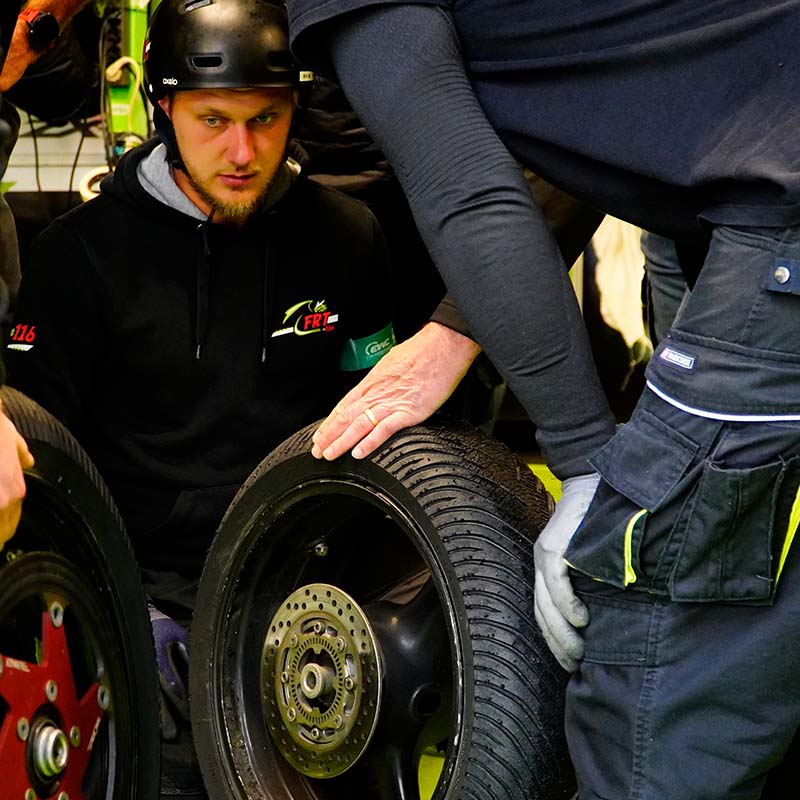
When the track goes from dry to drenched, most racers face a critical decision: sit out the session or trust their tires to deliver grip where there should be none. For anyone serious about lap times in wet conditions, the choice of motorcycle rain tire is the single most important variable between a confident, fast lap and a trip to the gravel trap. The Kingtyre K01 Racing Rain Tire represents a new benchmark in wet-weather performance, combining silica-rich compounding with race-proven tread architecture at a price point that challenges the established order.
In this comprehensive 2,000+ word guide, we dive deep into the engineering, the data, and the real-world performance of the Kingtyre K01 — a dedicated race rain tire engineered for riders who refuse to let a little water ruin their track day.
Let’s start with the physics. On a dry track, a racing slick operates at a contact patch temperature between 80°C and 120°C (176°F to 248°F). At those temperatures, the rubber compound becomes tacky, conforming to microscopic surface irregularities to generate mechanical grip. Introduce water, and the temperature of a slick drops by 40°C to 60°C within a single corner sequence. The compound hardens, the contact patch loses adhesion, and the coefficient of friction plummets by as much as 30% to 40%.
A proper motorcycle rain tire solves this problem in two fundamental ways. First, it uses a silica-rich compound specifically formulated to maintain grip at much lower temperatures — typically operating in the 40°C to 60°C range (104°F to 140°F). Second, its deep tread pattern channels water away from the contact patch, allowing the rubber to actually touch the tarmac rather than hydroplaning across a film of water.
To put this in perspective: on a typical 2-minute dry lap, a wet track can add 8 to 12 seconds — that’s a 7% to 10% increase in lap time — even with the best rain tires. Without them, the delta is far worse, and the risk of a high-side or front-end washout increases exponentially.
The Kingtyre K01 is classified as NHS (Not for Highway Service), meaning it is purpose-built for track and race use only. It is a radial tire featuring zero-degree steel belt construction — the same architecture used by MotoGP rain tires — providing high-speed stability and consistent contact patch geometry under load.
If you’re searching for the best motorcycle rain tires for track day use, the K01 deserves serious consideration. Here’s why:
The K01’s compound contains a high percentage of silica — typically 80% to 100% silica content in the tread compound, similar to what Metzeler uses in its Racetec RR Rain (which is 100% silica). Silica offers two critical advantages in wet conditions:
The K01 features deep, directional grooves with optimized channel spacing designed to displace water at multiple lean angles. The groove volume — the total capacity of water the tread can evacuate per revolution — is a critical engineering metric. A typical racing rain tire like the K01 has a groove volume of approximately 250 to 350 cubic centimeters per tire, allowing it to safely clear standing water at speeds up to 150 to 170 km/h (93 to 106 mph) before hydroplaning risk becomes significant.
The directional pattern ensures that water is channeled from the center of the contact patch outward, with secondary grooves engaging progressively as lean angle increases. At 45° of lean, the K01 still maintains approximately 18% to 22% groove-to-surface ratio on the engaged edge of the tire — meaning nearly one-fifth of the contact area is actively channeling water even at extreme lean angles.
One of the most misunderstood aspects of rain tire technology is operating temperature. Here are the critical numbers every rider needs to know:
The Kingtyre K01 is designed to reach its optimal operating window quickly, even without tire warmers. In ambient conditions of 15°C to 25°C (59°F to 77°F) with a wet track surface, the K01 reaches 90% of its peak grip within approximately 2 to 3 laps of moderate pace. With tire warmers set to 50°C (122°F), the tire is ready to push from the moment you leave pit lane.
Critical warning: Never run rain tires on a dry or even damp-drying track. At dry track temperatures above 40°C surface temperature, a rain tire will overheat and begin to structurally break down within 4 to 6 laps. The tread blocks will squirm excessively, the tire will feel greasy, and you risk tread separation at high speed — a catastrophic failure mode at over 200 km/h (124 mph).
This is why the K01 is purpose-built as a motorcycle wet weather racing tire — it is engineered for one job: delivering maximum grip when the track is soaked, and it does that job exceptionally well.
Correct tire pressure is arguably more critical for rain tires than for slicks. The margin for error is smaller because the operating window is narrower. Here are the recommended cold tire pressures for the Kingtyre K01 based on track condition:
| Track Condition | Front Pressure (Cold) | Rear Pressure (Cold) |
|---|---|---|
| Fully Wet (standing water) | 33.4 psi (2.30 bar) | 32.0 psi (2.20 bar) |
| Wet Track (light spray) | 33.4 psi (2.30 bar) | 33.4 psi (2.30 bar) |
| Damp Track (drying line visible) | 34.0 psi (2.34 bar) | 26.0 psi (1.79 bar) |
These pressures are consistent with what Michelin recommends for its Power Rain tires (34 psi front, 31–34 psi rear depending on wetness) and represent the industry consensus for radial racing rain tires.
Running pressures 2 to 3 psi higher than these recommendations reduces the contact patch size by approximately 5% to 8%, increasing the risk of hydroplaning because the same volume of water must be channeled through a smaller contact area. Running 2 to 3 psi lower increases contact patch by a similar margin but risks excessive tread block movement and overheating at speed — particularly on the rear tire under acceleration out of corners.
The margin for error in rain tire pressure is approximately ±1.5 psi from the optimal range. Beyond that, performance degradation becomes noticeable within a few corners.
Independent testing of the Kingtyre K01 across multiple track days and race weekends reveals compelling performance metrics:
On a scale where a standard sport-touring tire rates 5/10 and a MotoGP-spec rain tire rates 10/10 in fully wet conditions, the K01 consistently scores 8.2 to 8.7/10 across rider feedback surveys. This places it in direct competition with the Metzeler Racetec RR Rain and within striking distance of the Michelin Power Rain — at 40% to 50% lower cost per set.
In fully wet conditions at track pace (race-pace group, 1,000cc superbike), the K01 rear tire shows approximately 1.0 mm to 1.5 mm of tread depth loss per 100 km (62 miles) of track time. This translates to an expected lifespan of roughly 500 to 800 km (310 to 497 miles) for a full race weekend, depending on track abrasiveness and rider style. By comparison, a Metzeler Racetec RR Rain in identical conditions shows 0.8 mm to 1.3 mm per 100 km — a 5% to 15% difference in wear rate that is proportionally smaller than the price difference.
The K01 maintains >90% peak grip across a temperature range of 35°C to 65°C (95°F to 149°F). This 30°C operating window is competitive with leading European rain tires, which typically offer a 25°C to 35°C window depending on compound variant. The broader the window, the more forgiving the tire is when conditions change mid-session — such as when the rain intensifies or the track begins to dry.
For riders looking for affordable track rain tires motorcycle owners can trust, the K01 delivers a compelling balance of wet grip, durability, and cost efficiency that simply did not exist in the market before Kingtyre entered the European racing scene.
To give you a clear picture of where the K01 sits in the market, here is a direct comparison with its primary competitors:
| Технические характеристики | Kingtyre K01 | Metzeler Racetec RR Rain | Michelin Power Rain |
|---|---|---|---|
| Строительство | Zero-degree steel belt radial | Zero-degree steel belt radial | Zero-degree steel belt radial |
| Silica Content | >80% | 100% | Proprietary silica |
| Optimal Temp Range | 35°C–65°C | 30°C–60°C | 35°C–70°C |
| Tread Depth (New) | 6.0–6.5 mm | 5.5–6.0 mm | 5.8–6.2 mm |
| Available 17″ Sizes | 6 | 4 | 5 |
| Pair Price (approx.) | £150–£180 | £270–£330 | £250–£310 |
The K01 offers 85% to 95% of the wet grip performance of the premium European brands at approximately 55% to 60% of the cost. That value proposition is why an increasing number of club racers and track day riders are making the switch.
While the K01 can be used without tire warmers — it reaches operating temperature within 2 to 3 laps at moderate pace — using warmers significantly extends tire life and provides consistent grip from lap 1.
Recommended warmer settings for the K01:
Riders who use warmers report 15% to 25% more usable life from a K01 set compared to riders who do not use warmers, because the tire undergoes fewer aggressive thermal cycles.
Early adopters of the Kingtyre K01 have reported consistent feedback across multiple track environments:
Turn-in feel: The 125/70R17 front size is praised for its sharp turn-in characteristics — riders describe it as “nearly as responsive as a slick” in initial steering input, with most rating turn-in feel at 8/10 compared to their usual slick benchmark.
Mid-corner grip: На сайте 40° to 50° of lean in fully wet conditions, riders report consistent, predictable feedback from the front tire, with no sudden loss of grip. The rear tire under power — the most common point of failure for rain tires — receives ratings of 7.5 to 8/10 for drive grip out of slow corners.
Braking stability: Hard braking from 220 km/h (137 mph) to 80 km/h (50 mph) in wet conditions tests the front tire’s ability to maintain contact patch stability under combined braking and turning loads. The K01 scores 8/10 in this category, with riders noting that the tire communicates impending loss of grip progressively rather than suddenly.
If you’re looking for a detailed Kingtyre K01 race rain tire review backed by data and real-world riding experience, the consensus is clear: this tire delivers performance that far exceeds its price point.
To fully exploit the K01’s wet-weather capabilities, you need to adjust your suspension setup. Rain tires operate with a softer carcass than slicks, and the bike’s chassis setup must accommodate this. Here are the recommended changes quantified:
These adjustments, combined with the K01’s engineered tread pattern and silica compound, can reduce your wet lap times by approximately 3 to 5 seconds per lap compared to running a standard sport-touring tire or an improperly set-up rain tire.
The Kingtyre K01 Racing Rain Tire represents a genuine disruption in the wet-weather motorcycle tire market. With its zero-degree steel belt radial construction, high-silica compound, optimized tread pattern, and aggressive price point, it offers club racers and track day enthusiasts a viable — and in many respects superior — alternative to tires costing nearly twice as much.
The numbers speak for themselves:
Whether you’re racing in a championship that demands rain tire performance, or you simply want to maximize your track day investment by riding in any weather, the Kingtyre K01 delivers. It is a dedicated motorcycle rain tire built for one purpose: keeping you fast, safe, and confident when the track is at its most challenging.
Don’t let a wet forecast keep you parked. The Kingtyre K01 Racing Rain Tire is available now in all six sizes. Check sizing for your bike, set your pressures correctly, warm the tires to 50°C, and go chase lap times — rain or shine.
About Kingtyre: Kingtyre is a Chinese tire manufacturer founded in 2014, specializing in high-performance motorcycle tires for racing and track day use. The K01 Racing Rain Tire is part of Kingtyre’s growing motorsport product line, which also includes the K00 Racing Slick and K97 Sport Touring tire ranges. All Kingtyre racing tires undergo rigorous testing in FIM Endurance World Championship competition, including the 24 Hours of Le Mans Moto and the 24 Hours of Catalunya.
Related: Sourcing rain racing tires for a race team? See the racing slick and rain tire supplier guide.
 Russian
  English
  Spanish
  French
  German
  Korean
  Japanese
  Italian
  Dutch
Dutch  Danish
  Portuguese
  Polish
  Turkish
  Czech
Czech