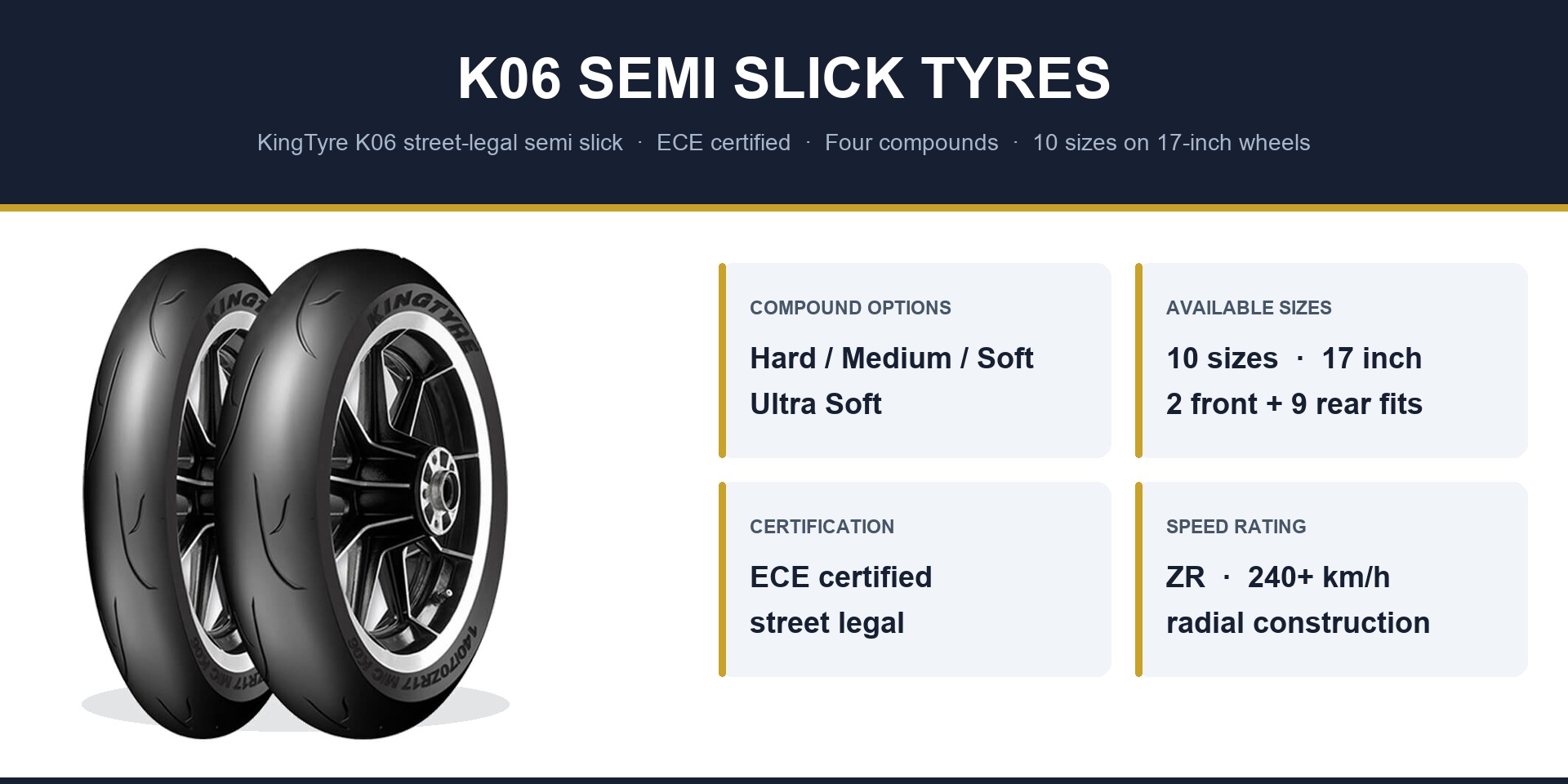
Quick answer: The KingTyre K06 is an ECE-certified, street-legal semi slick racing tyre on a radial carcass with a ZR speed rating (240 km/h and above). It is produced in four compounds — hard, medium, soft and ultra soft — across ten 17-inch sizes, and it sits in KingTyre's race-derived road-and-track line rather than in the track-only slick category.
Last updated: November 13, 2026. Written and reviewed by the KingTyre technical team. Compound, certification, size, rim-width and pressure figures come from the current KingTyre K06 product page and KingTyre's official race tyre specification sheet; company figures come from the KingTyre about page. Where KingTyre has not published a figure, this guide says so rather than estimating it.
The KingTyre K06 is a street-legal semi slick tyre that behaves like a racing tyre without giving up road legality. A semi slick tread keeps an almost continuous contact patch across the centre of the tyre and cuts only a few shallow grooves into it, so most of the rubber stays on the road at any lean angle. Those grooves are the whole point of the design: they disperse water and give the tyre a measurable margin in damp conditions, while the large stiff rubber area around them delivers the high-grip surface a track rider needs.
The K06 is deliberately not a full slick. Race-only slicks such as the KingTyre K00 carry the NHS marking — not for highway service — and cannot legally be run on public roads. The K06 is the road-legal alternative: the same four-compound logic, the same race-derived construction, plus ECE certification and shallow shoulder grooves that make it usable between track sessions. If you are still weighing tread types, our semi slick vs full slick comparison explains the engineering trade-off in full.
Riders normally arrive at the K06 after hitting one of four recurring problems with ordinary tyres:
The K06 answers all four: four compounds to match the surface temperature, ECE approval so the tyre is legal between sessions, and a stiff radial carcass with reinforced sidewalls that holds its shape through a full day of track use.
The table below is the fastest way to see what the K06 actually is. Every row is taken from KingTyre's published K06 product data and the company's official race tyre specification sheet.
| Spezifikation | KingTyre K06 |
|---|---|
| Tread type | Semi slick with minimal grooves and rain-resistant shoulder treads |
| Zertifizierung | ECE certified — legal for public road use |
| Speed rating | ZR — certified for speeds above 240 km/h |
| Bauwesen | Radial, carbon-reinforced sidewalls, reinforced carcass |
| Compounds available | 4 — hard, medium, soft, ultra soft |
| Published sizes | 10 sizes on 17-inch wheels — 2 front fitments, 9 rear fitments |
| Front sizes | 110/70ZR17, 120/70ZR17 |
| Rear sizes | 120/70 ZR17, 140/70 ZR17, 150/60 ZR17, 160/60 ZR17, 180/55 ZR17, 180/60 ZR17, 190/55 ZR17, 200/55 ZR17, 200/60 ZR17 |
| Official warming spec | 60 minutes at 80–90°C |
| Wear indicators | Two wear bars per tyre |
| Product category | Racing Slicks / Super Sport Tyres |
| Reference SKU | KT-K06 |
Behind those numbers is a factory that builds the K06 on the same lines as its race tyres. KingTyre uses automated curing systems, precision CNC mould engineering and ISO 9001-certified processes, and its computer-aided compound distribution system controls rubber density so that heat dissipation and wear rate stay consistent across a production run. The compound development data comes from track day testing and from racing teams across Asia and Europe.

The four-compound system is the K06's single most important commercial feature for a distributor or a race team, because one tyre family then covers a cold-morning sprint and a hot afternoon endurance race without changing supplier.
The K06's four compounds exist because one rubber cannot cover a 40°C track and a 120°C track. KingTyre publishes a surface-temperature window for two of them: the soft compound is stable from 40°C to 85°C, and the hard compound holds up to 120°C. The medium and ultra soft compounds sit between those two duties, and KingTyre does not publish a fixed temperature band for them — treat them as the all-round and the maximum-grip options rather than as a temperature-graded series.
| Verbindung | Best used for | Published temperature data | What to expect |
|---|---|---|---|
| Hart | Endurance sessions and hot tracks | Stable up to 120°C | Longest life of the four, slowest to warm up, forgiving when the track is above 90°C |
| Mittel | Mixed track days and road-and-track use | Not separately published | Balanced grip and life; the safe default when the track temperature is unknown |
| Weich | Cool-morning sprints and qualifying | Stable from 40°C to 85°C | High mechanical grip, faster to reach working temperature, shorter life |
| Ultra soft | Maximum grip in short bursts | Not separately published | Peak grip and the sharpest turn-in, but the shortest service life of the four |
KingTyre's own selection rule is short and practical: choose soft for cold tracks and sprint races, and hard for endurance and high-temperature tracks. Rider style and session length matter just as much as temperature — a rider who drags the rear tyre out of slow corners will get more from a hard compound, while a rider who carries corner speed will get more from a softer one.
All ten K06 sizes are 17-inch ZR radials, which means the tyre fits the wheel widths that sport and superbike machinery actually uses. The front range runs from 110/70ZR17 to 120/70ZR17 and the rear range from 120/70ZR17 up to 200/60ZR17, so a K06 package can be built for anything from a 600-class sportbike to a litre superbike.
| Größe | Position | Measured rim | Approved rim widths |
|---|---|---|---|
| 110/70ZR17 | Vorderseite | MT3.00 | 3.00–3.50 in |
| 120/70ZR17 | Front / rear | MT3.50 | 3.50–3.75 in |
| 140/70ZR17 | Rückseite | MT3.75 | 3.50–4.00 in |
| 150/60ZR17 | Rückseite | MT4.25 | 4.00–4.50 in |
| 160/60ZR17 | Rückseite | MT4.50 | 4.25–5.00 in |
| 180/55ZR17 | Rückseite | MT5.50 | 5.50–6.00 in |
| 180/60ZR17 | Rückseite | MT5.00 | 5.00–5.50 in |
| 190/55ZR17 | Rückseite | MT6.00 | 5.50–6.00 in |
| 200/55ZR17 | Rückseite | MT6.25 | 6.00–6.25 in |
| 200/60ZR17 | Rückseite | Not published | Not published |
One honest caveat: the 200/60ZR17 rear appears on the KingTyre K06 product page, but it is not listed in KingTyre's official race tyre specification sheet, so its measured rim width, approved rim range and pressures are not published by the factory. If you plan to build a set around that size, ask KingTyre for the fitment and pressure data for your exact wheel width rather than guessing.

The same size logic applies across the whole 17-inch tyre category — our 17-inch motorcycle tyre guide covers how rim width, aspect ratio and load rating interact when you are matching a tyre to a machine.
These are the numbers to start from, straight out of KingTyre's own race tyre specification sheet for the K06 line. Pressures are given cold, with the hot figure measured straight out of the warmers, exactly as a rider would read them in the pit lane.
| Tyre size | Fitment | Cold pressure | Hot straight out of warmers |
|---|---|---|---|
| 110/70ZR17 | Vorderseite | 2.2 bar (32 psi) | 2.4 bar (35 psi) |
| 120/70ZR17 | Vorderseite | 2.2 bar (32 psi) | 2.4 bar (35 psi) |
| 140/70ZR17 | Rückseite | 1.6 bar (23 psi) | 1.8 bar (26 psi) |
| 150/60ZR17 | Rückseite | 1.6 bar (23 psi) | 1.8 bar (26 psi) |
| 160/60ZR17 | Rückseite | 1.6 bar (23 psi) | 1.8 bar (26 psi) |
| 180/55ZR17 | Rückseite | 1.6 bar (23 psi) | 1.8 bar (26 psi) |
| 180/60ZR17 | Rückseite | 1.6 bar (23 psi) | 1.8 bar (26 psi) |
| 190/55ZR17 | Rückseite | 1.6 bar (23 psi) | 1.8 bar (26 psi) |
| 200/55ZR17 | Rückseite | 1.6 bar (23 psi) | 1.8 bar (26 psi) |
KingTyre's own footnote on that sheet is the part most riders skip, and it matters: optimal hot pressures on track vary with rider style, rider weight, track surface and temperature, and suspension set-up. KingTyre recommends checking hot pressures in the pit lane directly after a few laps and making small adjustments if necessary. The published figures are a starting point, not a setting to run all season.
Für street riding, KingTyre's K06 product page recommends starting at 32 psi front and 34 psi rear, adjusted for load and rider weight. That is deliberately higher than the race figures above, because public-road riding loads the tyre in a completely different way and because low track pressures are not appropriate for road use.
The warming specification for the K06 line is 60 minutes at 80–90°C. For a deeper look at pressure technique in general, see what is the best tire pressure for racing slicks.
Choosing the right compound is a four-step decision, and getting it wrong costs a whole session.
| Scenario | Recommended compound | Why |
|---|---|---|
| Cold morning track, 20–30 minute sessions | Soft or ultra soft | Soft compounds reach their working window quickest and give the most mechanical grip while the track is still cold |
| Mid-range track temperature, mixed use | Mittel | Holds a usable grip window across a wide temperature range and doubles as a road tyre between sessions |
| Hot track above 90°C surface temperature | Hart | Resists thermal overload, gives consistent lap times over a long session and lasts longest |
| Road riding between track days | Medium or hard | Lower wear rate on asphalt and a much longer road life than the soft and ultra soft compounds |
| Endurance race or long race day | Hart | Survives the heat soak that soft and ultra soft compounds cannot |
| Qualifying lap on a cold track | Ultra soft | Maximum grip for a single flying lap, accepting the shortest possible service life |
Yes — the K06 is ECE certified, which is what makes it legal to ride on public roads. This is the single most important difference between the K06 and a race slick such as the K00, and it is also the reason the K06 exists as a separate product line. For the wider legal picture, our country-by-country guide to slick street legality explains which markets permit what.
Here is what the certification actually means for a rider or an importer:
Two caveats worth stating plainly. First, approval is per size and per construction — if you change the size or the rim width away from the published combination, the certification no longer applies to what you have fitted. Second, road rules still apply: tread depth, wear and the limits of the tyre's own construction are the rider's responsibility in every market.
For the regulatory detail behind these marks, our ECE R75 vs DOT FMVSS 119 comparison und DOT/ECE tyre codes explained guides cover what each standard tests and how the markings differ.
In the wet, the K06's shallow grooves and rain-resistant shoulder treads give it a genuine margin over a full slick, but it is still a semi slick. KingTyre's own guidance is to use the K06 in dry or slightly damp conditions and to treat standing water as outside its design envelope.
The K06 is the closest thing KingTyre makes to a road-legal track tyre, but it is not the only semi slick in the range — and the difference matters. Riders and distributors regularly confuse the K06, the K905 Semi Slick and the K97 Super Motard, then order the wrong tyre. This table separates them.
| Modell | Tread | Zertifizierung | Compounds | Where it fits |
|---|---|---|---|---|
| K06 Semi Slick | Semi slick with rain-resistant shoulders | ECE | Hart / Mittel / Weich / Ultraweich | Race-derived road-and-track tyre: track days, club racing, and legal use between sessions |
| K905 Semi Slick | Near-slick with minimal grooves | ECE + DOT | Hart / Mittel / Weich / Ultraweich | Street-and-track crossover for riders who also commute and stunt on the same tyre |
| K97 Super Motard | Fully treaded supermoto pattern | ECE + DOT + CCC | Hart / Mittel / Weich / Ultraweich | Supermoto, street stunt and wet-weather work where drainage matters more than a dry contact patch |
| K97 Sport On-Road | Road sport pattern | Road-certified | Not a multi-compound race line | Everyday road and long-distance riding, not track work |
| K00 Slick | Full slick, no tread grooves | NHS — track use only | Super Soft / Soft / Medium / Hard | Race teams and clubs on closed circuits; not legal on public roads |
| K01 Rain | Dedicated wet-weather pattern | NHS — track use only | Wet-specific compound | Endurance racing in the rain |
For the road-tyre side of the range, the K97 Sport On-Road is the long-life street option rather than a track product.
If you want the full picture on the K905, read the K905 semi slick tyre guide, and for the racer's-eye view of the difference between the tyre families, start with semi slick motorcycle tires: a buyer's guide to track-day performance. Riders who also run race-only tyres can compare the K06 directly with the K00 slick engineering guide, which explains how the track-only line is built.
A K06 is a performance tyre, and how it is fitted and warmed up decides how much of that performance you actually get.

For distributors and brands, the K06 is a compact way to enter the street-legal track tyre segment. One tyre family covers four compounds, ten 17-inch sizes and both track and road use, which means a distributor can serve track-day riders, club racers and road riders from a single product line.
The manufacturing background behind those deliveries is specific. KingTyre (Tianjin Kingtyre Group Co., Ltd.) was founded in 2015 and is one of the few Chinese manufacturers producing motorcycle radial tyres at scale. The Tianjin plant has an annual capacity of more than 300,000 radial tyres across 150-plus sizes and five product categories, and KingTyre currently exports to more than 45 countries across Europe, South America, Asia and the Middle East.
Quality and compliance are certified rather than claimed: production runs under ISO 9001, and the range is certified to DOT for the United States, ECE R75 for Europe and CCC for China. KingTyre also supports OEM and ODM programmes for teams and resellers — including private-label moulding and branding, which is covered in detail in our private label and OEM motorcycle tyre manufacturer guide.
The racing credentials are not a marketing layer over a road tyre. KingTyre's Full Gas Racing Team has competed in the FIM Endurance World Championship at the 24 Hours of Le Mans since 2022, and the telemetry, tyre-temperature and wear-rate data collected in that programme feeds straight back into compound formulation — the same development loop documented in our engineering report on the K00 endurance slick. If you are assessing whether the K06 belongs in your range, our guide to choosing a motorcycle tyre manufacturer in China sets out the questions worth asking any supplier — including the sourcing guide for racing slick suppliers and distributors if you also carry race-only tyres, and the importing guide for wholesale buyers for logistics, documentation and shipping.
Yes. The K06 is ECE certified, which is the approval that allows it to be ridden and registered on public roads. Every published size carries the ZR designation for speeds above 240 km/h. This is the difference that separates the K06 from race-only slicks such as the K00, which are marked NHS and are not permitted on the highway. Approval still applies only to the published size and rim-width combinations.
The four compounds are hard, medium, soft and ultra soft, and they differ in how wide a temperature window they work across and how quickly they reach it. Hard is stable up to 120°C and lasts longest. Soft is stable from 40°C to 85°C and gives the most mechanical grip in cool conditions. Medium is the balanced all-round option. Ultra soft is the maximum-grip choice for short bursts, with the shortest life of the four.
Use the compound that matches the track surface temperature rather than the weather forecast. Below 45°C, choose soft or ultra soft. Between 45°C and 80°C, choose medium or soft. Above 80°C, choose hard, because softer compounds will overheat and fall out of their grip window. Session length and riding style come next: sprints favour soft, endurance favours hard.
KingTyre's race specification sheet gives 2.2 bar (32 psi) cold for the 110/70ZR17 and 120/70ZR17 fronts, and 1.6 bar (23 psi) cold for every listed rear size, with hot figures of 2.4 bar (35 psi) and 1.8 bar (26 psi) respectively. These are starting points: check the hot pressure in the pit lane after a few laps and adjust in small steps.
The measured rim for the K06 sizes runs from MT3.00 on the 110/70ZR17 front to MT6.25 on the 200/55ZR17 rear, with approved rim widths from 3.00–3.50 inches up to 6.00–6.25 inches. The 200/60ZR17 rear is published on the product page but is not listed in KingTyre's race specification sheet, so its rim data should be requested directly from the factory.
For soft and ultra soft compounds, yes — KingTyre's official warming specification for the K06 line is 60 minutes at 80–90°C. Hard and medium compounds tolerate a slower warm-up, but every compound benefits from being brought into its window before the first timed lap. Riding out of the pit lane cold gives away grip that the tyre has already paid for.
The K06's shallow grooves and rain-resistant shoulder treads give it more wet capability than a full slick, but KingTyre's own guidance is to use the K06 in dry or slightly damp conditions. It is not a wet-weather tyre. For genuine rain capability, the dedicated K01 rain tyre is the product designed for that job.
KingTyre does not publish a mileage figure for the K06, because life depends on compound, track, rider and usage. The practical rule is that these are track compounds: they wear quickly on rough asphalt, and the soft and ultra soft compounds wear considerably faster than hard and medium. Each tyre carries two wear bars so remaining life can be monitored directly.
Both are four-compound semi slicks, so the difference is in their certification and their intended use. The K06 is ECE certified with a race-derived construction, aimed at track days and club racing where road legality matters between sessions. The K905 is certified to both ECE and DOT and is pitched as a street-and-track crossover for riders who also commute and stunt on the same tyre.
The K06 is supplied as a wholesale, OEM and ODM product, and KingTyre quotes per order rather than publishing fixed prices. Contact the factory with the sizes, compounds and annual volume you need, and you can also ask about private-label moulding and branding for your own brand.
The KingTyre K06 is available now from Tianjin Kingtyre Group, with four compounds and ten 17-inch sizes covering both track days and legal road use. Open the K06 Semi Slick product page for the full size list, or browse the complete KingTyre product range to see how the K06 fits alongside the rest of the racing and road tyre lines.
If you are building a 17-inch package, compare the K06 with the K905 semi slick and the K97 Super Motard before you commit, and if you also run race-only tyres, add the K00 slick and the K01 rain tyre to the same quote.
For wholesale enquiries, technical data for a specific size, or OEM and ODM packaging, talk to the KingTyre team and quote the K06 reference and the sizes you need.
 German
 English
 Spanish
 French
 Korean
 Japanese
 Italian
 Russian
 Dutch
 Danish
 Portuguese
 Polish
 Turkish
 Czech