
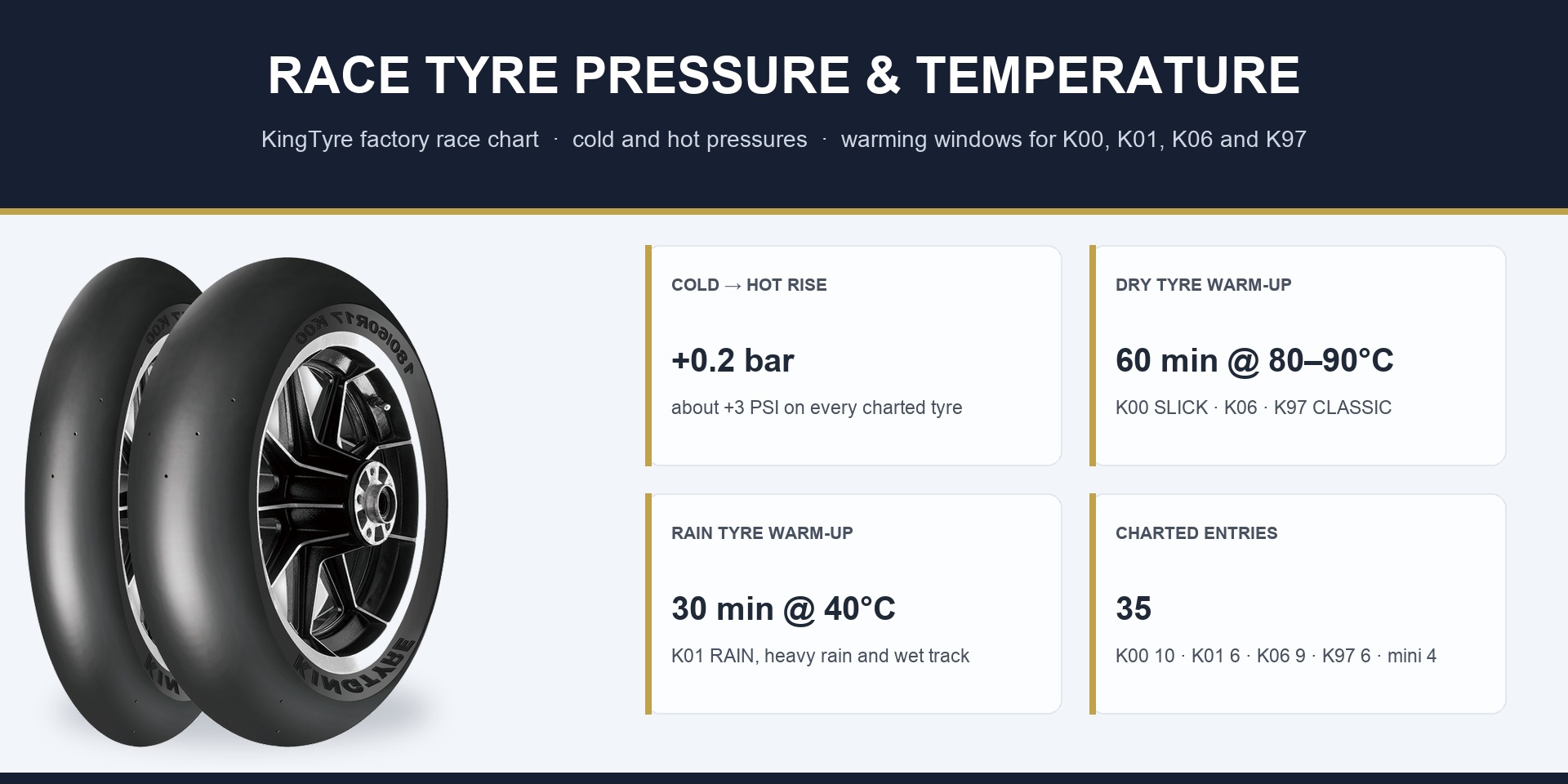
Cada equipo de competición establece dos valores antes de la primera sesión del día: la presión en frío que se aplica al neumático y la presión en caliente que se espera que alcance el neumático una vez en pista. KingTyre publica ambos valores, junto con la temperatura a la que debe calentarse el neumático, en una única tabla de fábrica para competición. Esta guía reproduce dicha tabla para las cinco familias de neumáticos de competición de KingTyre, establece el protocolo de calentamiento para cada una de ellas y explica qué significan realmente esos valores en el pit lane.
En resumen: Cada paso de «frío a caliente» publicado en la tabla de carreras de KingTyre es de +0,2 bar, lo que equivale aproximadamente a +3 PSI., con una única excepción: las tres medidas delanteras del neumático de lluvia K01, cuya presión aumenta en +0,3 bar, pasando de 29 a 33 PSI. Los neumáticos de carrera en seco se calientan a entre 80 y 90 °C durante 60 minutos. El neumático de lluvia se calienta a 40 °C durante 30 minutos. La tabla de minimotos indica la presión en frío y nada más.
Nada de lo que aparece en esta página es una estimación. Todas las cifras proceden de la propia tabla de carreras de KingTyre o de la página del producto correspondiente de KingTyre, y todas las cifras que KingTyre no publica se marcan como «no publicadas» en lugar de «estimadas». Si estás elaborando una hoja de configuración o un pliego de condiciones de compra, utilice esta página como referencia. Si quieres conocer el razonamiento que hay detrás de las presiones en lugar de las cifras en sí, empieza por qué significa realmente la presión óptima de los neumáticos lisos de competición.
La tabla incluye cinco denominaciones de neumáticos: el neumático liso K00, el neumático de lluvia K01, el neumático superdeportivo K06, el neumático de competición clásico K97 y el neumático liso K00 para minimotos. Entre todos suman 35 entradas en la tabla. La tabla que figura a continuación muestra el rango de cada uno, para que puedas ver de un vistazo en qué categoría se encuentran tus números de trabajo.
| Designación del neumático | Entradas en la tabla | Presión en frío | Presión en caliente | Ventana de calentamiento | Tiempo de calentamiento |
|---|---|---|---|---|---|
| K00 SLICK | 10 | 1,4 - 2,1 bar (20 - 30 PSI) | 1,6 - 2,3 bar (23 - 33 PSI) | 80 - 90 °C | 60 minutos |
| K01 LLUVIA | 6 | 1,7 - 2,0 bar (25 - 29 PSI) | 1,9 - 2,3 bar (27 - 33 PSI) | 40 °C | 30 minutos |
| K06 SUPERSPORT | 9 | 1,6 - 2,2 bar (23 - 32 PSI) | 1,8 - 2,4 bar (26 - 35 PSI) | 80 - 90 °C | 60 minutos |
| K97 CLASSIC RACING | 6 | 1,5 - 2,1 bar (22 - 30 PSI) | 1,7 - 2,3 bar (25 - 33 PSI) | 80 - 90 °C | 60 minutos |
| K00 SLICK MINIBIKE | 4 | 1,1 - 1,3 bar (16 - 19 PSI) | Sin publicar | 70 - 90 °C | Sin publicar |
Hay dos cosas que hay que destacar desde el principio. La primera es que los neumáticos traseros siempre circulan a una presión inferior a la de los delanteros. En el neumático liso K00, la presión trasera en frío es de 1,4 bar, mientras que la delantera oscila entre 2,0 y 2,1 bar, ya que el neumático trasero soporta más carga y una presión más baja mantiene la superficie de contacto en buen estado, evitando que se doble hacia el hombro. La segunda es que el valor en caliente siempre es superior al valor en frío en un intervalo fijo, y ese intervalo es lo que hace que la tabla sea útil: se establece el valor en frío y el valor en caliente es lo que confirma que el neumático ha alcanzado su rango óptimo.
Un valor de presión en caliente solo tiene sentido si el neumático se encontraba dentro del rango de temperatura indicado en el manual en el momento de la medición. Por ello, KingTyre publica el protocolo de calentamiento en la misma tabla que las presiones, y ambos datos deben interpretarse conjuntamente.
| Tipo de neumático | Aumento de la temperatura | Duración del calentamiento |
|---|---|---|
| K00 SLICK | @ 80 - 90 °C | 60 minutos |
| K00 SLICK MINIBIKE | @ 70 - 90 °C | Sin publicar |
| K01 LLUVIA | a 40 °C | 30 minutos |
| K06 SUPERSPORT | @ 80 - 90 °C | 60 minutos |
| K97 CLASSIC RACING | @ 80 - 90 °C | 60 minutos |
Todos los neumáticos de carrera para pista seca tienen el mismo rango de temperatura: de 80 a 90 °C durante 60 minutos. El neumático de lluvia es deliberadamente diferente, con 40 °C durante 30 minutos, porque un neumático para pista mojada funciona a una temperatura mucho más baja que un neumático liso para seco, y calentarlo más hace que el neumático resulte demasiado blando, tenga una vida útil más corta y rinda peor bajo la lluvia, en lugar de mejor.
La propia tabla de KingTyre incluye esta nota, y es la frase más importante de la página:
Ten en cuenta que las presiones óptimas en caliente en pista pueden variar en función del estilo de conducción, el peso del piloto, la superficie y la temperatura de la pista, así como de la configuración de la suspensión. Recomendamos comprobar las presiones en caliente en el callejón de boxes inmediatamente después de dar unas cuantas vueltas y realizar pequeños ajustes si es necesario.
Translated: the chart gives you the starting point, not the final answer. Optimal hot pressure on track changes with the rider's style, the rider's weight, the track surface and temperature, and the suspension set up. KingTyre's instruction is to check the hot pressure directly in the pit lane after a few laps and make small adjustments if needed. The full reasoning behind reading a tyre's behaviour is covered in how many heat cycles a slick tyre can handle, and the theory of pressure and grip in the racing slick pressure guide.
El gráfico te permite calcular la subida para cualquier tamaño, ya que las cifras de las fases bajistas y alcistas se publican una al lado de la otra. Al analizar cada entrada del gráfico, se observa que la tendencia es inusualmente constante.
| Tyre and position | Presión en frío | Presión en caliente | Rise | Rise in PSI |
|---|---|---|---|---|
| K00 SLICK, front | 2.0 - 2.1 bar (29 - 30 PSI) | 2.2 - 2.3 bar (32 - 33 PSI) | +0.2 bar | +3 PSI |
| K00 SLICK, rear | 1.4 - 1.5 bar (20 - 22 PSI) | 1.6 - 1.8 bar (23 - 26 PSI) | +0.2 bar | +3 PSI |
| K01 RAIN, front | 2.0 bar (29 PSI) | 2.3 bar (33 PSI) | +0.3 bar | +4 PSI |
| K01 RAIN, rear, heavy rain | 1.9 bar (27-28 PSI) | 2.1 bar (30 PSI) | +0.2 bar | about +2 to +3 PSI |
| K01 RAIN, rear, wet track | 1.7 bar (25 PSI) | 1.9 bar (27-28 PSI) | +0.2 bar | about +2 to +3 PSI |
| K06 SUPERSPORT, front | 2.2 bar (32 PSI) | 2.4 bar (35 PSI) | +0.2 bar | +3 PSI |
| K06 SUPERSPORT, rear | 1.6 bar (23 PSI) | 1.8 bar (26 PSI) | +0.2 bar | +3 PSI |
| K97 CLASSIC RACING, front and front/rear | 2.1 bar (30 PSI) | 2.3 bar (33 PSI) | +0.2 bar | +3 PSI |
| K97 CLASSIC RACING, rear | 1.5 bar (22 PSI) | 1.7 bar (25 PSI) | +0.2 bar | +3 PSI |
| K00 SLICK MINIBIKE | 1,1 - 1,3 bar (16 - 19 PSI) | Sin publicar | Sin publicar | Sin publicar |
Every charted tyre rises +0.2 bar, roughly +3 PSI, except the three front sizes of the K01 rain tyre, which rise +0.3 bar. The minibike chart breaks the pattern completely, because it publishes a cold pressure with no hot figure attached at all.
This is the practical value of the chart: if you know the cold figure for a size and you know the tyre is at its published warming window, you can predict the hot reading before you go out. If the hot reading comes back at something other than the charted value, the tyre was not at temperature, or the fitment is wrong, or the setup needs a small change. That is a three-way diagnosis you can make in the pit lane with a gauge.
Below is the chart as KingTyre publishes it, with nothing added, nothing removed and nothing rounded in a way that changes a number. Sizes, tread widths, overall diameters, measured rims, approved rim ranges, cold pressures and hot pressures are exactly as issued.
The K00 is the endurance racing slick and the most used tyre in the KingTyre programme. The chart gives 10 sizes, five for the front and five for the rear, each with a measured rim, an approved rim range, a cold pressure and a hot pressure straight out of the warmers.
| Tyre size | Fitment | Tread width (mm) | Overall diameter (mm) | Measured rim | Approved rims | Cold – bar (PSI) | Hot out of warmers – bar (PSI) |
|---|---|---|---|---|---|---|---|
| 125/75 R16.5 NHS | Frente | 125 | 603 | MT3.50 | 3.50 - 3.75 | 2.0 (29) | 2.2 (32) |
| 95/75 R17 NHS | Frente | 92 | 580 | MT2.50 | 2.50 - 3.00 | 2.0 (29) | 2.2 (32) |
| 120/70 R17 NHS | Frente | 116 | 600 | MT3.50 | 3.50 - 3.75 | 2.1 (30) | 2.3 (33) |
| 125/70 R17 NHS | Frente | 120 | 610 | MT3.50 | 3.50 - 3.75 | 2.1 (30) | 2.3 (33) |
| 115/75 R17 NHS | Trasera | 111 | 604 | MT3.00 | 3.00 - 3.50 | 1.5 (22) | 1.8 (26) |
| 160/60 R17 NHS | Trasera | 160 | 625 | MT4.50 | 4.25 - 5.00 | 1.4 (20) | 1.6 (23) |
| 180/60 R17 NHS | Trasera | 179 | 649 | MT5.00 | 5.00 - 5.50 | 1.4 (20) | 1.6 (23) |
| 190/60 R17 NHS | Trasera | 182 | 658 | MT5.00 | 5.00 - 5.50 | 1.4 (20) | 1.6 (23) |
| 200/60 R17 NHS | Trasera | 203 | 672 | MT6.00 | 5.50 - 6.25 | 1.4 (20) | 1.6 (23) |
| 200/65 R17 NHS | Trasera | 198 | 700 | MT6.00 | 5.50 - 6.25 | 1.4 (20) | 1.6 (23) |
If you are specifying a K00, the measured rim and the approved rim range matter as much as the pressure. A tyre fitted outside its approved rim window will not behave as the chart describes, whatever the pressure is set to. The full K00 picture, including all 21 published sizes and the ones KingTyre publishes without chart data, is in the K00 slick size and pressure guide.
One note for anyone cross-checking against the K00 product page: that page also carries a short generic pressure table with a different set of numbers. KingTyre's race chart is the size-by-size reference published with the race programme, and it is the one used throughout this guide. Work from the chart issued with your set, and ask KingTyre for the current chart if you need a size that is not charted.
The K01 rain tyre is the only charted tyre whose pressure depends on the weather. The chart treats the front and the rear differently: the three front sizes carry a single cold and hot pair, while each rear size carries two pairs, because a rear on a wet track is set up differently from a rear in heavy rain.
| Tyre size | Fitment | Tread width (mm) | Overall diameter (mm) | Measured rim | Approved rims | Cold – bar (PSI) | Hot out of warmers – bar (PSI) |
|---|---|---|---|---|---|---|---|
| 110/70 R17 NHS | Frente | 110 | 586 | MT3.00 | 3.00 - 3.50 | 2.0 (29) | 2.3 (33) |
| 125/70 R17 NHS | Frente | 122 | 600 | MT3.50 | 3.50 - 3.75 | 2.0 (29) | 2.3 (33) |
| 125/80 R17 NHS | Frente | 122 | 624 | MT3.00 | 3.00 - 3.75 | 2.0 (29) | 2.3 (33) |
| 140/70 R17 NHS | Trasera | 139 | 628 | MT3.75 | 3.50 - 4.00 | Heavy rain 1.9 (27-28) Wet track 1.7 (25) |
Heavy rain 2.1 (30) Wet track 1.9 (27-28) |
| 160/60 R17 NHS | Trasera | 161 | 624 | MT4.50 | 4.25 - 5.00 | Heavy rain 1.9 (27-28) Wet track 1.7 (25) |
Heavy rain 2.1 (30) Wet track 1.9 (27-28) |
| 190/55 R17 NHS | Trasera | 190 | 642 | MT6.00 | 5.50 - 6.00 | Heavy rain 1.9 (27-28) Wet track 1.7 (25) |
Heavy rain 2.1 (30) Wet track 1.9 (27-28) |
Read the rear rows as two settings rather than two values. In heavy rain the rear runs 1.9 bar (27–28 PSI) cold and 2.1 bar (30 PSI) hot. On a wet track it runs 1.7 bar (25 PSI) cold and 1.9 bar (27–28 PSI) hot. The wet track setting is lower because the water evacuation pattern on a damp surface works better with less pressure in the tyre, while a full wet race leans on the deeper cut to push water out of the contact patch, which needs a firmer tyre.
Because the setting changes with the condition, the K01 needs a re-set between a dry warm-up and a full wet stint, and a tyre that has been running in the rain will not read the same as one that has been sitting in the paddock. The wider K01 story, including the wet-weather compound and the endurance testing behind it, is in the K01 racing rain tyre guide.
The K06 super sport tyre is the road-legal member of the race chart. It is the only charted tyre with an ECE certification, which means the same tyre can be used in a race meeting and on the road. The chart publishes nine sizes with measured rims, approved rim ranges and pressures.
| Tyre size | Fitment | Measured rim | Approved rims | Cold – bar (PSI) | Hot out of warmers – bar (PSI) |
|---|---|---|---|---|---|
| 110/70 ZR17 | Frente | MT3.00 | 3.00 - 3.50 | 2.2 (32) | 2.4 (35) |
| 120/70 ZR17 | Frente | MT3.50 | 3.50 - 3.75 | 2.2 (32) | 2.4 (35) |
| 140/70 ZR17 | Trasera | MT3.75 | 3.50 - 4.00 | 1.6 (23) | 1.8 (26) |
| 150/60 ZR17 | Trasera | MT4.25 | 4.00 - 4.50 | 1.6 (23) | 1.8 (26) |
| 160/60 ZR17 | Trasera | MT4.50 | 4.25 - 5.00 | 1.6 (23) | 1.8 (26) |
| 180/55 ZR17 | Trasera | MT5.50 | 5.50 - 6.00 | 1.6 (23) | 1.8 (26) |
| 180/60 ZR17 | Trasera | MT5.00 | 5.00 - 5.50 | 1.6 (23) | 1.8 (26) |
| 190/55 ZR17 | Trasera | MT6.00 | 5.50 - 6.00 | 1.6 (23) | 1.8 (26) |
| 200/55 ZR17 | Trasera | MT6.25 | 6.00 - 6.25 | 1.6 (23) | 1.8 (26) |
Two figures in this table are not published by KingTyre for this tyre: tread width and overall diameter. The chart leaves both blank for the K06, and they have not been filled in here. The full K06 picture, including its four compounds and the temperatures they are stable at, is in the K06 semi slick tyre guide.
The K97 classic racing tyre is the ZR18 entry in the chart, built for classic and vintage racing machinery. It is a front-and-rear tyre, so the chart publishes one pressure pair for the two sizes that run on either axle and a lower pair for the three rear-only sizes.
| Tyre size | Fitment | Measured rim | Approved rims | Cold – bar (PSI) | Hot out of warmers – bar (PSI) |
|---|---|---|---|---|---|
| 90/90 ZR18 | Front/Rear | MT2.15 | 1.85 - 2.50 | 2.1 (30) | 2.3 (33) |
| 100/90 ZR18 | Front/Rear | MT2.50 | 2.50 - 2.75 | 2.1 (30) | 2.3 (33) |
| 110/80 ZR18 | Frente | MT2.50 | 2.50 - 3.00 | 2.1 (30) | 2.3 (33) |
| 110/80 ZR18 | Trasera | MT2.50 | 2.50 - 3.00 | 1.5 (22) | 1.7 (25) |
| 120/70 ZR18 | Trasera | MT3.50 | 3.50 - 3.75 | 1.5 (22) | 1.7 (25) |
| 130/70 ZR18 | Trasera | MT3.50 | 3.50 - 4.00 | 1.5 (22) | 1.7 (25) |
KingTyre does not publish a dedicated product page for the K97 classic racing chart, and it does not publish tread width, overall diameter or compound options for it. It is also worth being precise about naming here, because the K97 name is used across more than one tyre. The K97 super motard is a road-legal supermoto tyre certified to ECE, DOT and CCC, and it shares several size labels with the classic racing chart. They are different tyres with different certifications and different purposes, and the super motard's pressures are not the classic racing chart's pressures.
The minibike chart is published as a separate table with a separate column set, and it is the thinnest part of the KingTyre race chart. It covers four 10 and 12 inch sizes for minibike racing, and it gives a measured rim and a cold pressure. That is all.
| Tyre size | Fitment | Measured rim | Cold – bar (PSI) | Hot out of warmers – bar (PSI) |
|---|---|---|---|---|
| 100/85 R10 NHS | Frente | MT2.50 | 1.3 (19) | Sin publicar |
| 100/90 R12 NHS | Frente | MT2.50 | 1.3 (19) | Sin publicar |
| 120/80 R10 NHS | Trasera | MT2.75 | 1.1 (16) | Sin publicar |
| 120/80 R12 NHS | Trasera | MT2.75 | 1.1 (16) | Sin publicar |
No hot pressure, no approved rim range, no tread width, no overall diameter and no warming duration are published for these sizes. The chart gives a warming window of 70 to 90°C and stops there. Those gaps are marked rather than filled, because a guessed hot pressure on a minibike tyre is a guess on the only tyre most junior riders will ever run.
Do not confuse the minibike chart with the K96 mini GP racing tyre. The K96 is a separate, DOT-approved product that publishes its own pressures and its own warm-up guidance, and it is a different tyre with different data. The complete K00 size list, including which sizes carry chart data and which do not, is in the K00 slick size and pressure guide.
Because several KingTyre products share size labels, and because the race chart uses designations rather than product names, it is easy to pick the wrong table. The table below maps every chart designation to its product page and road status, and flags the two KingTyre race products that sit on the track but are deliberately not on this chart.
| Race chart designation | Product page | Entradas en la tabla | Road status | Note |
|---|---|---|---|---|
| K00 SLICK | KingTyre K00 motorcycle slick tires | 10 | NHS, track only | 21 sizes are published on the product page; 10 of them carry full chart data |
| K01 LLUVIA | KingTyre K01 racing rain tire | 6 | NHS, track only | The product page lists 5 sizes; the chart adds the 160/60 R17 rear |
| K06 SUPERSPORT | KingTyre K06 semi slick tires | 9 | ECE certified, street legal | The product page publishes 10 17-inch sizes; the chart covers 9 |
| K97 CLASSIC RACING | No dedicated product page | 6 | Not stated on the chart | ZR18 classic racing sizes. Shares size labels with K97 Super Motard, which is a different tyre |
| K00 SLICK MINIBIKE | Listed on the K00 range | 4 | NHS, track only | 10 and 12 inch minibike sizes; cold pressure only |
| Not on the race chart: K96 Mini GP | KingTyre K96 mini GP racing tire | – | DOT approved race tyre | A separate product with its own published pressures. Do not mix it with the minibike chart |
| Not on the race chart: K97 Super Motard | KingTyre K97 super motard tires | – | ECE, DOT and CCC certified, street legal | A road-legal supermoto tyre, not the classic racing chart |
This is the order of operations that KingTyre's chart and its pit-lane note describe. It is short, and every step exists because the chart assumes the one before it has been done.
KingTyre's chart note identifies four reasons why the optimal hot pressure on track can differ from the published figure. The second column below explains the mechanism behind each one, which is the physical reason the variable moves the number.
| Variable KingTyre names | Why it moves the optimal hot pressure |
|---|---|
| Rider style | How the rider loads the tyre changes how much the carcass flexes and where the heat goes, so the same tyre settles at a different pressure for a different style of rider. |
| Rider weight | More mass on the machine changes the load carried by the contact patch and the deflection of the carcass under that load. |
| Track surface and temperature | A hot, coarse surface generates more heat and more shear at the contact patch than a cold, smooth one. |
| Suspension setup | Setup changes how much of the load reaches the tyre and how much the suspension absorbs before the tyre does. |
The chart gives the temperature to warm to. Two KingTyre product pages also publish the range a tyre is expected to work in, which is a different number answering a different question.
| Tyre | Published temperature statement | Source |
|---|---|---|
| K01 rain tyre | Performs reliably in 5°C to 40°C racing conditions | K01 product page |
| K06 super sport | Soft compound remains stable from 40°C to 85°C | K06 product page |
| K06 super sport | Hard compound holds up to 120°C | K06 product page |
| K00 slick | No operating temperature range published. The chart gives a warming window of 80 - 90°C | Factory race chart |
| K97 classic racing | No operating temperature range published. The chart gives a warming window of 80 - 90°C | Factory race chart |
| K00 slick minibike | No operating temperature range published. The chart gives a warming window of 70 - 90°C | Factory race chart |
Note that a warming window is not an operating range. 80 to 90°C is the temperature a warmer's blanket should hold a dry slick at before it goes out; it is not the surface temperature the tyre will then run at on track. KingTyre does not publish measured carcass temperatures or surface temperature targets for any of the charted tyres, and this guide does not invent them.
For anyone specifying a tyre, the gaps matter as much as the numbers. Here is the full published position across the five charted designations.
| Data point | K00 SLICK | K01 LLUVIA | K06 SUPERSPORT | K97 CLASSIC RACING | K00 SLICK MINIBIKE |
|---|---|---|---|---|---|
| Sizes on the race chart | 10 | 6 | 9 | 6 | 4 |
| Presión en frío | Published | Published | Published | Published | Published |
| Presión en caliente | Published | Published | Published | Published | Sin publicar |
| Measured rim | Published | Published | Published | Published | Published |
| Approved rim range | Published | Published | Published | Published | Sin publicar |
| Tread width | Published | Published | Sin publicar | Sin publicar | Sin publicar |
| Overall diameter | Published | Published | Sin publicar | Sin publicar | Sin publicar |
| Aumento de la temperatura | Published | Published | Published | Published | Published |
| Duración del calentamiento | Published | Published | Published | Published | Sin publicar |
| Compound options | Published (Super Soft, Soft, Medium, Hard) | Sin publicar | Published (4 compounds) | Sin publicar | Sin publicar |
| Road certification | NHS, not road legal | NHS, not road legal | ECE certified | Not stated on the chart | NHS, not road legal |
For a size that is published as a size only, with no chart data, the answer is the same in every case: request the current chart from the factory before you write the tyre into a specification. Do not interpolate between two charted sizes, and do not carry a pressure across from a neighbouring size. The relationship between size and pressure in the chart is not monotonic across the range, because a rear tyre carrying a heavier load runs a lower pressure than a lighter front tyre of a similar diameter.
A published chart only means something if somebody uses it. KingTyre's own endurance programme is the reference customer for these numbers.
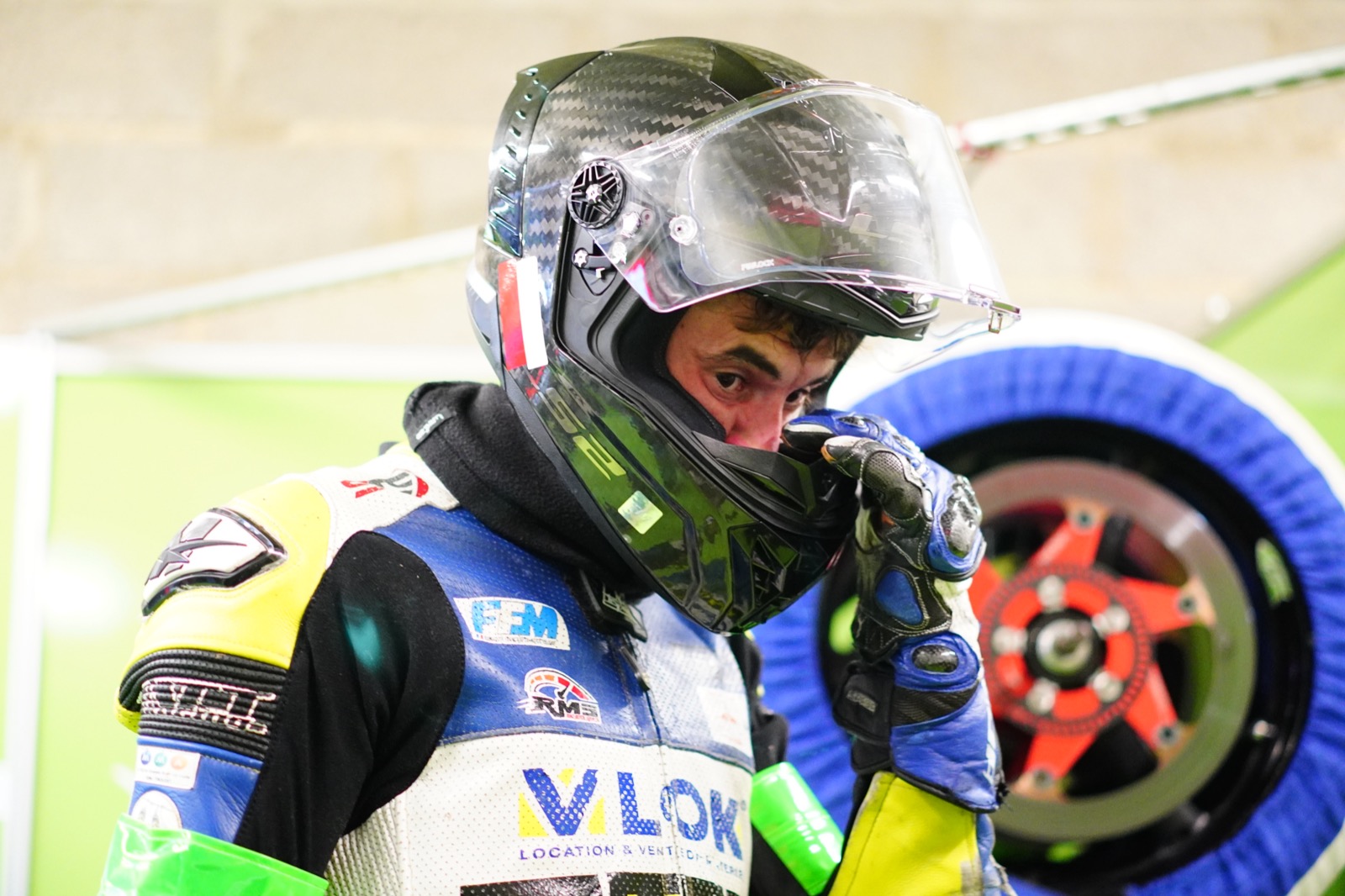
The Kingtyre Fullgas Racing Team has run five consecutive campaigns at the 24 Heures Motos at Le Mans, from 2022 to 2026, running the K00 slick in dry conditions and the K01 rain tyre when the track turned. In the 2026 race the team's #116 machine completed 742 laps over 24 hours on a Kawasaki ZX-10R. The results, the pit-stop pattern and the compound data from that race are in the 2026 Le Mans race report and in the seven-year field report. The engineering behind the K00 itself is covered in the K00 technical guide and in how the K00 slick is engineered for endurance racing.
What that record does and does not prove is worth stating plainly. It shows the K00 completing a full 24-hour endurance race in a championship environment, with a team managing stints, compound changes and tyre life under pressure. It does not produce a per-size laboratory test report, and it does not replace the factory race chart for your own setup. If you are writing a specification, use the chart for pressures and the race programme for provenance.
The race range is a specialist business and should be ordered like one. KingTyre is a manufacturer with an annual capacity of over 300,000 radial tyres and exports to more than 45 countries across Europe, South America, Asia and the Middle East, with an ISO 9001 certified production facility. For distributors, series organisers and racing teams, the practical order specification is short:
For the full import route, see the 2026 wholesale buying guide for importing motorcycle tyres from China, and for the private-label route, the private label and OEM guide. En racing slick supplier guide covers the specialist side of the trade. Request the current race chart, the compound list and the batch documentation when you first talk to us, and every quotation after that is built on the same numbers as this page.
En el caso de un neumático de competición KingTyre, la presión en frío es el valor que se ajusta en un neumático frío, y la presión en caliente es el valor que debe marcar el neumático nada más sacarlo de los calentadores. En la tabla de competición de KingTyre, cada paso publicado de presión en frío a presión en caliente es de +0,2 bar, aproximadamente +3 PSI, con una excepción: los tres tamaños delanteros del neumático de lluvia K01 aumentan +0,3 bar, pasando de 2,0 bar (29 PSI) en frío a 2,3 bar (33 PSI) en caliente. Toma la cifra en caliente como objetivo y calcula a partir de ella la presión en frío.
En la tabla de carreras publicada por KingTyre, el aumento es de +0,2 bar, lo que equivale aproximadamente a +3 PSI, en todos los neumáticos incluidos en la tabla, excepto en las tres medidas delanteras del neumático de lluvia K01, en las que es de +0,3 bar (de 29 PSI a 33 PSI). El aumento solo es significativo si el neumático se encuentra realmente en su rango de calentamiento publicado en el momento de la medición, por lo que es necesario consultar conjuntamente la tabla y el protocolo de calentamiento.
La guía de calentamiento de KingTyre establece entre 80 y 90 grados centígrados para el neumático slick K00, el neumático superdeportivo K06 y el neumático de competición clásico K97; 40 grados centígrados para el neumático de lluvia K01; y entre 70 y 90 grados centígrados para el neumático slick K00 para minimotos. El neumático de lluvia se calienta hasta un rango más bajo porque, en una pista mojada, funciona a una temperatura mucho más baja que un neumático liso para pista seca.
Sesenta minutos para el neumático liso K00, el neumático superdeportivo K06 y el neumático de competición clásico K97, y 30 minutos para el neumático de lluvia K01. KingTyre no publica la duración del calentamiento en la ficha técnica del neumático slick K00 para minimotos, solo el intervalo de temperatura de 70 a 90 grados Celsius, por lo que debes confirmar la duración con el fabricante para ese tamaño.
En la tabla de competición de KingTyre, los tamaños traseros del neumático de lluvia K01 indican dos pares de presiones. En caso de lluvia intensa, el neumático funciona a 1,9 bar (27-28 PSI) en frío y a 2,1 bar (30 PSI) en caliente. En pista mojada, se utiliza a 1,7 bar (25 PSI) en frío y a 1,9 bar (27-28 PSI) en caliente. Los tres tamaños delanteros del mismo neumático indican un único par de valores: 2,0 bar (29 PSI) en frío y 2,3 bar (33 PSI) en caliente.
No, no son los que aparecen en la tabla de carreras. El neumático liso K00, el neumático de lluvia K01 y el neumático liso para minimotos K00 llevan todos la marca NHS (Not for Highway Service), lo que significa que no están homologados para su uso en la vía pública. El neumático superdeportivo K06 es la excepción: cuenta con la certificación ECE y puede utilizarse en carretera. Para obtener información completa, consulta si los neumáticos lisos de moto están homologados para circular por la vía pública.
Se trata de dos tablas independientes con datos distintos. La tabla de neumáticos lisos K00 abarca 10 tamaños con una llanta medida, un rango de llantas homologado, una presión en frío y una presión en caliente, tras un calentamiento a una temperatura de entre 80 y 90 grados Celsius durante 60 minutos. La tabla de neumáticos lisos K00 para minimotos abarca cuatro tamaños de 10 y 12 pulgadas con una llanta medida y solo una presión en frío. KingTyre no publica la presión en caliente ni el rango de llantas homologadas para los tamaños de minimoto.
No. La tabla de minibikes de la guía de competición de KingTyre indica cuatro tamaños, una medida de llanta y una presión en frío de 1,3 bar (19 PSI) en la rueda delantera o de 1,1 bar (16 PSI) en la trasera. No indica la presión en caliente, el rango de llantas homologadas, el ancho de la banda de rodadura ni el diámetro total. Esos datos simplemente no se publican y deben solicitarse a la fábrica, en lugar de estimarse.
Calienta el neumático hasta alcanzar el rango indicado para ese tipo de neumático, ajusta la presión en frío sobre el neumático frío, móntalo en una llanta dentro del rango homologado, da unas cuantas vueltas y, a continuación, lee la presión en caliente en el callejón de boxes y compárala con el valor en caliente que figura en la tabla. Según las propias indicaciones de KingTyre, hay que comprobar la presión en caliente directamente en el pit lane tras unas cuantas vueltas y realizar pequeños ajustes si es necesario.
Sí. KingTyre publica la tabla de carreras para un conjunto definido de tamaños, y los demás tamaños de la gama se publican únicamente como tamaños. En el caso de un tamaño que no figure en la tabla, solicita a la fábrica la tabla actual y los datos de presión correspondientes a ese tamaño antes de incluirlo en una especificación o en una hoja de configuración. La lista completa de tamaños K00, incluidos los tamaños sin datos en la tabla, se encuentra en nuestra guía de tamaños y presiones de los neumáticos lisos K00.
The chart is the fastest way to narrow the conversation. Send us the size, the position and the conditions, and we will confirm what KingTyre publishes for it and what is still to be requested from the factory. The full KingTyre range is on the product list, the K00 racing slick is on the K00 product page, and a request for the current race chart or a wholesale quotation goes straight to the contact team.
 Spanish
 English
 French
 German
 Korean
 Japanese
 Italian
 Russian
 Dutch
 Danish
 Portuguese
 Polish
 Turkish
 Czech