
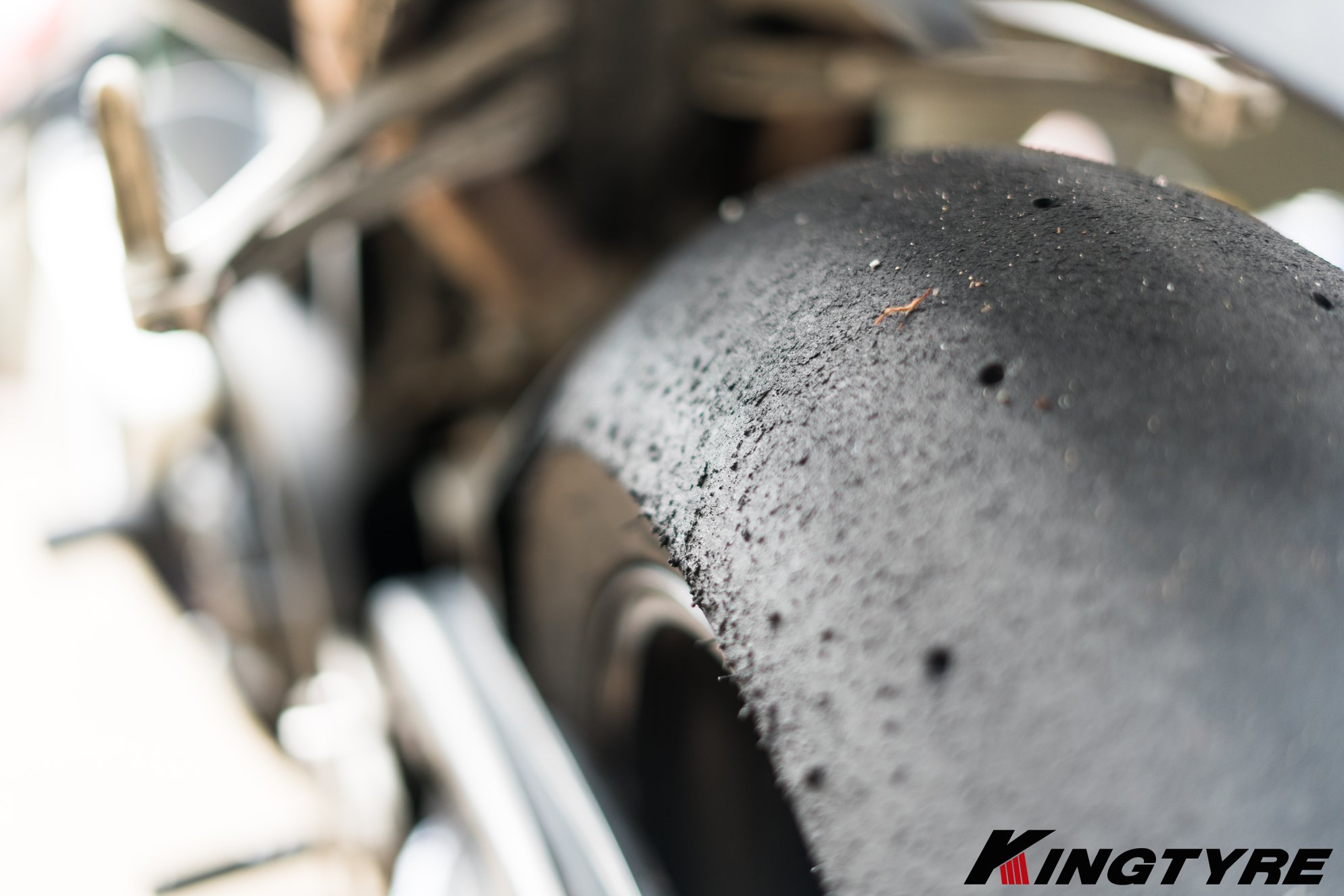
When you walk through the paddock, you will notice tread cracking on slick tires is a common sight. Some racers ignore it. Others panic and throw away perfectly good tires. The reality is more nuanced: there are multiple types of tread cracking, each with different causes, severity levels, and implications for tire life.
Understanding tread cracking on slick tires can range from harmless surface-level heat checking to structural damage that makes a tire unsafe. No matter what type of tread cracking on slick tires you encounter, knowing the root cause saves you money, keeps you safe, and helps you extract every last competitive lap. For related guidance, see our article on how many heat cycles a slick tire can handle to understand how cycling affects compound integrity.
| Cause | Crack Appearance | Primary Risk Period | Severity |
|---|---|---|---|
| Heat checking | Fine, shallow cracks across tread surface | After multiple heat cycles | Low (cosmetic) |
| Thermal degradation | Deep, wide cracks with rough edges | Single session of extreme overheating | 높음 |
| Ozone / UV cracking | Random, spiderweb-like pattern | Long-term storage | Moderate |
| Over-inflation cracking | Cracks concentrated in center tread | During use with excessive pressure | Moderate |
| Compound fatigue | Gradual network of fine cracks | 20+ heat cycles | Low–Moderate |
| Manufacturing defect | Cracks appearing on first use | First 1–2 sessions | High (warranty) |
What it looks like: Very fine, shallow hairline cracks running across the tread surface, often perpendicular to the direction of rotation. They rarely penetrate more than 0.5–1 mm into the rubber.
What causes it: Every time a slick tire heats up and cools down, the rubber expands and contracts. The tread surface experiences the most extreme temperature gradient, creating micro-stresses that manifest as surface cracks.
Is it dangerous? Generally no. Surface heat checking is a normal sign of a properly used tire. Many professional teams consider lightly heat-checked tires to be at peak grip.
When to worry: If heat checking is accompanied by rubber chunks missing or cracks penetrating into the carcass layers.
What it looks like: Deep, wide, jagged cracks with rough, torn edges. The rubber around the cracks often appears discolored—bluish, brownish, or melted-looking. In extreme cases, small chunks of tread rubber detach (tread chunking).
What causes it: The tire surface temperature exceeds the compound thermal limit (typically 130–150°C). This happens through prolonged sliding, under-inflated tires, or too many consecutive hot laps. For proper inflation advice, see our best tire pressure for racing slicks guide.
Is it dangerous? Yes. Thermal degradation weakens the rubber matrix permanently and can lead to tread separation at speed.
Remedy: The tire is damaged. Reduce pressure 1–2 PSI for the next set, add a cool-down lap between hot stints, and consider a harder compound if overheating is chronic.
What it looks like: A random, spiderweb-like network of cracks, most prominent on the sidewall but also visible on tread edges. Often appears on tires stored for months without use.
What causes it: Ozone (O₃) in the atmosphere attacks the polymer chains in rubber, causing them to break. UV radiation accelerates this process.
Is it dangerous? On the tread surface, ozone cracking is usually superficial. On the sidewall, cracks deeper than 2 mm can expose the carcass cords and require immediate tire retirement.
Prevention: Store tires in sealed black plastic bags in a cool, dark environment (below 25°C). Keep away from motors, generators, and welding equipment.
What it looks like: Cracks concentrated in the center of the tread width, running circumferentially or as short transverse cracks.
What causes it: Excessive air pressure causes the center of the tread to bulge, placing the rubber under tension while operating at high temperature.
Is it dangerous? Moderate. Center-tread cracking indicates the tire is running with too small a contact patch. If cracks penetrate more than 2 mm, the tire should be retired.
Remedy: Reduce cold pressure by 2–3 PSI. Verify with a pyrometer that center temperatures are not running higher than shoulder temps.
What it looks like: A uniform, fine network of cracks across the entire tread surface, usually accompanied by harder rubber feel and reduced grip. The surface may also appear shiny or glazed.
What causes it: After 20–40 heat cycles, the rubber has post-cured to its maximum hardness and begins to crack under the shear forces of cornering and braking.
Is it dangerous? At the fine crack stage, the tire is simply at end of competitive life. The tire should be replaced for any competitive use.
What it looks like: Cracks appearing within the first 1–2 sessions, often in unusual locations or patterns that do not match any of the above causes.
What causes it: Inconsistent rubber mixing, contamination during manufacturing, or curing anomalies.
Is it dangerous? Yes. A tire that cracks immediately has not met its design specifications. Contact your tire supplier for warranty evaluation.
Kingtyre note: Every Kingtyre slick undergoes visual and flexibility inspection before shipment. Manufacturing defect rates are below 0.2%. If you encounter abnormal cracking within the first two sessions, contact our support team with photos for warranty assessment.
Retire a slick tire immediately if:
Kingtyre manufacturing processes include antioxidant and antiozonant packages in every compound to slow environmental cracking, heat-cycle durability testing on every batch, and carcass-to-tread bonding inspection. Our medium and hard compounds are formulated for extended life, making them resistant to heat checking. For more on tire selection, see our slick vs semi slick tires comparison.
No. Cracked tread rubber cannot be reliably repaired. Tire plugs and patches are designed for punctures, not material fatigue or thermal cracks.
Properly set warmers (70–80°C) reduce thermal shock and can actually reduce heat checking. Overheating warmers past 90°C accelerates degradation.
No. When used within their designed pressure and temperature range, Kingtyre slicks show comparable or better crack resistance than equivalent-compound tires from premium brands. For reliable industry reference on tire testing standards, visit the SAE International 그리고 Tire Technology International resources on rubber compound durability testing.
 Korean
  English
  Spanish
  French
  German
  Japanese
  Italian
  Russian
  Dutch
Dutch  Danish
  Portuguese
  Polish
  Turkish
  Czech
Czech
How Many Heat Cycles Can a Slick Tire Handle? || China King Tyre says:
[…] The short answer: Most racing slick compounds deliver peak grip for 3–6 heat cycles, remain competitive for 10–20 cycles, and are fully cycled out by 25–40 cycles. But the exact number depends heavily on compound softness and how the tire is treated. For context on how this affects your track safety, see our guide on what causes tread cracking on slick tires. […]